
Photo: Wikipedia
Political ClimatePolitical Climate in New Albany, IN
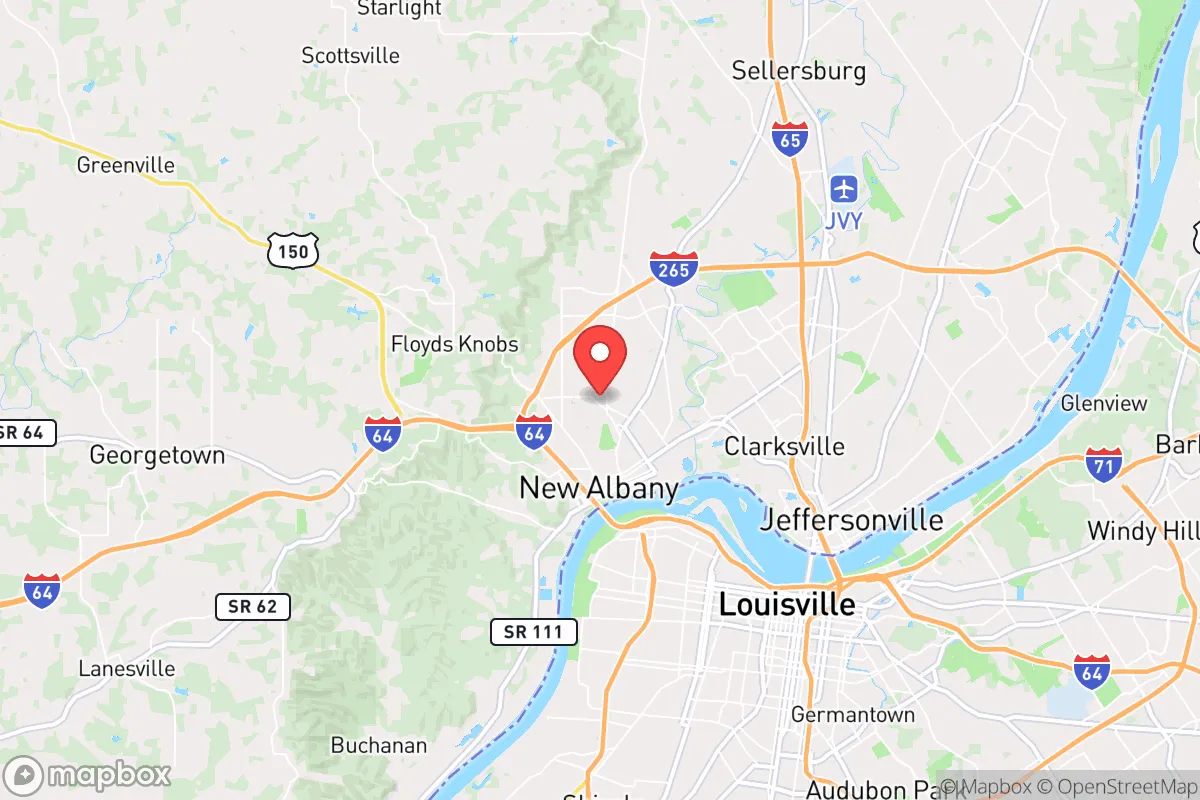
District shown is the primary district for this city’s centroid. Cities may span multiple districts.
Local Political AnalysisPolitical Analysis of New Albany, IN
New Albany has long been a solid conservative stronghold, and that hasn’t changed much despite the broader shifts you see in some parts of the country. The Cook PVI sits at R+15, which tells you right away that this isn’t a place where progressive policies get much traction—at least not yet. But if you’ve lived here as long as I have, you’ve noticed the subtle pressure creeping in from across the river, where Louisville’s blue politics sometimes try to spill over. The trajectory here is still firmly right-leaning, but you have to keep an eye on local school board races and city council seats, because that’s where the quiet battles over personal freedoms and government overreach really play out.
How it compares
If you drive ten minutes north to Clarksville or Jeffersonville, you’ll find a similar conservative vibe, though both have seen a bit more development and the accompanying political noise. But the real contrast is just across the Ohio River in Louisville, Kentucky—a city that’s gone deep blue in recent years, with all the heavy-handed regulations and tax hikes that come with it. New Albany residents tend to see Louisville as a cautionary tale: a place where government overreach into business operations, property rights, and even school curriculum has become the norm. Meanwhile, Floyd County as a whole still leans red, and the rural areas east of town are even more reliably conservative. That said, the newer subdivisions popping up along State Road 62 are bringing in folks from out of state, and some of them carry progressive ideas that don’t always mesh with the local way of life. It’s not a crisis yet, but it’s something to watch.
What this means for residents
For the average person living here, the political climate means you can still count on a government that mostly stays out of your business. Property taxes are reasonable, zoning laws are straightforward, and you’re not constantly fighting new mandates on how to run your small business or what you can teach your kids. The local sheriff’s office and city police tend to focus on real crime rather than turning into social workers, which is a relief compared to what you hear happening in bigger cities. That said, there’s been a slow push in recent years to adopt more progressive policies—like diversity initiatives in the school system or talk of “affordable housing” mandates that sound a lot like government picking winners and losers. If you value your Second Amendment rights and don’t want the city telling you what kind of lightbulb to buy, New Albany is still a good place to be. But you have to stay engaged, because the long-term trend in Indiana’s urban corridors is toward more regulation, not less.
Culturally, New Albany has a distinct feel that sets it apart from the Louisville metro area. You’ll see more American flags than pride flags, more church parking lots than bike lanes, and the local diners still serve sweet tea without anyone batting an eye. The city has a proud history—it was a stop on the Underground Railroad, but also a place where conservative values like self-reliance and community responsibility have always held strong. One policy distinction worth noting: Indiana is a right-to-work state, and New Albany’s local government has generally resisted the kind of union-friendly ordinances you see in places like Indianapolis or Gary. That keeps wages competitive and keeps the government from picking sides in labor disputes. If the progressive wave ever really hits here, it’ll likely come through the school system first—so if you’re moving in, pay attention to school board meetings. For now, though, New Albany remains a place where you can live your life without the government breathing down your neck, and that’s something worth holding onto.

State Political ClimatePolitical Climate in Indiana
State Political AnalysisPolitical Environment in the State
Indiana has been a reliably Republican state for decades, but it’s not the deep-red monolith outsiders often assume. The GOP holds a supermajority in both chambers of the state legislature and has won every presidential election here since 2008, with Donald Trump carrying the state by 16 points in 2024. However, the state’s political trajectory over the last 10-20 years shows a slow but steady shift: the reliably red suburbs are becoming more competitive, while rural areas have hardened into GOP strongholds. For a conservative-leaning individual or family looking to relocate, Indiana offers a generally friendly policy environment, but there are emerging fault lines—especially around education, local control, and the influence of urban growth—that are worth watching closely.
Urban vs. rural divide
The political map of Indiana is a classic tale of three regions. The Indianapolis metro area, home to nearly 2 million people, is the state’s blue anchor. Marion County (Indianapolis) has voted Democratic in every presidential election since 2008, and its surrounding suburban counties—Hamilton, Hendricks, and Johnson—have shifted from solid red to purple over the past decade. Hamilton County, once a GOP fortress, voted for Trump by only 8 points in 2024, down from 20 points in 2016. Meanwhile, the state’s other urban centers—Fort Wayne (Allen County), Evansville (Vanderburgh County), and South Bend (St. Joseph County)—are competitive but lean Republican at the county level, with the GOP winning each in 2024 by margins of 5-12 points. The real red meat is in the rural and small-town counties that dominate the rest of the state. Counties like Kosciusko (Warsaw), Dubois (Jasper), and Steuben (Angola) routinely vote 70-80% Republican. The divide is stark: drive 30 minutes outside any major city, and you’re in deep-red territory where conservative values are the default. This geographic split means state-level policy is driven by rural and suburban Republicans, not the urban core.
Policy environment
Indiana’s policy environment is broadly conservative, but with some notable wrinkles. The state has a flat income tax rate of 3.05% (down from 3.23% in 2023, with a scheduled phase-down to 2.9% by 2027), and property taxes are among the lowest in the Midwest—averaging about 0.85% of assessed value. There is no estate tax, and the sales tax is a flat 7%. On education, Indiana was an early adopter of school choice: the state’s Choice Scholarship program, enacted in 2011, now serves over 60,000 students, and the 2023 expansion made nearly all families eligible for vouchers. This is a major draw for conservative parents who want options outside the public school system. However, the state has also seen a push for more centralized control over curriculum—the 2022 law requiring schools to post curriculum materials online (HEA 1605) was sold as transparency but has been used by activist groups to challenge books and lessons. On healthcare, Indiana expanded Medicaid under the HIP 2.0 waiver in 2015, a move that many conservatives opposed, but the program has remained stable. Election laws are solid: Indiana has a strict voter ID law (one of the first in the nation, passed in 2005), and the 2021 law (SEA 391) added restrictions on mail-in voting and shortened the early voting window. For a conservative, the policy environment is generally good, but the creeping influence of federal funding and urban-driven cultural shifts is something to keep an eye on.
Trajectory & freedom
On balance, Indiana has been moving in a more freedom-oriented direction over the past decade, but the trend is uneven. The biggest win for personal liberty was the 2022 permitless carry law (HEA 1296), which allows any law-abiding adult to carry a handgun without a license. This was a major step for Second Amendment rights and was passed with strong bipartisan support in rural districts. On parental rights, the 2023 law (HEA 1449) requires schools to notify parents of any changes to a student’s health or well-being, including mental health services—a direct response to concerns about schools overstepping on gender identity issues. However, there are also concerning expansions of government power. The 2023 law banning gender-affirming care for minors (SEA 480) was popular among conservatives, but it also set a precedent for the state dictating medical decisions, which some see as a double-edged sword. On property rights, Indiana has a strong right-to-farm law, but local zoning battles—especially around solar and wind energy projects—have become flashpoints, with the state legislature increasingly preempting local control. The 2024 law (HEA 1192) that restricts local governments from regulating short-term rentals like Airbnb is another example of state-level overreach that cuts both ways. Overall, Indiana is becoming more free on guns and parental rights, but less free on local control and medical autonomy.
Civil unrest & political movements
Indiana is not a hotbed of civil unrest, but there have been notable flashpoints. The 2020 George Floyd protests in Indianapolis turned violent, with several buildings damaged and a state of emergency declared. Since then, the city has seen a rise in organized activist groups on both sides. On the right, the Indiana Firearms Coalition and the Indiana Republican Assembly are active, pushing for further gun rights and school choice. On the left, Indivisible Indy and the Indiana chapter of the ACLU have been vocal on voting rights and criminal justice reform. Immigration politics are relatively quiet—Indiana is not a border state, and the immigrant population is small (about 5% of the total). However, there have been local controversies, such as the 2023 debate in Logansport over a proposed immigrant detention center, which was ultimately blocked by local opposition. Election integrity has been a recurring theme: the 2020 election saw no major fraud cases in Indiana, but the 2021 law tightening mail-in voting was driven by concerns from rural Republicans. The most visible political movement in recent years has been the school board wars—from Hamilton County to Allen County, conservative parents have organized to challenge curriculum and library books, leading to heated meetings and recall efforts. A new resident would notice that these battles are mostly localized to suburban school districts, not the rural areas where conservative values are already dominant.
Projection
Over the next 5-10 years, Indiana is likely to remain Republican at the state level, but the margins will continue to shrink in the suburbs. The Indianapolis metro area is growing faster than the rest of the state, and its demographic shift—more college-educated, more diverse, more secular—will push the state’s politics toward a more competitive two-party system. Rural counties will remain deeply red, but they are losing population, which means their political weight will diminish over time. The biggest wildcard is in-migration: Indiana is attracting people from Illinois, California, and the Northeast, many of whom are fleeing high taxes and crime. These newcomers tend to be more conservative on fiscal issues but more moderate on social issues, which could create a new suburban coalition that is less aligned with the current GOP supermajority. On policy, expect continued battles over school choice (likely to expand further), property tax caps (already a hot topic in the 2025 legislative session), and local control (the state will probably continue to preempt local ordinances on everything from rental regulations to energy projects). For a conservative moving in now, the state will likely be a safe bet for the next decade, but the political culture will become more contested, especially in the suburbs around Indianapolis, Carmel, and Fishers.
For a new resident, the bottom line is this: Indiana offers a solidly conservative policy environment with low taxes, strong gun rights, and robust school choice. The state is not immune to the cultural and political shifts affecting the rest of the country, but the pace of change is slower here. If you’re looking for a place where your values are the default and the government generally stays out of your way, Indiana is a strong choice. Just be aware that the suburbs are where the political action is—and if you move to a place like Zionsville or Noblesville, you’ll be on the front lines of the next decade’s cultural battles. In the rural counties, life goes on much as it has for generations, and that’s exactly what most conservatives are looking for.
* Values derived from national, state, county, city and local statistics and may differ in a specific area. Last updated: 2026-04-22T08:27:11.000Z
Narrative content on this page is AI-generated and may contain mistakes. Verify any details that matter before acting on them.
ReloMaps may earn a commission from affiliate links at no extra cost to you.

