Photo: Wikipedia
Demographics of New Berlin, WI
Affluence Level in New Berlin, WI
An upper-middle-class area. Household wealth, education levels, and homeownership run ahead of national benchmarks.
People of New Berlin, WI
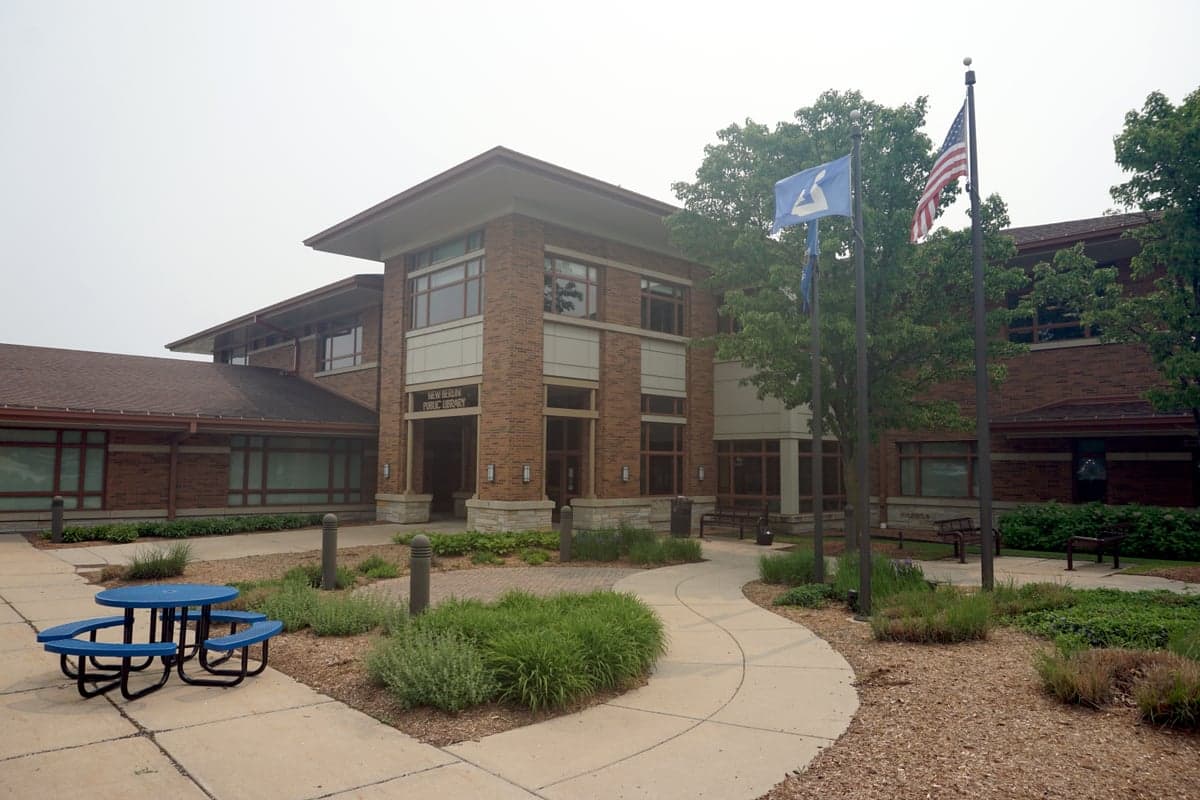
The people of New Berlin, Wisconsin, today number 40,384, forming a predominantly white, upper-middle-class suburban community with a notably high college attainment rate of 46.6%. The city’s character is defined by its quiet, family-oriented residential neighborhoods, low crime rates, and a strong sense of local governance, with a population density that feels spacious and suburban. Distinctive identity markers include a robust park system, a high proportion of owner-occupied homes, and a demographic profile that is less diverse than the Milwaukee metro area as a whole, with a foreign-born population of just 1.8%.
How the city was settled and grew
New Berlin’s human history begins not with a dramatic founding event but with a slow, agricultural settlement pattern typical of southeastern Wisconsin. The area was originally inhabited by the Potawatomi people, who were displaced through treaties in the 1830s. The first European settlers, primarily of German and Irish stock, arrived in the 1840s and 1850s, drawn by the availability of fertile farmland and the promise of land grants under the federal land office system. These early families established small, dispersed farmsteads rather than a concentrated village center. The historic Calhoun neighborhood, centered around the intersection of Calhoun Road and National Avenue, became a focal point for these early German farming families, who built the area’s first churches and schools. The Moorland area, named for the road that bisects it, similarly developed as a cluster of German and Irish homesteads. The city remained a sparsely populated farming community through the early 20th century, with no major industrial draw until the post-World War II era. The arrival of the railroad in the late 1800s did not spur significant growth, as New Berlin was a stop rather than a hub. The population hovered around 1,000 until the 1950s.
Modern era (post-1965)
The modern transformation of New Berlin began in earnest after 1965, driven by the twin forces of suburbanization and the expansion of Milwaukee’s highway system. The construction of Interstate 43 and the expansion of Highway 100 made New Berlin a commuter-friendly suburb for white-collar workers in Milwaukee and Waukesha. This period saw a massive influx of domestic in-migrants, primarily white families of German and Polish descent moving from Milwaukee’s south side and central city neighborhoods. These new residents were drawn by the promise of larger lots, newer schools, and lower taxes. The Sunny Slope neighborhood, developed in the 1970s and 1980s, became a primary landing zone for these families, featuring mid-century ranch homes and split-levels on half-acre lots. The Greenfield Park area, near the city’s western edge, similarly absorbed a wave of families seeking newer construction in the 1990s. The city’s population surged from 5,000 in 1960 to over 30,000 by 1990, a growth rate that fundamentally reshaped its character from rural crossroads to suburban bedroom community. The post-1965 era saw no significant influx of immigrant communities; the city’s foreign-born population remains very low at 1.8%, and its racial composition—84.9% white, 4.5% Hispanic, 3.4% Indian, 2.3% East/Southeast Asian, and 2.0% Black—reflects a pattern of selective suburbanization where minority groups have arrived in small, dispersed numbers rather than forming concentrated ethnic enclaves. The Indian community, at 3.4%, is the largest non-white group, likely drawn by professional opportunities in the Milwaukee area’s engineering and healthcare sectors, but they are scattered across newer subdivisions rather than concentrated in a single neighborhood.
The future
The population trajectory of New Berlin points toward gradual, modest diversification rather than rapid change. The city is not homogenizing into a single demographic bloc, nor is it tribalizing into distinct ethnic enclaves. The small but present Indian and East/Southeast Asian communities are likely to grow slowly, driven by professional in-migration to the broader Milwaukee region, but they are expected to assimilate into the existing suburban fabric rather than form separate neighborhoods. The Hispanic population, at 4.5%, is plateauing, with growth rates that mirror the national trend of slower Hispanic suburbanization in the Midwest. The white population, while still the overwhelming majority, is aging, and the city’s school district has seen slight enrollment declines, suggesting that younger families are being partially replaced by empty-nesters. The next 10-20 years will likely see New Berlin remain a predominantly white, upper-middle-class suburb with a slowly diversifying population, but it will not become a majority-minority city or a hub for new immigrant communities. The city’s zoning policies, which favor large lots and single-family homes, will continue to limit the construction of affordable multi-family housing that might attract a more diverse population.
For someone moving in now, New Berlin is becoming a stable, mature suburb where the population is aging in place and new arrivals are primarily domestic professionals seeking a safe, well-regarded school system and low property taxes. The city offers a predictable, low-drama demographic environment, but those seeking a rapidly diversifying or culturally dynamic community will find it elsewhere in the metro area. The bottom line: New Berlin is a place where the past—a quiet, German-farming heritage—still shapes the present, and the future looks like a slower, whiter version of the American suburban norm.

* Values derived from national, state, county, city and local statistics and may differ in a specific area. Last updated: 2026-04-21T10:43:07.000Z
Narrative content on this page is AI-generated and may contain mistakes. Verify any details that matter before acting on them.
ReloMaps may earn a commission from affiliate links at no extra cost to you.

