Photo: Wikipedia
Demographics of Hudson County
Affluence Level in Hudson County
A middle-class area roughly in line with national averages across income, home values, education, and employment.
People of Hudson County
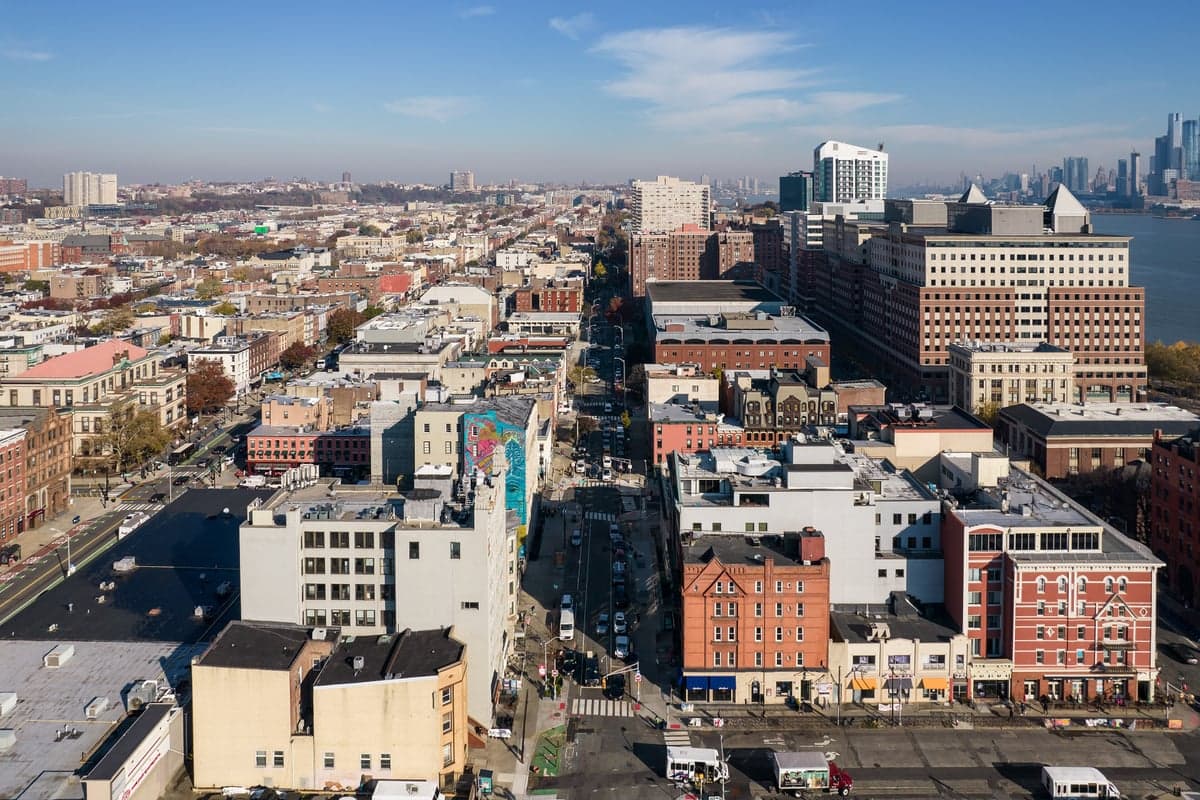
Hudson County, New Jersey, is one of the most densely populated and ethnically diverse counties in the United States, home to 710,478 residents packed into just 47 square miles across the Hudson River from Manhattan. Its population is characterized by a pronounced Hispanic plurality at 40.7%, a substantial white population of 28.1%, and significant Black (10.8%), East/Southeast Asian (7.7%), and Indian-subcontinent (8.6%) communities. With 20.7% foreign-born and nearly half of adults holding a college degree, the county is a high-density, high-education, immigrant-rich corridor that blends historic working-class roots with rapid gentrification and ongoing demographic churn.
Settlement & growth (pre-1960)
Before European contact, the area now known as Hudson County was inhabited by the Lenape people, specifically the Hackensack and Tappan bands, who lived along the tidal marshes and wooded ridges of the Palisades. Dutch colonists from New Netherland established the first permanent European settlements in the 1630s and 1640s, founding Bergen (now part of Jersey City) in 1660 as one of the oldest towns in New Jersey. The English took control in 1664, but the region remained sparsely populated through the colonial era, dominated by small farms and ferry landings.
The real population boom began in the mid-19th century, driven by industrialization and immigration. The construction of railroads and the development of the Morris Canal made Jersey City a major transportation and manufacturing hub. Irish immigrants fleeing the Great Famine arrived in large numbers during the 1840s and 1850s, settling in Hoboken and Jersey City to work on the railroads, docks, and in the burgeoning factories. German immigrants followed in the 1850s and 1860s, establishing communities in Union City and West New York, where they worked in brewing, baking, and skilled trades.
From the 1880s through the 1920s, a massive wave of Southern and Eastern European immigrants transformed Hudson County. Italians concentrated in Hoboken and Jersey City's "Little Italy" neighborhoods, working on the docks and in construction. Polish immigrants settled in Bayonne and Jersey City, finding employment in the oil refineries and shipping industries. Eastern European Jews, fleeing pogroms and poverty, established a dense community in Jersey City's Greenville section and along Bergen Avenue. By 1910, Hudson County was among the most foreign-born counties in the nation, with over 40% of residents born abroad. The Great Migration of African Americans from the South began during World War I and accelerated through the 1940s, as Black families moved into Jersey City and Hoboken for industrial jobs in shipyards, factories, and railroads. This period cemented the county's identity as a dense, multi-ethnic, working-class industrial corridor.
Modern era (post-1965)
The 1965 Hart-Cellar Immigration Act fundamentally reshaped Hudson County's demographics. The first major post-1965 wave was from the Caribbean and Latin America. Puerto Ricans, who were U.S. citizens, had been arriving since the 1950s, but the flow surged in the 1970s and 1980s, establishing a strong presence in Jersey City's Heights and Bergen-Lafayette neighborhoods. Cuban exiles, many arriving via the Mariel boatlift in 1980, settled in Union City and West New York, transforming those cities into the heart of "Havana on the Hudson." Dominicans began arriving in large numbers in the 1980s and 1990s, concentrating in Jersey City and North Bergen. Today, the Hispanic population of 40.7% is the largest single ethnic bloc, with a mix of Puerto Rican, Dominican, Cuban, Mexican, and Central American communities.
The second major shift came from Asia and the Indian subcontinent, beginning in the 1980s and accelerating through the 2000s. East/Southeast Asian immigrants, primarily Chinese and Filipino, settled in Jersey City's Downtown and Newport areas, drawn by proximity to Manhattan's financial district and the city's growing tech and professional sectors. Indian-subcontinent immigrants—from India, Pakistan, and Bangladesh—established a rapidly growing community in Jersey City's Journal Square and Hoboken, with a notable concentration of Gujarati and Punjabi families. The Indian-subcontinent population now stands at 8.6%, a share that has more than doubled since 2000. This wave is highly educated and professional, with many working in finance, technology, and healthcare in New York City.
Domestic migration has also reshaped the county. The decline of manufacturing in the 1970s and 1980s led to population loss and urban decay, particularly in Bayonne and parts of Jersey City. However, the 1990s and 2000s brought a wave of gentrification driven by young professionals and families fleeing Manhattan's high housing costs. This in-migration has been predominantly white and college-educated, pushing the county's college-educated share to 47.9% and driving rapid redevelopment in Jersey City's Downtown, Hoboken, and Weehawken. The Black population, which peaked at around 20% in the 1970s, has declined to 10.8% as many African American families have moved to suburbs in Essex and Union counties.
The future
Hudson County is likely to continue its trajectory of densification, diversification, and gentrification over the next 10-20 years. The Hispanic population, while still the largest group, is showing signs of plateauing as immigration from Latin America slows and second- and third-generation families move to more affordable suburbs. The Indian-subcontinent community is the fastest-growing major group, projected to approach 12-15% of the population by 2040, driven by both immigration and high birth rates. East/Southeast Asian communities are also growing steadily, particularly in Jersey City's Downtown and Hoboken, where new luxury high-rises cater to affluent professionals.
The white population, which bottomed out at around 20% in the 1990s, has rebounded to 28.1% due to gentrification, but this growth is concentrated among younger, childless professionals and may slow as housing costs continue to rise. The county is not homogenizing; rather, it is tribalizing into distinct enclaves based on income and ethnicity. Hoboken and Jersey City's Downtown are increasingly white, wealthy, and young, while Union City and West New York remain heavily Hispanic and working-class. Jersey City's Journal Square is becoming a dense Indian-subcontinent hub, while Bayonne retains a more mixed, older, and lower-income character.
For someone moving in now, Hudson County offers a high-density, transit-rich, and culturally vibrant environment, but with stark contrasts between its gentrified waterfront and its older, more diverse inland neighborhoods. The county is becoming more educated, more Asian and Indian, and more expensive, while its historic Black and working-class white populations continue to shrink. It is a place of rapid change, where newcomers will find a dynamic, polyglot community, but also one where affordability and cultural cohesion are increasingly strained.

* Values derived from national, state, county, city and local statistics and may differ in a specific area. Last updated: 2026-05-19T07:24:09.000Z
Narrative content on this page is AI-generated and may contain mistakes. Verify any details that matter before acting on them.
ReloMaps may earn a commission from affiliate links at no extra cost to you.

