
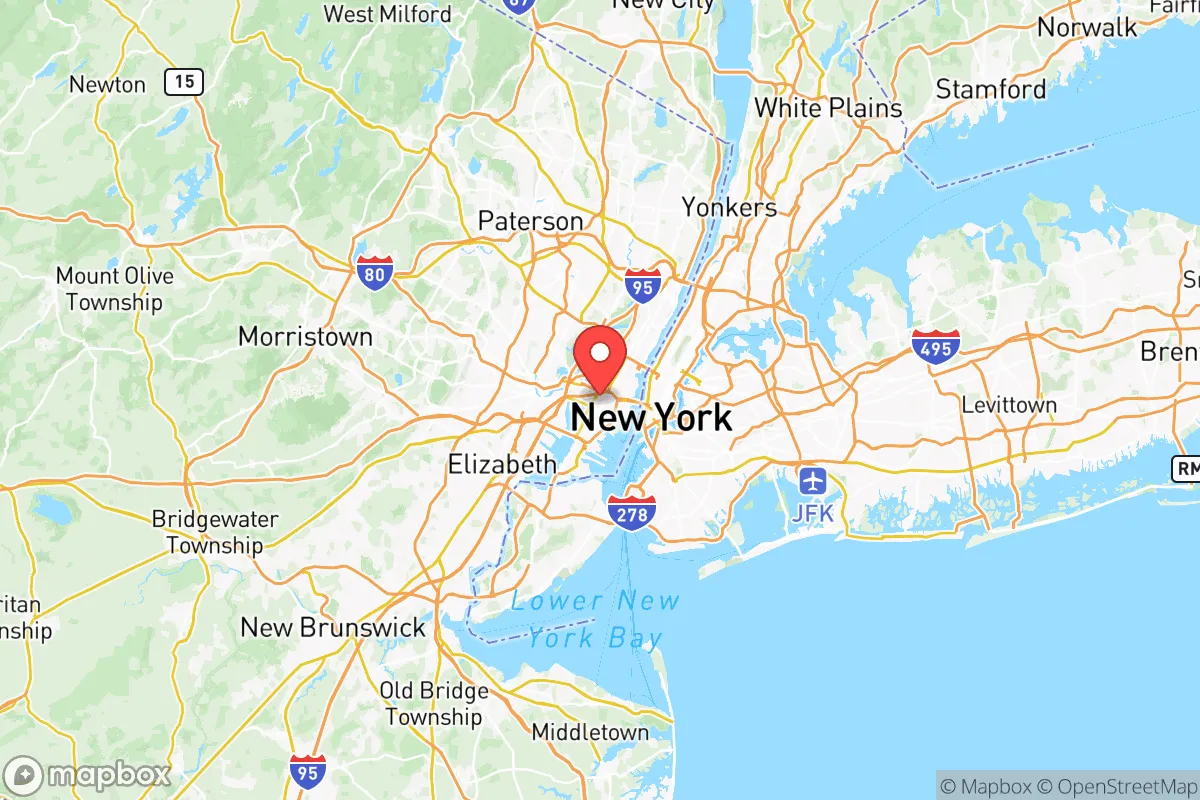
Photo: Wikipedia
Personal Sovereignty in Hudson County
Viable for self-reliance. Generally workable, though some barriers may limit total independence.
What does Personal Sovereignty tell us?
Personal Sovereignty measures your capacity for self-reliance and independence with minimal government friction. Higher scores mean fewer barriers between you and the way you want to live... but it assumes you have the space you need and good neighbors.
What does this tell us?
Personal Sovereignty measures your capacity for self-reliance and independence with minimal government friction. Higher scores mean fewer barriers between you and the way you want to live... but it assumes you have the space you need and good neighbors.
State Policy
Energy independence: Importer (8% of energy produced in-state)
Personal Liberty
Homesteading

Personal Liberty Analysis
For single individuals and parents evaluating Hudson County, New Jersey, from a personal sovereignty perspective, the area presents a challenging environment defined by dense population, high taxation, and extensive state-level regulation that consistently overrides local autonomy. New Jersey’s political climate, with a Democratic trifecta in Trenton, has produced a legal framework that prioritizes collective mandates over individual discretion, particularly in areas of self-defense, medical choice, and property use. While Hudson County offers economic opportunities and proximity to New York City, those seeking maximum personal freedom—especially from a survivalist or prepper mindset—will find the county’s regulatory posture a significant obstacle, though pockets like Bayonne and Kearny offer slightly more breathing room than the urban core of Jersey City or Hoboken.
Tax burden and regulatory posture: what the state takes and controls
New Jersey’s tax burden is among the highest in the nation, and Hudson County is no exception. The state’s progressive income tax tops out at 10.75% for earners over $1 million, but even middle-income households face rates around 5-6%. Property taxes in Hudson County average 2.3% of assessed value, among the highest in the U.S., with Jersey City and Hoboken seeing effective rates near 2.5% due to high valuations. For a $500,000 home, that’s roughly $11,500 annually—money that could otherwise fund personal preparedness or off-grid investments. Sales tax is 6.625%, with no local option to reduce it. Regulatory posture is equally heavy: New Jersey mandates strict building codes, environmental reviews, and land-use approvals that make even minor property modifications a bureaucratic ordeal. In Union City and West New York, zoning is dense and multi-family oriented, leaving little room for private storage sheds, rainwater collection, or backyard gardens without permits. The state’s energy policies, including a planned phase-out of natural gas by 2050, signal a long-term push toward centralized control over home energy systems, directly conflicting with off-grid or self-reliant living goals.
Self-defense and gun law specifics: what you can and cannot do
New Jersey’s gun laws are among the most restrictive in the country, and Hudson County enforces them rigorously. The state requires a Firearms Purchaser Identification Card (FPID) for long guns and a separate permit for each handgun purchase, with a 30-day waiting period between handgun purchases. Concealed carry is effectively impossible for most residents: after the Supreme Court’s Bruen decision in 2022, New Jersey passed a “sensitive places” law that bans firearms in parks, public transit, restaurants serving alcohol, and private property without explicit owner permission—covering nearly all of Hudson County’s public spaces. In Jersey City and Hoboken, local police departments are known for denying carry permits even for applicants who meet state requirements, citing “good cause” standards that remain subjective. Magazine capacity is capped at 10 rounds, and “assault weapons” bans cover many common semi-automatic rifles. For preppers, this means self-defense options are limited to home-only firearms with strict storage laws (must be unloaded and locked). Bayonne and Kearny have slightly more gun-friendly cultures, with a few local gun shops and ranges, but the state’s legal framework leaves little room for armed preparedness. Stand-your-ground laws do not exist; New Jersey imposes a duty to retreat in public spaces.
Self-reliance and homesteading viability: lot sizes, zoning, and off-grid feasibility
Hudson County is the most densely populated county in the U.S., with over 16,000 people per square mile, making traditional homesteading nearly impossible. Typical residential lot sizes in Jersey City and Hoboken are 25 feet by 100 feet or smaller, with zero-lot-line row houses and multi-unit buildings dominating. Zoning codes in Union City and West New York prohibit livestock, limit garden size, and require impervious surface ratios that prevent rainwater harvesting systems. Off-grid energy systems like solar panels face HOA restrictions in many condo and co-op buildings, and net metering policies require utility approval. Kearny and Harrison, with more single-family homes and slightly larger lots (often 40x100 feet), offer marginally more room for vegetable gardens, small chicken coops (with permits), and backup generators, but still fall far short of rural self-sufficiency. The state’s building codes require grid-tied electrical systems for new construction, and composting toilets are illegal without a septic system permit—rarely granted in urban areas. For preppers, the county’s reliance on centralized infrastructure (water, power, sewage) is a vulnerability, not a strength. Bayonne, with its peninsula location and some industrial-zoned parcels, has a few residents who maintain small-scale food production, but the overall environment is hostile to off-grid living.
Personal liberties: parental rights, medical autonomy, speech, and property
Parental rights in New Jersey are under consistent pressure from state mandates. The state’s sex education curriculum, which includes LGBTQ+ topics from kindergarten, is mandatory and cannot be opted out of, overriding parental discretion. Vaccine mandates for school attendance are strict, with no philosophical exemptions and only limited medical exemptions. Medical autonomy is similarly constrained: New Jersey’s public health emergency powers allow the governor to mandate treatments (as seen with COVID-19 vaccine mandates for healthcare workers and school staff), and the state’s medical aid-in-dying law is tightly regulated. Free speech protections are standard under the First Amendment, but Hudson County’s local ordinances in Jersey City and Hoboken restrict leafleting, public gatherings, and signage in ways that can chill political expression. Property rights are weak: the state’s eminent domain powers are broad, and rent control ordinances in Hoboken and Jersey City limit what landlords can do with their own property. For parents, the lack of school choice is notable—New Jersey has no voucher program, and charter schools are limited, with Jersey City having only a handful. Homeschooling is legal but requires annual notification and standardized testing, with increasing legislative pressure for more oversight.
Overall, personal sovereignty in Hudson County is significantly constrained compared to states like Texas, Florida, or New Hampshire. The combination of high taxes, restrictive gun laws, dense zoning that blocks self-reliance, and state overrides of parental and medical autonomy creates an environment where individual discretion is secondary to collective mandates. For single individuals and parents with a survivalist or prepper mindset, the county’s urban density and regulatory web make it a poor fit for long-term preparedness. While Bayonne and Kearny offer slightly more room for personal projects and a marginally less restrictive culture, the state-level framework remains the dominant factor. Those prioritizing personal sovereignty should look to lower-density, lower-regulation areas within New Jersey—such as Sussex County or Hunterdon County—or consider relocation to states with stronger protections for self-defense, property rights, and parental control. Hudson County is best viewed as a temporary base for economic opportunity, not a place to build lasting self-reliant freedom.

* Values derived from national, state, county, city and local statistics and may differ in a specific area. Last updated: 2026-05-19T07:24:09.000Z
Narrative content on this page is AI-generated and may contain mistakes. Verify any details that matter before acting on them.
ReloMaps may earn a commission from affiliate links at no extra cost to you.

