Photo: Wikipedia
Quality of Life in Hudson County
A livable area that tracks near national norms for affordability, walkability, and neighborhood health.
What does Quality of Life tell us?
Quality of Life measures an area by evaluating factors like cost of living, nearby amenities, country club access, airport proximity, socioeconomic signals and neighborhood character. For large states, this is a general average — quality of life can vary dramatically between metro areas, suburbs, and rural communities within the same state.
What does this tell us?
Quality of Life measures an area by evaluating factors like cost of living, nearby amenities, country club access, airport proximity, socioeconomic signals and neighborhood character. For large states, this is a general average — quality of life can vary dramatically between metro areas, suburbs, and rural communities within the same state.
Cost of Living
66% above national average
62%
The Real Cost of Living in Hudson County for 2026
| Tier | Individual | Family (4) |
|---|---|---|
| Survival | $29k | $54k |
| Comfortable | $99k | $145k |
| Luxury | $163k+ | $252k+ |
| Elite (Top 5%) | $224k+ | $347k+ |
Quality-of-Life Analysis
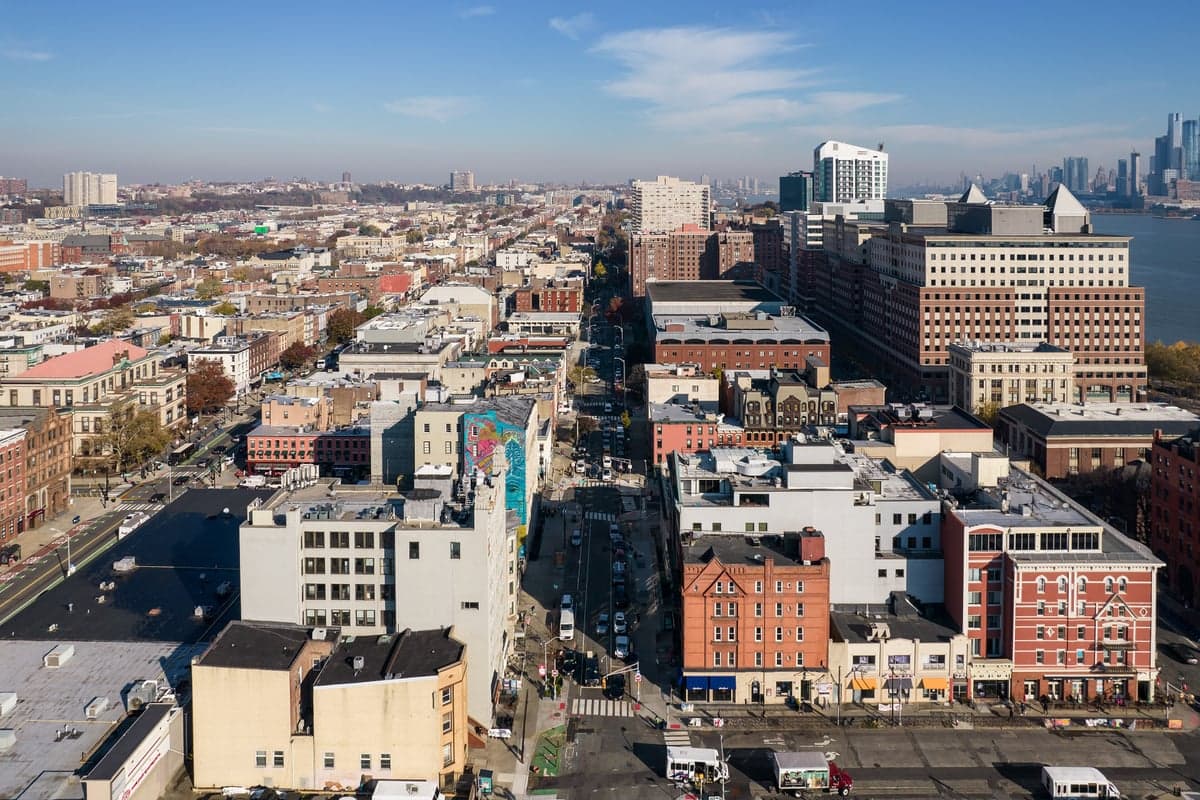
Hudson County, New Jersey, presents a starkly urban quality-of-life spectrum, drawing professionals who prioritize rapid Manhattan access, families seeking more space in historic neighborhoods, and a growing creative class attracted to its diverse, transit-oriented communities. With a cost of living index of 166 (66% above the national average) and an average commute of 35.5 minutes, the county is defined by its density and proximity to New York City, yet its character shifts noticeably from the high-rise corridors of Jersey City to the quieter streets of Kearny and the industrial-residential mix of Bayonne.
Largest town(s) & population centers
Jersey City is the county's dominant population center, a dense urban hub of over 290,000 residents where daily life revolves around the PATH train, waterfront parks, and a skyline of luxury high-rises alongside brownstone-lined streets. The downtown and Newport areas offer a fast-paced, amenity-rich lifestyle with median home values near $508,600 and rents averaging $1,811, though prices climb higher in neighborhoods like Paulus Hook. Hoboken, with its mile-square grid and vibrant Washington Street corridor, attracts young professionals and families who prioritize walkability and a 10-minute PATH ride to Manhattan, but contend with some of the county's highest per-square-foot costs. Union City and West New York, perched on the Palisades, offer a more affordable, heavily Latino-influenced urban experience with dense rowhouse blocks, excellent views, and frequent bus service across the Lincoln Tunnel.
Smaller towns & rural pockets
Hudson County has no true rural areas, but Kearny and Harrison function as smaller, less dense towns with a more suburban feel. Kearny, bisected by the Passaic River, features single-family homes, a historic downtown, and a large Portuguese and Brazilian community, offering a quieter alternative to the waterfront cities. Harrison, home to Red Bull Arena and a growing transit-oriented development around its PATH station, blends older residential blocks with new apartment complexes. Secaucus, with its large retail hubs and wetlands, feels more suburban than urban, while Bayonne, a peninsula city at the county's southern tip, retains a working-class, family-oriented character with lower housing costs than Jersey City or Hoboken. The county's only unincorporated area, West Hudson (including parts of Kearny and Harrison), contains light industrial pockets and older housing stock that keep costs relatively moderate.
Cost & lifestyle range
The cost and lifestyle spread across Hudson County is dramatic. At the high end, Hoboken's downtown and Jersey City's waterfront command median home values well above the county average of $508,600, with rents often exceeding $2,500 for a one-bedroom, attracting finance and tech workers who value a 10-minute commute to lower Manhattan. At the more affordable end, Bayonne and Kearny offer median home values closer to $400,000 and rents near $1,500, drawing families and longer-term residents who accept a 40- to 50-minute commute via bus or light rail. Union City and West New York sit in the middle, with rents around $1, home prices, and commute times that balance urban convenience with slightly lower costs than the waterfront. The county's average commute of 35.5 minutes masks this range: residents of Jersey City's Newport may commute in under 20 minutes, while those in Bayonne or Kearny often spend 45 minutes or more on a one-way trip. Amenities vary accordingly—waterfront areas boast high-end dining, gyms, and grocery stores, while smaller towns rely on local bodegas, ethnic markets, and strip malls.
Hudson County best suits individuals and families who prioritize proximity to New York City above all else and are willing to trade space and quiet for transit access and urban energy. Professionals who can afford the premium of Hoboken or Jersey City's waterfront will find a walkable, amenity-dense lifestyle with the shortest commutes, while those seeking more affordable housing and a slower pace will gravitate toward Bayonne, Kearny, or the Palisades towns. The county's diversity, density, and transit connectivity make it a compelling choice for anyone who values city living but cannot afford Manhattan or Brooklyn, though the trade-offs in cost, space, and commute time are significant across its varied neighborhoods.

Crime in Hudson County
WARNING: The crime statistics are unreliable for this jurisdiction. Local authorities have either not reported or under reported their data to the FBI. This could be due to bad intentions, incompetence or technical issues. Regardless, we suggest skepticism.
Crime rates similar to the national median for U.S. locations.
Violent CrimeViolent Crime Analysis
Property CrimeProperty Crime Analysis
Crime Analysis
Hudson County, New Jersey, presents a mixed safety picture where overall crime rates fall below the national average but remain elevated compared to the rest of the state, with significant variation between its densely urbanized cities and quieter suburban enclaves. The county’s violent crime rate of 191.7 incidents per 100,000 residents is roughly half the national average, while its property crime rate of 1,232 per 100,000 also undercuts the U.S. figure. However, residents in cities like Jersey City and Bayonne face markedly different day-to-day realities than those in Hoboken or Weehawken, driven largely by population density, policing strategies, and the progressive judicial philosophy that dominates the county’s court system.
Crime in context
Hudson County’s violent crime rate is about 45% lower than the national average of roughly 380 per 100,000, but it sits above New Jersey’s statewide rate of approximately 175 per 100,000. Property crime in the county, at 1,232 per 100,000, is similarly below the national benchmark of about 2,200 per 100,000 but higher than New Jersey’s average of roughly 1,100 per 100,000. These numbers reflect the county’s dense, transit-oriented character: thefts from vehicles and package thefts are common in walkable neighborhoods like Jersey City’s Downtown and Hoboken’s Washington Street corridor, while violent offenses concentrate in areas with higher poverty and gang activity, such as parts of Jersey City’s Greenville and Bergen-Lafayette sections. The Hudson County Prosecutor’s Office, led by a progressive-leaning prosecutor, has emphasized diversion programs and alternatives to incarceration for nonviolent offenders—a philosophy that critics argue reduces deterrence and contributes to repeat property crime, particularly in areas with high foot traffic like Journal Square and Exchange Place.
What residents experience
Daily life in Hudson County involves a heightened awareness of petty theft and occasional violent incidents, but most residents do not face direct victimization. In Jersey City, the county’s largest city, the overall crime rate is about 2,800 per 100,000—higher than the county average—with property crimes like larceny and motor vehicle theft accounting for the bulk. Hoboken, by contrast, reports a lower violent crime rate of roughly 150 per 100,000, but its dense layout and nightlife scene produce frequent reports of theft, disorderly conduct, and occasional assaults near bars on Washington Street. Bayonne, a more residential city, sees property crime rates near 1,100 per 100,000, with burglary and theft as primary concerns. Union City and West New York, both densely packed with multi-family housing, experience moderate property crime but lower violent crime than Jersey City. The progressive policies of the Hudson County judiciary—including bail reform and reduced sentences for drug-related offenses—mean that many arrested individuals are quickly released, a pattern that frustrates residents who see repeat offenders cycling through their neighborhoods, particularly in areas near the Hudson-Bergen Light Rail stations where transient populations gather.
Neighborhood-level variation
The sharpest safety divide in Hudson County is between its waterfront luxury districts and its older, inland neighborhoods. In Jersey City, the Downtown and Newport areas—home to high-rise condos and corporate offices—report violent crime rates below 100 per 100,000, while the Greenville and Bergen-Lafayette sections see rates exceeding 400 per 100,000. Hoboken’s crime is concentrated around the PATH station and bars on First Street, with property crime spiking during summer months. Weehawken and Guttenberg, small towns along the Palisades, enjoy some of the county’s lowest crime rates—violent crime below 50 per 100,000—thanks to limited public transit access and a more affluent, older demographic. Kearny, in the county’s western edge, sees moderate property crime but benefits from a more conservative local police approach. For prospective residents, the choice often comes down to accepting higher property crime in exchange for walkable urban amenities in Hoboken or Jersey City’s Downtown, versus prioritizing safety in quieter towns like Weehawken or Bayonne, where progressive judicial policies have less visible impact on daily life.
* Values derived from national, state, county, city and local statistics and may differ in a specific area. Last updated: 2026-05-19T07:24:09.000Z
Narrative content on this page is AI-generated and may contain mistakes. Verify any details that matter before acting on them.
ReloMaps may earn a commission from affiliate links at no extra cost to you.

