Photo: Wikipedia
Demographics of New Jersey
Affluence Level in New Jersey
A wealthy area with high-earning, well-educated households. Incomes, home values, and educational attainment meaningfully outpace national averages.
People of New Jersey
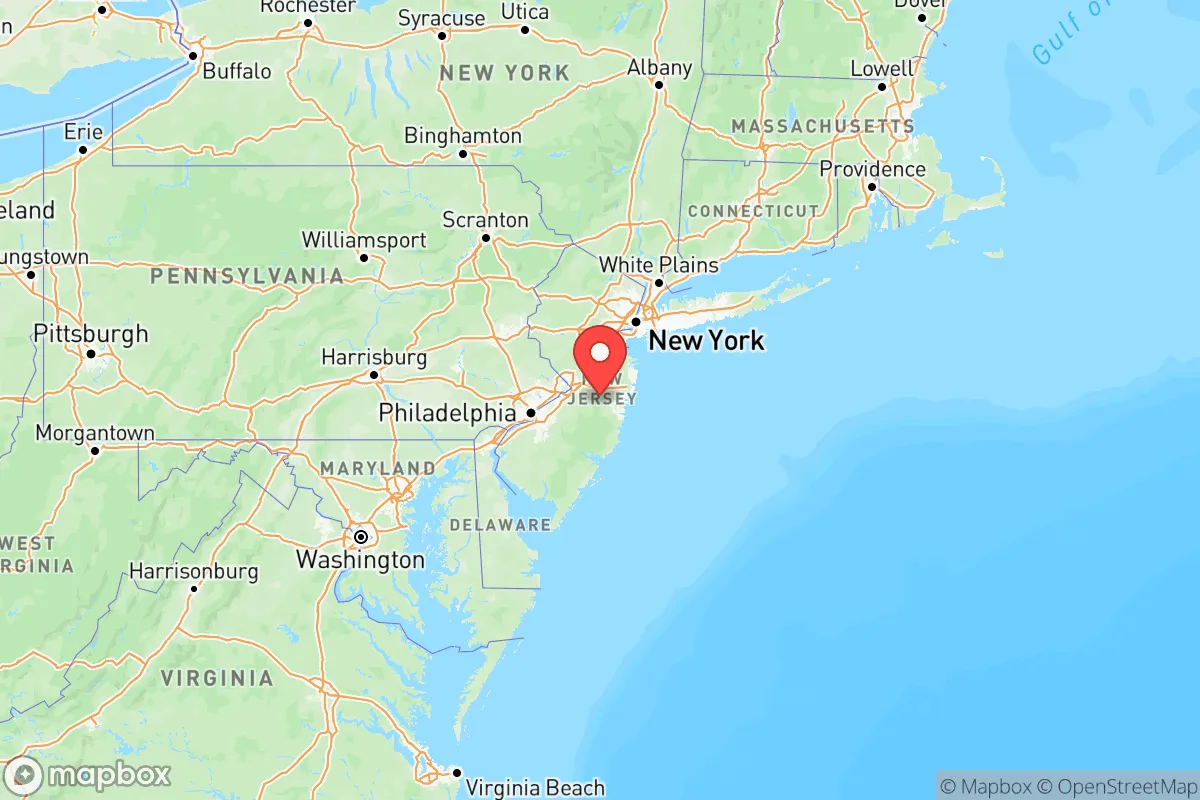
New Jersey is the most densely populated state in the nation, home to 9.3 million people who live in a tight patchwork of distinct ethnic enclaves, suburban sprawl, and urban centers. Its population is a study in contrasts: a majority-white state (51.9%) that is simultaneously one of the most diverse in the country, with a large Hispanic population (21.9%), a significant Black population (12.3%), and rapidly growing East/Southeast Asian (4.7%) and Indian-subcontinent (5.1%) communities. The state’s identity is shaped by its role as a corridor between New York and Philadelphia, its dense suburban middle class, and a history of immigration that has layered group upon group into the same small towns and cities.
Settlement & growth (pre-1960)
Before European contact, the land now called New Jersey was home to the Lenape people, who lived in decentralized bands across the region’s forests and coastal plains. Dutch and Swedish traders established the first European outposts in the early 1600s, with the Dutch West India Company founding settlements at Bergen (now Jersey City) in 1660 and along the Passaic River. The English took control in 1664, dividing the colony into East Jersey (largely settled by Puritans from New England and Scots) and West Jersey (dominated by Quakers from England and the British Isles).
The 18th and 19th centuries brought successive waves of European immigrants who shaped the state’s industrial and agricultural character. Germans arrived in large numbers after the 1848 revolutions, settling in Newark and the farming communities of Hunterdon and Warren Counties. The Irish came during the Great Famine of the 1840s, concentrating in Newark, Jersey City, and Paterson, where they built the canals and railroads that powered the state’s early economy. Italians began arriving in the 1880s, settling in Newark’s Ironbound district, Trenton’s Chambersburg neighborhood, and the industrial cities of Elizabeth and Passaic. Eastern European Jews, fleeing pogroms in Russia and Poland, established dense communities in Newark, Jersey City, and later the suburbs of Essex and Union Counties.
The Great Migration of Black Americans from the South began in earnest during World War I and accelerated through the 1940s and 1950s, drawn by industrial jobs in Newark, Camden, Trenton, and Paterson. By 1960, Newark was over 50% Black, and Camden had become a majority-Black city. The same period saw the rise of suburbanization, with the construction of the Garden State Parkway (opened 1954) and the New Jersey Turnpike (opened 1951) enabling white flight from cities to developing towns like Edison, Woodbridge, and Cherry Hill. The state’s population grew from 1.4 million in 1900 to 6.1 million by 1960, driven almost entirely by European immigration and internal migration from the South.
Modern era (post-1965)
The 1965 Hart-Cellar Act fundamentally reshaped New Jersey’s population. The first major post-1965 wave came from Puerto Rico and the Dominican Republic, settling in Newark, Camden, and Paterson. By 1980, Hispanic communities had become a permanent feature of the state’s urban landscape, with Newark’s North Ward and Camden’s Waterfront South becoming predominantly Puerto Rican and Dominican enclaves. The 1990s and 2000s saw a surge of Mexican and Central American immigration, particularly to suburban counties like Passaic, Bergen, and Middlesex, where agricultural and service-industry jobs drew families to towns like Passaic City, Perth Amboy, and Dover.
The Indian-subcontinent population exploded after 1990, driven by the tech boom and the expansion of H-1B visa programs. Edison and Iselin in Middlesex County became the epicenter of the state’s Indian community, with Oak Tree Road emerging as one of the largest South Asian commercial corridors in the United States. The community has since spread to Bridgewater, Parsippany, and Monroe Township, where Indian-Americans now make up over 20% of the population in some census tracts. East and Southeast Asian communities—primarily Chinese, Korean, and Filipino—grew more slowly but concentrated in Bergen County, particularly in Fort Lee, Palisades Park, and Ridgefield, where Korean-language signage and businesses dominate entire commercial strips.
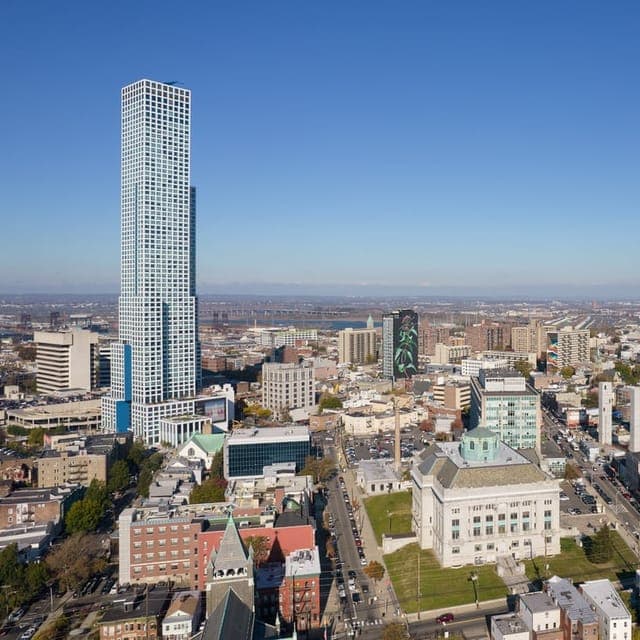
Domestic migration patterns have also shifted the population. The 1970s and 1980s saw significant white flight from Newark, Camden, and Trenton to outer-ring suburbs like Howell, Jackson, and Manalapan in Monmouth and Ocean Counties. The 2000s and 2010s brought a reverse trend: young professionals and empty-nesters began moving back to downtown Jersey City, Hoboken, and parts of Newark, drawn by proximity to Manhattan and the redevelopment of former industrial waterfronts. Jersey City’s population grew from 240,000 in 2000 to over 290,000 by 2023, driven largely by Asian and Hispanic immigrants and native-born millennials.
The future
New Jersey’s population is projected to grow slowly, reaching roughly 9.5 million by 2040, but the composition will shift dramatically. The white population, already a bare majority at 51.9%, will continue to decline as older white cohorts age out and younger, more diverse cohorts enter childbearing years. The Hispanic population is the fastest-growing segment, projected to reach 25-28% of the state by 2040, driven by both immigration and higher birth rates. The Indian-subcontinent population is also growing rapidly, fueled by continued tech-sector immigration and family reunification, and is likely to surpass 6-7% of the state within the next decade.
The state is not homogenizing but rather tribalizing into distinct, self-reinforcing enclaves. Edison and Middlesex County will become increasingly Indian-majority, while Bergen County’s Korean and Chinese communities will continue to expand outward from Fort Lee and Palisades Park. Hispanic communities in Passaic, Union, and Hudson Counties are becoming more Mexican and Central American in character, replacing older Puerto Rican and Dominican populations. The Black population, concentrated in Newark, Camden, and Trenton, is stable but aging, with younger Black families increasingly moving to southern states like Georgia and North Carolina for lower costs and better schools.
Suburbanization will continue, but the pattern is shifting: the classic white-flight suburbs of the 1970s are now diversifying, with Asian and Hispanic families moving into towns like Edison, Parsippany, and Cherry Hill that were once overwhelmingly white. The urban core—Jersey City, Hoboken, and parts of Newark—will remain magnets for young professionals and immigrants, but housing costs are pushing working-class families further out to places like Phillipsburg, Vineland, and the Pine Barrens region.
New Jersey is becoming a state of layered ethnic enclaves, where each group maintains its own institutions and commercial corridors while sharing the same dense suburban geography. For someone moving in now, the state offers a choice: live in a town where one group dominates and find deep community, or live in a mixed suburb and navigate the daily reality of America’s most diverse state. The cultural identity is not fading—it is fragmenting into distinct, self-sustaining communities that coexist but rarely fully integrate.

Most Diverse Cities in New Jersey
Most Homogenous Cities in New Jersey
* Values derived from national, state, county, city and local statistics and may differ in a specific area. Last updated: 2026-04-18T23:43:52.000Z
Narrative content on this page is AI-generated and may contain mistakes. Verify any details that matter before acting on them.
ReloMaps may earn a commission from affiliate links at no extra cost to you.

