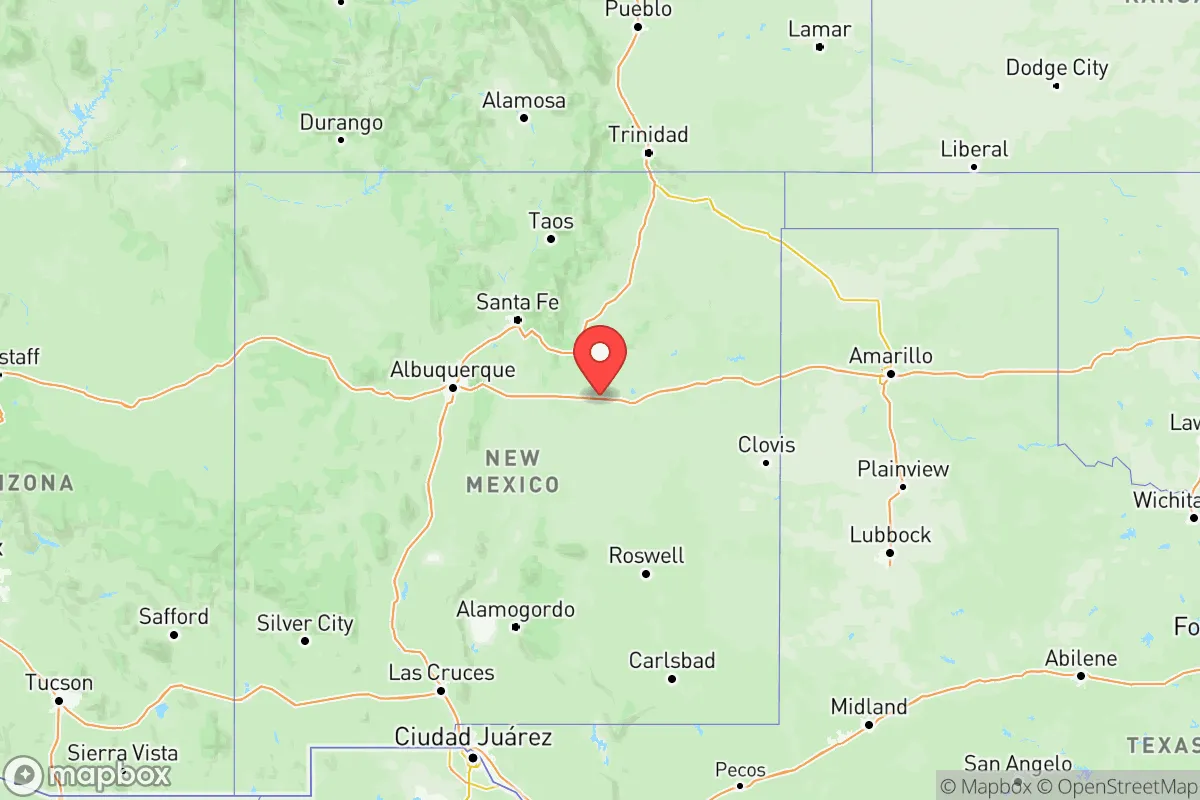
Photo: Wikipedia
Demographics of New Mexico
Affluence Level in New Mexico
An upper-middle-class area. Household wealth, education levels, and homeownership run ahead of national benchmarks.
People of New Mexico
New Mexico's population of 2.1 million is a unique blend of Native American, Hispanic, and Anglo heritage, making it the most heavily Hispanic state in the nation at 48.2% of the population, with a white non-Hispanic share of 36.5%. The state is characterized by its low population density, deep-rooted cultural traditions, and a distinctive identity shaped by centuries of Spanish and Mexican rule before American annexation. Today, the population is concentrated along the Rio Grande corridor from Albuquerque to Santa Fe and in the southern farming communities around Las Cruces, with a notably small foreign-born share of just 5.1% — far below the national average — reflecting a population that is largely native-born and deeply tied to its land.
Settlement & growth (pre-1960)
New Mexico's human history begins with its Native American nations, who have inhabited the region for over 10,000 years. The Pueblo peoples — including the Acoma, Zuni, Hopi, and Taos — built permanent adobe villages along the Rio Grande and its tributaries, with settlements like Acoma Pueblo (continuously occupied since the 12th century) and Taos Pueblo representing some of the oldest continuously inhabited communities in North America. The Navajo and Apache nations arrived later, around the 15th century, establishing a nomadic and semi-nomadic presence across the western and southern plains.
Spanish colonization began in 1598 when Juan de Oñate established the first European settlement at San Juan Pueblo (near present-day Española), bringing Spanish colonists, Franciscan missionaries, and Mexican Indian allies. This wave created the distinctive Hispano culture that still defines much of northern New Mexico. The Spanish crown granted large land grants to settlers, establishing farming and ranching communities in the Rio Grande Valley. After the Pueblo Revolt of 1680 temporarily expelled the Spanish, reconquest under Diego de Vargas in 1692 reestablished settlements in Santa Fe (founded 1610) and Albuquerque (founded 1706). By the end of the Spanish period in 1821, the population was overwhelmingly Hispanic and Pueblo Indian, with small enclaves of genízaro (detribalized Native Americans) communities.
Mexican rule from 1821 to 1846 brought little demographic change, but the Santa Fe Trail opened trade routes that attracted Anglo-American merchants and trappers to Santa Fe and Las Vegas (New Mexico). The U.S. acquisition of New Mexico in 1848 after the Mexican-American War triggered a slow but steady influx of Anglo settlers. The arrival of the Atchison, Topeka and Santa Fe Railway in 1880 transformed the territory, bringing railroad workers, merchants, and homesteaders to new towns like Raton, Las Vegas, and Deming. Cattle ranching and mining drew additional Anglo settlers to the eastern plains and southwestern mountains. By 1900, the population had grown to about 195,000, still predominantly Hispanic and Native American but with a growing Anglo minority concentrated in railroad towns and government centers.
The 20th century brought the federal government as a major demographic force. The Manhattan Project during World War II established Los Alamos as a secret scientific community, drawing physicists, engineers, and technicians from across the country — a wave that permanently shifted the state's demographic profile toward a highly educated, secular, and politically liberal enclave. Military bases at Alamogordo (Holloman Air Force Base), Clovis (Cannon Air Force Base), and Las Cruces (White Sands Missile Range) brought military families and defense contractors. The post-war period also saw the beginning of a Hispanic middle class in Albuquerque and Santa Fe, as rural Hispano families moved to cities for government and service jobs.
Modern era (post-1965)
The 1965 Hart-Cellar Act had a relatively muted effect on New Mexico compared to coastal states, given its already high Hispanic population and low overall immigration. The foreign-born share has remained low — just 5.1% today — and immigration has been primarily from Mexico and Central America, with smaller flows from Asia. The state's Hispanic population has grown through both immigration and high birth rates, rising from about 37% in 1970 to 48.2% today, making New Mexico one of the few states where the white non-Hispanic population is not a majority.
Domestic migration has been more significant. The 1970s and 1980s saw an influx of Anglo retirees and counterculture seekers to Santa Fe and Taos, drawn by the region's natural beauty, arts scene, and lower cost of living. This wave transformed Santa Fe from a sleepy state capital into a high-end tourist and second-home destination, driving up housing costs and creating cultural tensions between newcomers and long-time Hispano residents. Albuquerque experienced steady growth from Sun Belt migration, attracting Californians and Texans seeking affordable housing and jobs in government, healthcare, and technology. The East Asian population, while small at 1.2%, has concentrated in Albuquerque and Los Alamos, often tied to the scientific and engineering sectors. The Indian subcontinent population (0.4%) is similarly small and professional, with clusters near the state's universities and research facilities.
Suburbanization has reshaped the state's population distribution. The Albuquerque metro area — including Rio Rancho, which grew from a few hundred residents in 1980 to over 100,000 today — has absorbed most of the state's population growth. Rio Rancho, originally a master-planned retirement community, has become a middle-class suburb attracting families from across the state and country. Las Cruces has grown steadily as a retirement and college town, while the eastern plains and rural northern counties have experienced population stagnation or decline as younger residents leave for urban areas.
The future
New Mexico's population is projected to grow slowly, reaching about 2.3 million by 2040, with growth concentrated in the Albuquerque and Las Cruces metro areas. The state is becoming more Hispanic and more urban, with rural counties — particularly in the eastern plains and northern mountains — continuing to lose population. The white non-Hispanic share is declining gradually, while the Hispanic share is rising through both natural increase and continued immigration from Mexico and Central America. The Native American population, at roughly 10%, remains stable but faces challenges of outmigration from rural pueblos to cities.
The state is not homogenizing so much as polarizing into distinct cultural zones: the liberal, highly educated enclaves of Santa Fe and Los Alamos; the more moderate, working-class Hispanic communities of Albuquerque and the Rio Grande Valley; the conservative, Anglo-dominated eastern plains; and the traditional Pueblo and Navajo communities of the northwest. Immigrant communities are small and largely assimilating into the existing Hispanic culture, rather than forming distinct enclaves. The state's cultural identity remains deeply rooted in its Hispano and Native American heritage, with newcomers — whether Anglo retirees or Asian professionals — generally absorbed into this existing framework rather than reshaping it.
For someone moving in now, New Mexico offers a population that is stable, native-born, and culturally distinct — a place where the demographic trends are slow-moving and the character is already deeply set. The state is not experiencing the rapid transformation seen in Texas or Arizona, but rather a gradual evolution that preserves its unique blend of Native, Hispanic, and Anglo traditions while slowly urbanizing around its few major cities.

Most Diverse Cities in New Mexico
Most Homogenous Cities in New Mexico
* Values derived from national, state, county, city and local statistics and may differ in a specific area. Last updated: 2026-04-14T06:21:01.000Z
Narrative content on this page is AI-generated and may contain mistakes. Verify any details that matter before acting on them.
ReloMaps may earn a commission from affiliate links at no extra cost to you.

