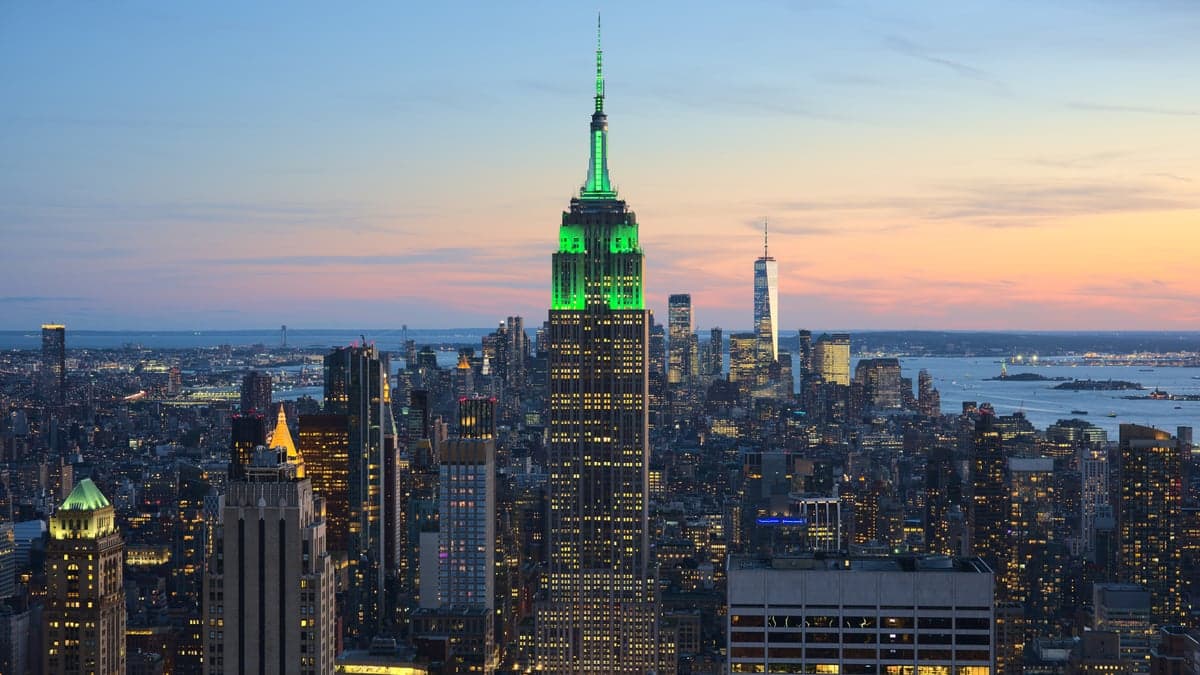
Photo: Wikipedia
Personal Sovereignty in New York, NY
Moderate friction. Expect trade-offs in some aspect of personal liberty and independence.
What does Personal Sovereignty tell us?
Personal Sovereignty measures your capacity for self-reliance and independence with minimal government friction. Higher scores mean fewer barriers between you and the way you want to live... but it assumes you have the space you need and good neighbors.
What does this tell us?
Personal Sovereignty measures your capacity for self-reliance and independence with minimal government friction. Higher scores mean fewer barriers between you and the way you want to live... but it assumes you have the space you need and good neighbors.
State Policy
Energy independence: Importer (12% of energy produced in-state)
Personal Liberty
Homesteading

Personal Liberty Analysis
For a survivalist or prepper evaluating personal sovereignty, New York City represents one of the most constrained environments in the United States—a dense, heavily regulated jurisdiction where individual autonomy is systematically subordinated to state and municipal authority. The city’s 8.5 million residents operate under layers of laws that limit everything from what you can own to how you can defend yourself, making it a location best suited for those who prioritize career access or urban amenities over the ability to live independently. While the broader state of New York has a reputation for progressive governance, NYC amplifies every restriction, creating a reality where self-reliance is actively discouraged by policy and infrastructure alike.
Tax burden and regulatory posture for independent living
New York City’s tax burden is among the highest in the nation, directly impacting a prepper’s ability to stockpile resources or maintain financial independence. Residents face a combined state and city income tax that can exceed 12% for top earners, plus a sales tax of 8.875% on most goods—including gear, tools, and supplies. Property taxes, while not the highest in the state, are levied on assessed values that often lag behind market rates, meaning a modest home in Queens or Staten Island can carry an annual bill of $5,000–$8,000. The regulatory posture is equally aggressive: the city’s Department of Buildings requires permits for even minor structural changes, and zoning laws in most residential areas prohibit home-based businesses, workshops, or agricultural activities. For a prepper, this means that converting a basement into a food storage room or installing a backup generator often triggers inspections, fines, or legal battles. The city’s rent stabilization laws cover roughly 1 million units, but they also discourage landlords from maintaining properties, creating a precarious housing situation for those who don’t own. Overall, the tax and regulatory climate in NYC is designed to extract wealth rather than enable self-sufficiency, making it one of the least favorable urban environments for building long-term resilience.
Self-defense realities and gun law specifics in New York City
For anyone serious about personal sovereignty, New York City’s gun laws are a dealbreaker. The city operates under the state’s SAFE Act (2013) and its own even stricter local ordinances, effectively creating a near-total ban on firearm ownership for most residents. To legally possess a handgun, you must obtain a “premises license” from the NYPD, which requires a background check, fingerprinting, character references, and a 16-hour safety course—and even then, the license only allows you to keep the gun in your home. Carrying a concealed weapon in public is virtually impossible for ordinary citizens; the Supreme Court’s Bruen decision (2022) forced the state to loosen its “proper cause” requirement, but New York responded by passing the Concealed Carry Improvement Act (CCIA), which designates “sensitive places” so broadly (including Times Square, subways, parks, and any private business that doesn’t explicitly allow guns) that carrying remains impractical. Long guns are less restricted but still require a permit for purchase, and the city bans “assault weapons” and magazines over 10 rounds. For a prepper, this means that self-defense options are limited to non-lethal tools like pepper spray (legal with restrictions) or knives (blade length limits apply). The NYPD’s enforcement posture is aggressive: even a legal gun owner can face arrest for accidentally stepping into a “sensitive place.” In a collapse scenario, this legal framework would leave residents defenseless against armed threats, making NYC one of the least survivable urban environments for those prioritizing personal protection.
Self-reliance and homesteading viability in a dense urban grid
Homesteading and off-grid living in New York City are essentially non-starters due to extreme density and zoning restrictions. The typical residential lot in the outer boroughs is 20–25 feet wide by 100 feet deep, leaving little room for gardens, livestock, or water storage. Zoning codes prohibit keeping chickens, goats, or bees in most areas (exceptions exist for community gardens with permits, but they’re rare and heavily regulated). Rainwater collection is technically allowed but limited to 100 gallons per property, and the city’s water supply—while high-quality—is entirely dependent on a centralized system vulnerable to disruption. Solar panels are permitted but require structural engineering approvals and often face pushback from co-op boards or historic district commissions. For a prepper, the lack of space means that food storage must be vertical and climate-controlled, which is expensive in a city where electricity costs $0.24 per kWh (nearly double the national average). Composting toilets are illegal in most residential buildings, and off-grid power generation is impractical due to building codes and fire regulations. The NYC Department of Sanitation actively discourages backyard burning or waste processing. In short, the city’s infrastructure is designed to centralize resources, not enable individual resilience. A prepper would need to rely on a bug-out location outside the city—typically in the Hudson Valley or Catskills—for any serious homesteading activity, making NYC a base of operations rather than a self-sufficient home.
Personal liberties: parental rights, medical autonomy, speech, and property
New York City’s approach to personal liberties reflects a broader state trend of prioritizing collective welfare over individual choice, which directly impacts a prepper’s autonomy. On parental rights, the city’s Department of Education has implemented policies that can override parental decisions on curriculum, health, and discipline. For example, NYC public schools require parental consent for some medical services but not others (e.g., reproductive health access for minors without parental notification), and the city’s vaccination mandates for school attendance are among the strictest in the nation, with no religious exemption. Medical autonomy is similarly constrained: the city’s health department has broad powers to mandate treatments during public health emergencies, as seen during COVID-19 when vaccine passports were required for indoor dining, gyms, and entertainment venues. Free speech is protected under the First Amendment, but NYC’s noise ordinances, parade permits, and “disorderly conduct” laws give police wide discretion to shut down protests or gatherings deemed disruptive—a concern for preppers who might want to organize community defense or information-sharing events. Property rights are heavily circumscribed: the city’s Rent Guidelines Board controls rent increases for stabilized units, and the Department of Buildings can issue vacate orders for properties deemed unsafe, effectively seizing control without compensation. For a prepper, this means that even owning a home doesn’t guarantee the right to modify it for security or self-sufficiency. The overall message is clear: in NYC, the state’s authority routinely supersedes individual judgment, making it a challenging environment for those who value personal sovereignty above all else.
In the broader context of U.S. cities, New York ranks near the bottom for personal sovereignty, alongside San Francisco and Los Angeles. For a survivalist or prepper, the city’s high taxes, restrictive gun laws, limited homesteading potential, and erosion of personal liberties create a reality where self-reliance is not just difficult but actively penalized. The trade-off is access to world-class career opportunities, cultural amenities, and a dense social network—but for those whose primary concern is autonomy in an uncertain future, NYC is a place to pass through, not to dig in. If you’re serious about prepping, look to states like Texas, Montana, or New Hampshire, where the legal and regulatory environment supports individual resilience rather than undermining it.

* Values derived from national, state, county, city and local statistics and may differ in a specific area. Last updated: 2026-04-15T19:12:32.000Z
Narrative content on this page is AI-generated and may contain mistakes. Verify any details that matter before acting on them.
ReloMaps may earn a commission from affiliate links at no extra cost to you.

