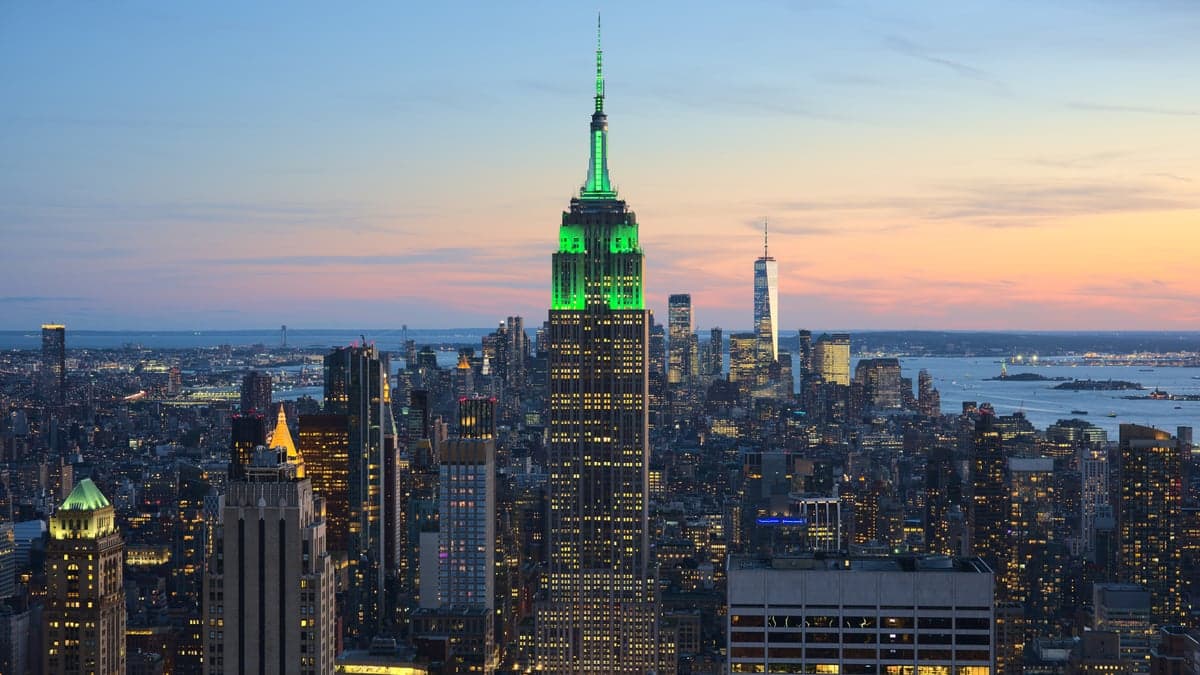
Photo: Wikipedia
Strategic Assessment of New York, NY
High tactical risk. This location is likely close to major population centers, strategic targets, or sits in a high-disaster corridor. A retreat property and careful exit planning is required.
What does the Strategic Assessment tell us?
Our Strategic Assessment grades tactical survivability of an area. Major population centers, military targets, fallout zones, natural disasters, and border exposure all drive risk — lower exposure means a more defensible position in a crisis.
This is heavily inspired by Joel Skousen's Strategic Relocation book. Highly recommended you checkout the book ($)What does this tell us?
Our Strategic Assessment grades tactical survivability of an area. Major population centers, military targets, fallout zones, natural disasters, and border exposure all drive risk — lower exposure means a more defensible position in a crisis.
This is heavily inspired by Joel Skousen's Strategic Relocation book. Highly recommended you checkout the book ($)Strategic Pillars

Key Distances
Regional Safe Places
Below is our recommended "safe zones" in New York and the surrounding area based on our strategic heuristics. For most people, it's unrealistic to live in a “safe zone” full-time due to work, family or other personal reasons. They tend to be more rural. However, many of these areas are perfect for second homes and retreat properties that double as a vacation home or even a short-term rental.
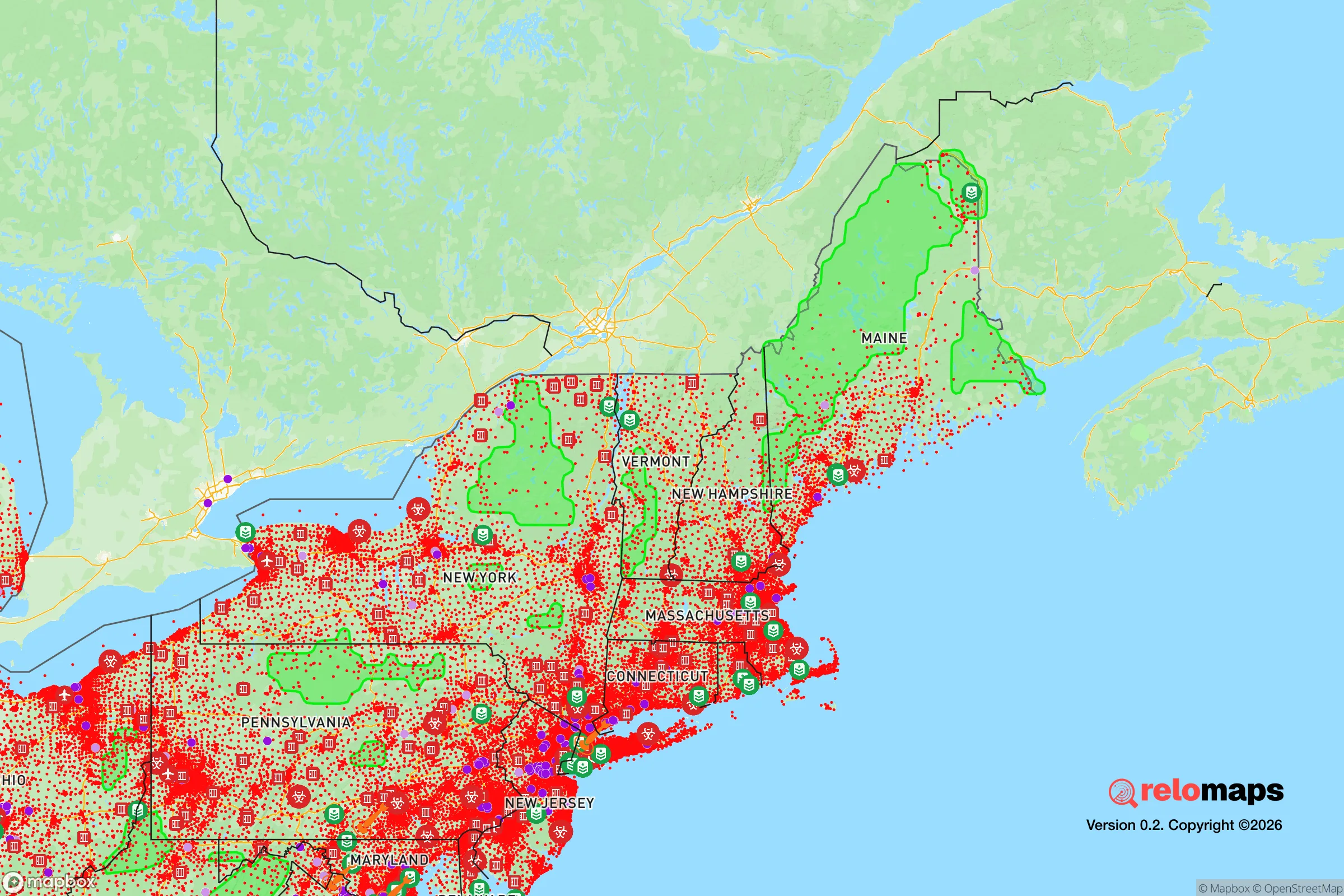
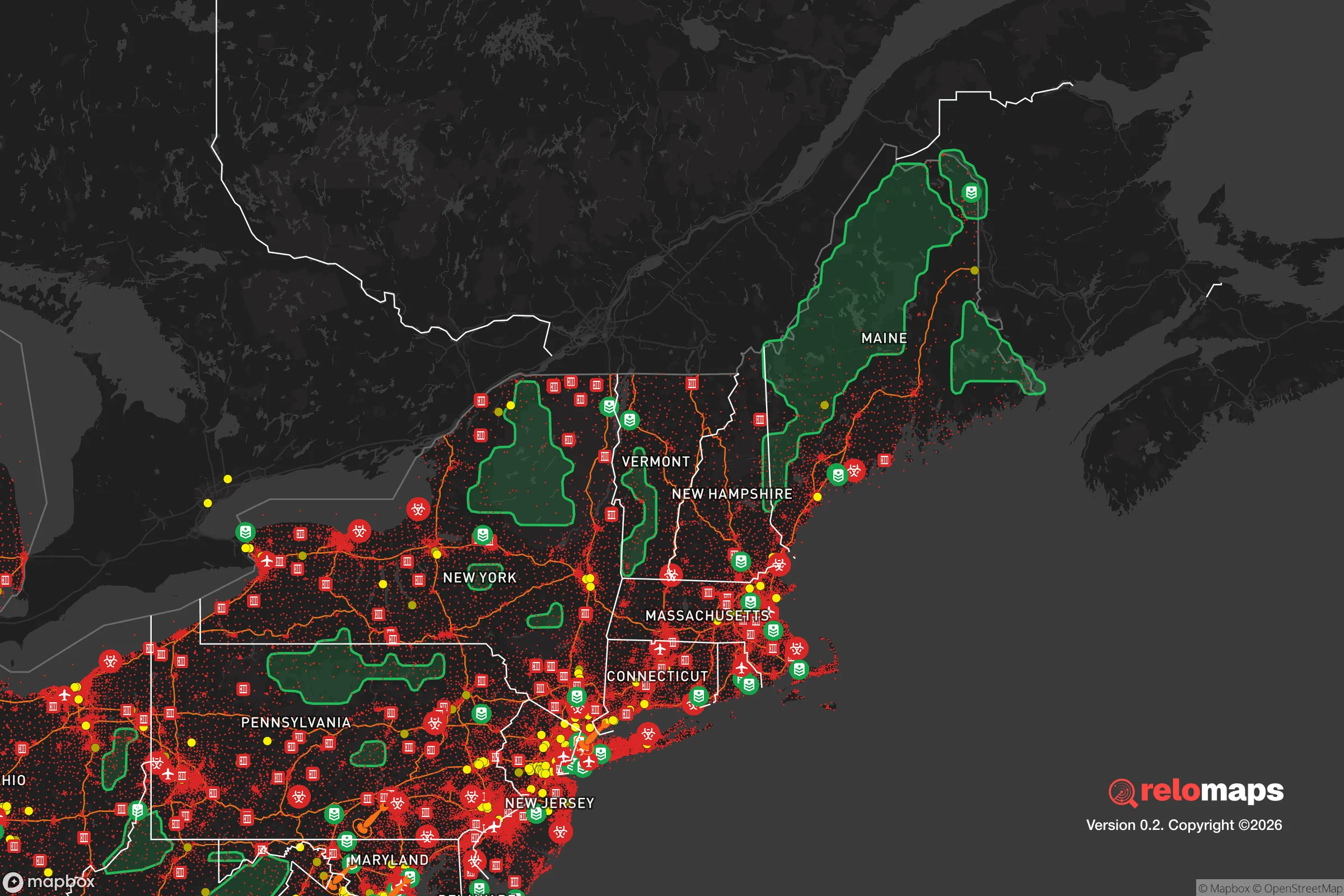


Important Note: For informational purposes only. This does not mean nothing bad ever happens in the green zones. Please use common sense. This is based on public data and modeled with AI. We tried to take a conservative approach but mistakes happen. We update this regularly as new information becomes available.
Solar Generator Recommendations
Backup power matters more here than in safer locations. We've picked three solar generators across budgets and capacity tiers — start with the budget unit if you only need a few essentials, or step up if you want to run a fridge and HVAC for days at a time.

Jackery Portable Power Station Explorer 300
Budget OptionPower on the Go: Weighing only 11 lbs, it's convenient to set up and store with book-sized foldable solar panels

BLUETTI Portable Power Station AC180
Designed for both indoor and outdoor scenarios, AC180 is highly capable as it has a robost capacity and continuous output power.

EF ECOFLOW DELTA Pro Ultra Power Station
Upgraded PickEcoFlow DELTA Pro Ultra is a whole-home energy system designed to grow with your family. Integrated with the Smart Home Panel 2, it scales to meet your evolving energy needs — keeping your home powered, intelligent, and secure through every stage of life.
We earn a commission, at no additional cost to you.
Strategic Assessment Analysis
New York City is a strategic paradox: it offers immense economic and logistical advantages, but its extreme population density, critical infrastructure concentration, and political vulnerability make it one of the highest-risk locations in the United States for a prepper or survivalist. While the city’s resilience is legendary—it rebounded after 9/11 and Superstorm Sandy—that resilience is built on a fragile web of just-in-time supply chains, centralized power grids, and a population that is overwhelmingly dependent on government services. For a conservative-leaning individual or family prioritizing self-reliance, security, and long-term sustainability, New York City presents a complex calculus where the risks of civic unrest, mass casualty events, and natural disasters often outweigh the benefits of its economic opportunities.
Geographic position and natural advantages for long-term survival
New York City’s geographic position is both a strength and a weakness. The city sits at the confluence of the Hudson and East Rivers, with a deep natural harbor that historically made it a global trade hub. For a prepper, this water access is a double-edged sword: it provides a potential evacuation route by boat and a source of water (though heavily polluted), but it also makes the city a prime target for naval or amphibious threats. The surrounding topography—the Palisades to the west, the hills of northern New Jersey and Westchester, and the Long Island Sound to the east—offers some natural barriers, but the city itself is largely flat and built on landfill, making it vulnerable to storm surge and sea-level rise. The five boroughs are connected by a network of bridges and tunnels that are choke points for both evacuation and supply; a single failure (e.g., a terrorist attack on the Holland Tunnel or a bridge collapse) could trap millions. The city’s latitude (40.7°N) means four distinct seasons, with cold winters that can stress unprepared populations, but also a growing season long enough for urban gardening if you can secure uncontaminated soil. The real natural advantage is the proximity to the Catskill and Adirondack watersheds, which supply the city’s drinking water via a gravity-fed aqueduct system—one of the few critical infrastructure pieces that is relatively hardened and decentralized. However, that system is also a single point of failure: a sabotage event at the Delaware Aqueduct could cut water to 8 million people.
Risks, exposures, and proximity to fallout-relevant landmarks
New York City is arguably the highest-value target in the United States for any adversary. It contains the United Nations headquarters, Wall Street, the Federal Reserve Bank of New York (with the largest gold reserve in the world), and the headquarters of nearly every major media and financial institution. For a prepper, this means the city is a primary target for nuclear, biological, or cyber attacks. The fallout risk is extreme: a single ground-burst nuclear weapon detonated over Midtown Manhattan would produce a lethal radiation zone extending into New Jersey and Long Island, with fallout patterns dependent on wind direction. Even a smaller-scale event—like a dirty bomb or a chemical attack on the subway system—could render large areas uninhabitable for weeks. The city’s proximity to Indian Point (a decommissioned nuclear plant 35 miles north) and multiple research reactors in the region adds another layer of risk. Beyond WMDs, the city is vulnerable to mass casualty events from conventional terrorism (e.g., truck attacks, subway bombings) and civil unrest. The 2020 protests and looting demonstrated how quickly the city can descend into chaos when police are overwhelmed or politically constrained. For a conservative relocator, the political climate is also a factor: New York City is a deep-blue jurisdiction with strict gun laws, high taxes, and a government that has shown willingness to impose lockdowns and mandates. In a prolonged crisis, the city’s 8.5 million residents—many of whom have no food storage, no backup power, and no evacuation plan—could become a desperate, dangerous population. The density alone makes it nearly impossible to defend a home or property against a determined mob.
Practical resilience for a relocator: food, water, energy, and defensibility
For a prepper considering relocation to New York City, the practical challenges are daunting. Food security is virtually nonexistent: the city has only about 48 hours of food supply on hand at any given time, relying on daily truck deliveries from warehouses in New Jersey and Pennsylvania. A disruption to the bridges, tunnels, or fuel supply would lead to empty shelves within days. Urban gardening is possible in community gardens or on rooftops, but soil contamination from decades of industrial pollution and lead paint is a serious concern. Water security is slightly better because of the gravity-fed aqueduct system, but that system is vulnerable to sabotage and the city’s distribution pipes are old and prone to breaks. Boiling or filtering water from the Hudson or East River is possible but requires advanced treatment due to sewage and chemical runoff. Energy resilience is poor: the grid is old, overloaded, and prone to blackouts during heat waves or storms. Solar panels are viable only for those with roof access and battery storage, but many buildings are shaded by taller structures. Natural gas is the primary heating fuel, and a disruption in supply (e.g., from a cyberattack on pipelines) would leave millions without heat in winter. Defensibility is the biggest weakness: apartment buildings are difficult to secure, with multiple entry points, shared walls, and neighbors who may be hostile or desperate. Single-family homes in the outer boroughs (Staten Island, parts of Queens and Brooklyn) offer slightly better defensibility, but they are still within easy walking distance of high-density areas. Evacuation is a nightmare: the city’s evacuation plan relies on public transportation and private vehicles, but the bridges and tunnels are choke points that would gridlock within hours. For a prepper, the only realistic strategy in New York City is to have a well-stocked bug-out location within 100 miles (e.g., in the Catskills, Poconos, or rural New England) and a pre-planned evacuation route that avoids the major choke points. Staying in the city during a major crisis is not a viable long-term survival plan.
The overall strategic picture for New York City is clear: it is a high-risk, low-resilience environment for anyone prioritizing self-reliance and security. The economic opportunities are real—high-paying jobs, diverse industries, and world-class healthcare—but they come with a price tag of extreme vulnerability to terrorism, civil unrest, natural disasters, and infrastructure failure. For a conservative prepper, the city’s political and cultural environment is also a liability: restrictive gun laws, high taxes, and a government that may not prioritize your safety in a crisis. If you must live in New York City for work or family reasons, the smart play is to treat it as a temporary base, not a permanent home. Invest in a remote property with well water, solar power, and a defensible layout, and have a plan to get there within hours of a major event. The city’s resilience is real, but it is the resilience of a system designed to support 8.5 million people who are not prepared for the worst. For the prepared individual, New York City is a place to pass through, not to dig in.

* Values derived from national, state, county, city and local statistics and may differ in a specific area. Last updated: 2026-04-15T19:12:32.000Z
Narrative content on this page is AI-generated and may contain mistakes. Verify any details that matter before acting on them.
ReloMaps may earn a commission from affiliate links at no extra cost to you.

