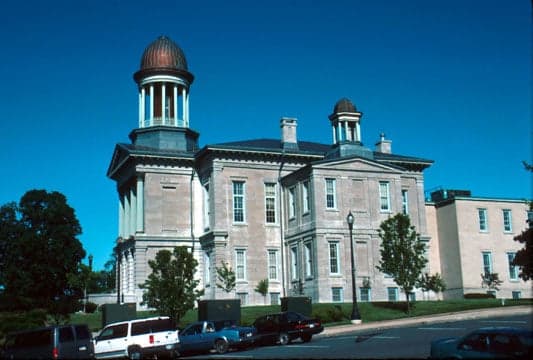
Photo: Wikipedia
Political ClimatePolitical Climate in Oswego County
Showing district-level results — no local-only data available.
Local Political AnalysisPolitical Analysis of Oswego County
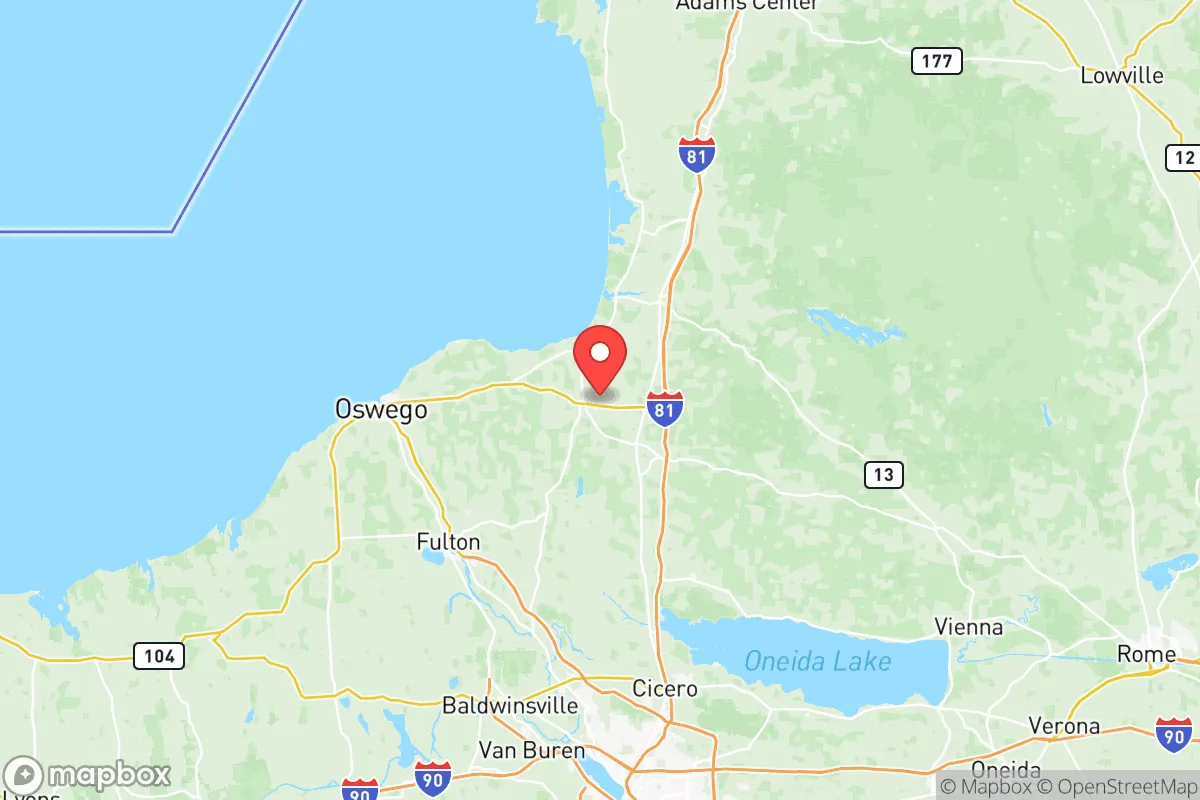
Oswego County, New York, is a reliably Republican stronghold in an otherwise blue state, carrying a Cook Partisan Voting Index of R+11. That means the county votes about 11 points more Republican than the national average, a stark contrast to the deep-blue politics of New York City. While the county has leaned red for decades, the margin has widened in recent presidential cycles—Donald Trump won it by over 20 points in both 2016 and 2020, and the trend shows no sign of reversing. The shift is driven largely by rural and exurban voters moving right, even as the county's small cities hold the line for Democrats.
How it compares to New York, NY
Comparing Oswego County to New York City is like comparing two different countries. New York City's five boroughs are overwhelmingly Democratic, with a Cook PVI estimated around D+30 or more, though no official rating exists for the city as a whole. In Oswego County, the political energy is conservative: gun rights, lower taxes, and opposition to state-level progressive policies like the Green New Deal and bail reform are common talking points. The county's largest town, Oswego (population ~18,000), is the only real blue dot—its precincts near SUNY Oswego and the waterfront lean Democratic, thanks to a mix of college students and unionized manufacturing workers. In contrast, towns like Fulton and Mexico are reliably red, with Fulton's working-class precincts swinging hard for Trump in 2020. The rural hamlets of Pulaski and Central Square are even more conservative, often voting 70%+ Republican. The swing precincts are few, but they exist in the suburban fringe of Volney and Schroeppel, where moderate voters occasionally split tickets in local races.
What this means for residents
For conservative residents, Oswego County feels like a refuge. Local government is dominated by Republicans—the county legislature has a 22-3 GOP supermajority—and conservative values shape everything from zoning laws to school board decisions. Gun owners enjoy relatively permissive local enforcement of state firearm laws, and property taxes, while high by national standards, are lower than in neighboring Onondaga County (home to Syracuse). For liberal residents, life is more complicated. They often feel politically isolated, especially in rural areas, but they find community in Oswego city and around the SUNY campus. Progressive policies from Albany—like the state's paid family leave and rent stabilization—still apply countywide, but local implementation can be slow or reluctant. The cultural divide is real: you'll see Trump flags on pickup trucks in Pulaski and "Coexist" bumper stickers on Subarus in Oswego, and both groups tend to keep to themselves.
One notable cultural distinction is the county's relationship with Lake Ontario and the power of the state. Oswego County residents are fiercely protective of their lake access and fishing rights, often clashing with state environmental regulations. The county also has a strong independent streak—it was one of the first in New York to pass a Second Amendment Sanctuary resolution in 2020. That said, the area's reliance on state funding for infrastructure and schools means even the most conservative officials work pragmatically with Albany. Looking ahead, the county's political trajectory seems locked: as New York City continues to drive state policy leftward, Oswego County will likely only harden its Republican identity, making it an increasingly distinct political island within the Empire State.

State Political ClimatePolitical Climate in New York
State Political AnalysisPolitical Environment in the State
New York State has been a reliably Democratic stronghold for decades, but the political reality is far more complex than a simple blue label. The state’s overall partisan lean is driven overwhelmingly by New York City and its immediate suburbs, which deliver massive Democratic margins that swamp the rest of the state. Over the last 10-20 years, the trajectory has been one of deepening polarization: the city and its inner-ring suburbs have moved further left, while vast stretches of Upstate New York have shifted sharply right, creating one of the most pronounced urban-rural divides in the country. For a conservative-leaning relocator, the practical takeaway is that your experience will vary dramatically depending on whether you land in Manhattan, Buffalo, or a small town in the Finger Lakes.
Urban vs. rural divide
The political map of New York is essentially two different countries. New York City’s five boroughs—Manhattan, Brooklyn, Queens, The Bronx, and Staten Island—cast roughly 40% of the state’s vote and consistently deliver 70-85% Democratic margins. The inner suburbs of Long Island (Nassau and Suffolk counties) and the Lower Hudson Valley (Westchester, Rockland) are also reliably blue, though with more competitive pockets. In contrast, the vast majority of Upstate New York—from the North Country near the Canadian border down through the Southern Tier and into the Finger Lakes—votes Republican by wide margins. Counties like Wyoming, Orleans, and Allegany routinely go +30 to +40 points Republican. The major Upstate cities—Buffalo, Rochester, Syracuse, and Albany—are Democratic islands surrounded by red countryside. A notable exception is Erie County (Buffalo), which has become more competitive as the city’s population shrinks relative to its conservative suburbs. Staten Island remains the most conservative borough in NYC, often voting Republican in local races, while the Hudson Valley suburbs of Dutchess and Putnam counties have been trending redder as New York City refugees seek lower taxes and more space.
Policy environment
New York’s policy environment is defined by high taxes, heavy regulation, and expansive government services. The state has a progressive income tax with rates up to 10.9% for top earners, and property taxes are among the highest in the nation—particularly in Upstate school districts where rural communities bear a heavy burden for local services. The regulatory posture is business-unfriendly by national standards, with strict environmental rules, a $15 minimum wage indexed to inflation, and expansive labor union protections. On education, New York spends more per pupil than almost any other state, but outcomes vary wildly: wealthy suburban districts in Westchester and Long Island are world-class, while many rural and urban districts struggle with declining enrollment and aging infrastructure. Healthcare is dominated by large hospital systems like Northwell Health and the University of Rochester Medical Center, and the state runs its own health insurance exchange under the Affordable Care Act. Election laws are among the most liberal in the country: no-excuse absentee voting, early voting, automatic voter registration, and same-day registration are all in place. For a conservative, the policy environment feels like a constant headwind—especially on taxes and business regulation—but the quality of public services in well-funded districts can be genuinely high.
Recent policy direction
The last five years have seen New York accelerate leftward on nearly every front. The 2019 Criminal Justice Reform Act eliminated cash bail for most misdemeanors and non-violent felonies, a move that sparked fierce backlash in suburban and Upstate communities. The SAFE Act of 2013 remains the state’s signature gun control law, banning assault weapons and high-capacity magazines, and in 2022 the state passed the Concealed Carry Improvement Act, which dramatically restricted where licensed gun owners can carry firearms—including in "sensitive locations" like Times Square, public transit, and places of worship unless explicitly permitted. On parental and education rights, the state has moved in the opposite direction of many red states: it mandates LGBTQ-inclusive curriculum and has resisted efforts to give parents more control over school library materials. Medical and bodily autonomy is fully protected, with New York codifying abortion rights into law in 2019 via the Reproductive Health Act and passing a shield law to protect providers who serve out-of-state patients. Property rights are constrained by rent stabilization laws in New York City and its immediate suburbs, and by the state’s aggressive use of environmental regulations to block development. On voting, the state has expanded access at every opportunity, including the 2021 John R. Lewis Voting Rights Act, which requires pre-clearance for local election changes in certain jurisdictions. For a relocator, the bottom line is that New York is actively moving in a direction that prioritizes government regulation, individual rights on social issues, and tight restrictions on guns—while showing no appetite for tax relief or deregulation.
Civil unrest & political movements
New York has been a flashpoint for political activism on both sides. The 2020 Black Lives Matter protests in New York City were among the largest and most sustained in the country, leading to significant police reform debates and the eventual repeal of 50-a, a law that had shielded police disciplinary records. On the right, the "Second Amendment Sanctuary" movement has gained traction in Upstate counties like Otsego, Delaware, and Sullivan, where local sheriffs have declared they will not enforce certain provisions of the state’s gun laws. Immigration politics are a constant source of tension: New York is a sanctuary state, and New York City’s "right to shelter" mandate has been strained by the arrival of tens of thousands of asylum seekers since 2022, leading to fierce debates over local resources and migrant housing in places like the Bronx and upstate cities like Albany and Buffalo. Election integrity controversies have been relatively muted compared to swing states, but the 2020 and 2022 cycles saw Republican complaints about the state’s mail-in voting expansion and the role of the state Board of Elections. Secession rhetoric is mostly a fringe phenomenon, though there have been periodic calls for Upstate New York to break away from the downstate region—none of which have gained serious legislative traction. A new resident will notice that political bumper stickers and yard signs are far more common Upstate than in the city, and that local news coverage is heavily polarized between left-leaning NYC outlets and more conservative Upstate papers.
Projection
Over the next 5-10 years, New York’s political trajectory points toward continued Democratic dominance at the state level, but with growing internal friction. Demographic trends are working against the state: New York has lost population in each of the last three years, driven largely by out-migration from New York City and Long Island to lower-tax states like Florida and Texas. The people leaving tend to be higher-income and more conservative-leaning, which further concentrates Democratic power in the remaining population. Meanwhile, the Upstate rural areas that vote Republican are aging and shrinking, reducing their political clout even as their cultural resistance hardens. The wild card is the suburbs: places like Orange County and Saratoga County are growing and becoming more politically competitive, and could shift the balance in state legislative races if they continue to trend right. The state’s fiscal situation is a looming concern—pension obligations, Medicaid costs, and the MTA’s structural deficit will force difficult choices that could accelerate out-migration. For a conservative moving in now, expect the state government to remain firmly in Democratic hands, with no major tax cuts or regulatory rollbacks on the horizon. The practical implication is that you will be living under policies you likely disagree with on guns, taxes, and education, but you will also find like-minded communities in many Upstate towns and suburbs where local government is more aligned with your values.
For a new resident, the bottom line is that New York offers a stark choice: live in or near a major city and accept the full weight of progressive state policy, or settle in a rural or exurban area where you can find a conservative community but still pay high taxes and abide by state laws you may oppose. The state’s political climate is not monolithic, and a savvy relocator can find a niche that works—but you cannot escape the long arm of Albany no matter where you live. If you value low taxes, gun rights, and local control, New York will be a constant frustration. If you prioritize strong public services, social tolerance, and environmental protection, it will feel like home. Know what you’re signing up for before you make the move.
* Values derived from national, state, county, city and local statistics and may differ in a specific area. Last updated: 2026-08-14T12:32:11.000Z
Narrative content on this page is AI-generated and may contain mistakes. Verify any details that matter before acting on them.
ReloMaps may earn a commission from affiliate links at no extra cost to you.

