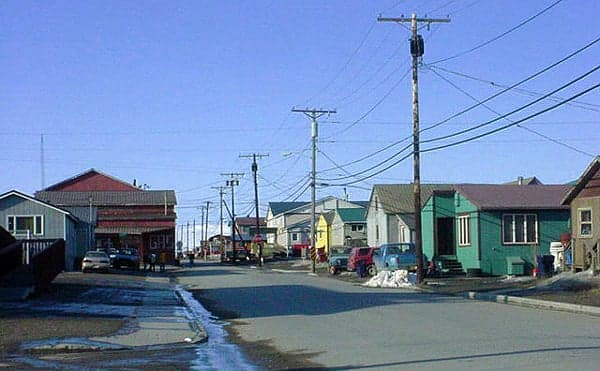
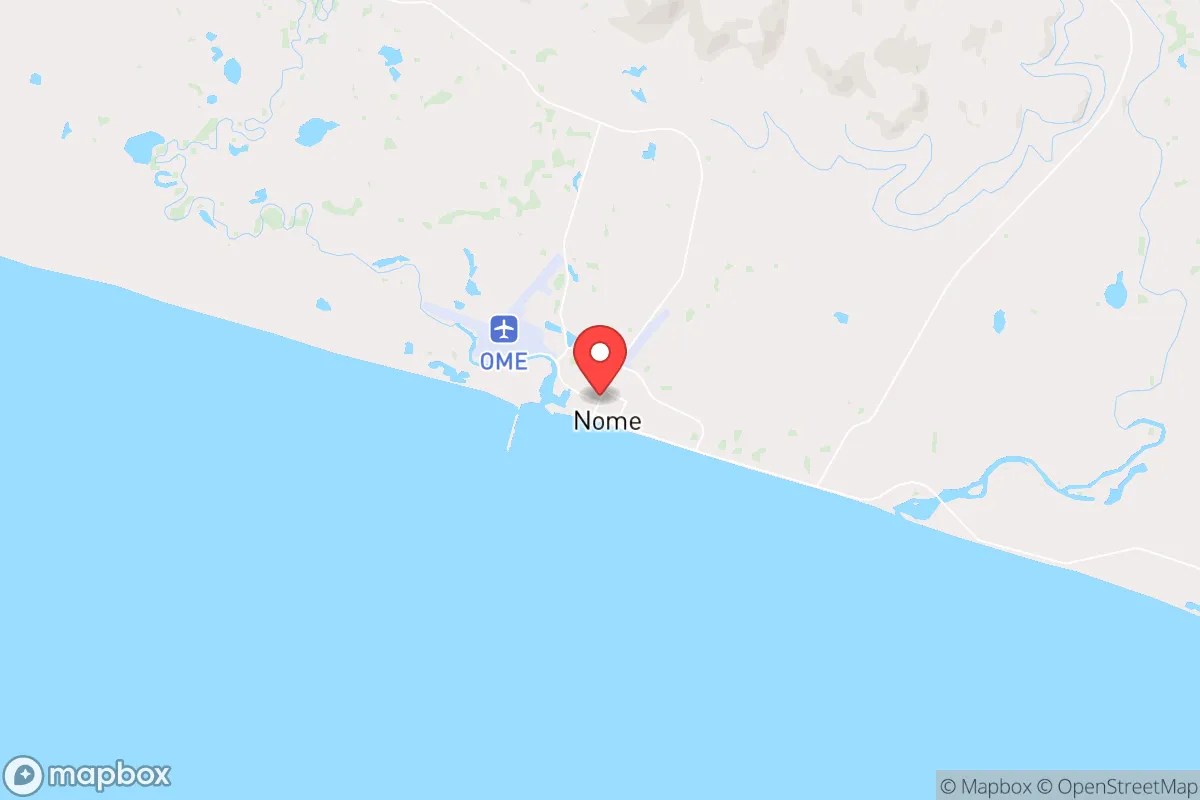
Photo: Wikipedia
Demographics of Nome, AK
Affluence Level in Nome, AK
A middle-class area roughly in line with national averages across income, home values, education, and employment.
People of Nome, AK
The people of Nome, Alaska today number 3,668, forming one of the most ethnically distinct small cities in the United States. The population is overwhelmingly Alaska Native — roughly 70% identify as Indigenous — with a white minority of 26.3%, a small Hispanic community at 5.1%, and East/Southeast Asian residents at 3.4%. This is not a typical American melting pot; it is a predominantly Iñupiat city with a frontier character shaped by gold rushes, government intervention, and the enduring presence of Indigenous lifeways on the Bering Sea coast.
How the city was settled and grew
Nome’s human history begins with the Iñupiat people, who have occupied the Seward Peninsula for thousands of years. The modern city was founded in 1898 after the discovery of gold on Anvil Creek, triggering the Nome Gold Rush. Prospectors — overwhelmingly white American and European men — flooded in, and the population exploded to roughly 20,000 by 1900, making Nome the largest city in Alaska at the time. These newcomers settled in what became known as Front Street, the commercial strip along the beach, and in the Dexter District, a cluster of tents and frame buildings near the mouth of the Snake River. The Iñupiat, who had summer fish camps in the area, were pushed to the margins, congregating in what is now Iñupiat Village (also called the Native Village of Nome), a distinct residential area along the coast east of downtown. By the 1910s, gold production declined sharply, and most white prospectors left. The population dropped to around 1,000 by the 1920s, and Nome became a regional supply and government center. The U.S. Army built Fort Davis (now a neighborhood on the east side) during World War II, bringing a temporary influx of military personnel and some Black soldiers, though few stayed permanently. The post-war era saw the construction of the Nome Airport and the Bering Strait School District headquarters, which stabilized the economy around government services and subsistence.
Modern era (post-1965)
The 1971 Alaska Native Claims Settlement Act (ANCSA) was the defining event for modern Nome. It created the Kawerak, Inc. regional corporation and the Nome Eskimo Community tribal government, which now own significant land and provide housing, health care, and jobs. This institutional framework anchored the Iñupiat population, reversing decades of out-migration. Since the 1970s, Nome’s white population has declined from roughly 40% to 26.3% today, while the Alaska Native share has held steady or grown slightly. The Hispanic community (5.1%) is a small but visible presence, largely working in construction, seafood processing, and seasonal tourism, concentrated in the Anvil City Square area and along East 5th Avenue. East/Southeast Asian residents (3.4%) are mostly Filipino and Korean families connected to the fishing industry and healthcare, living in the Bering Sea Village subdivision near the hospital. The Black population (2.8%) is small and dispersed, with no single neighborhood concentration. The Indian subcontinent community (0.4%) is negligible, typically transient professionals at the hospital or university. The foreign-born share is just 1.4%, one of the lowest in Alaska, reflecting Nome’s isolation and the dominance of Indigenous land ownership. College attainment is 24.4%, below the national average, but the local economy is driven by government (city, state, tribal, and school district jobs), healthcare (Norton Sound Regional Hospital), and seasonal gold mining (still active on the Seward Peninsula).
The future
Nome’s population is slowly aging and slightly shrinking — the 2020 census showed a decline from 3,598 in 2010 to 3,668 in 2020, a modest gain that masks a net out-migration of young adults. The Iñupiat population is stable but faces housing shortages and high cost of living, which push some families to Anchorage or the Lower 48. The white population is likely to continue a slow decline as government and mining jobs become more specialized and less attractive to outsiders. The Hispanic and East/Southeast Asian communities are small but growing, driven by healthcare recruitment and seasonal labor, though Nome’s remote location limits large-scale immigration. The city is not tribalizing into distinct ethnic enclaves — neighborhoods like Iñupiat Village, Front Street, and Fort Davis remain mixed, with Alaska Natives the majority everywhere. The next 10-20 years will likely see Nome remain a predominantly Iñupiat city with a small, stable non-Native minority, shaped by climate change (coastal erosion threatens Front Street), resource development (the proposed Ambler Road mining corridor), and the resilience of Indigenous governance.
For someone moving to Nome now, the city offers a tight-knit, culturally rich community where Alaska Native traditions are central to daily life. It is not a place of rapid demographic change or ethnic diversity in the Lower 48 sense — it is a small, remote Indigenous hub where outsiders are welcomed but remain a distinct minority. The bottom line: Nome is becoming more institutionally Iñupiat, not less, and newcomers should expect to live in a community where subsistence hunting, tribal politics, and the Bering Sea define the rhythm of life.

* Values derived from national, state, county, city and local statistics and may differ in a specific area. Last updated: 2026-04-19T19:33:03.000Z
Narrative content on this page is AI-generated and may contain mistakes. Verify any details that matter before acting on them.
ReloMaps may earn a commission from affiliate links at no extra cost to you.

