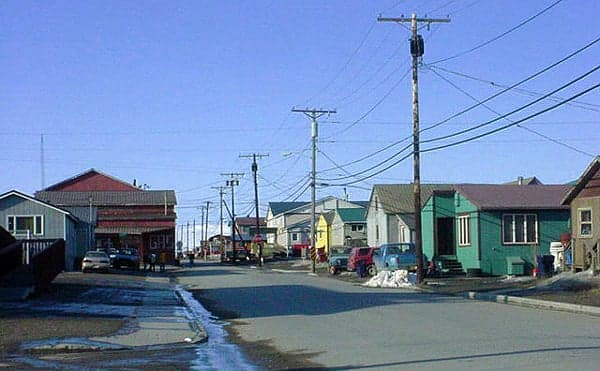
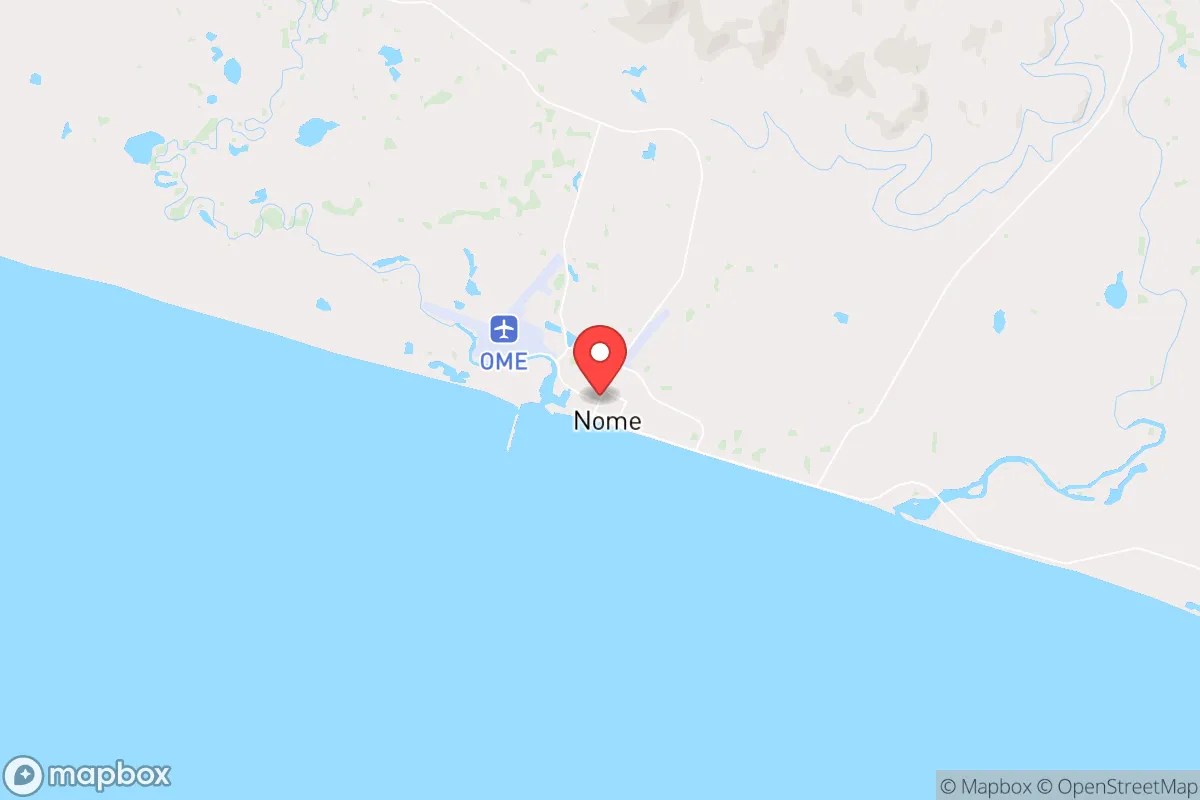
Photo: Wikipedia
Political ClimatePolitical Climate in Nome, AK
District shown is the primary district for this city’s centroid. Cities may span multiple districts.
Inherited from parent state — no local data available.
Local Political AnalysisPolitical Analysis of Nome, AK
Nome, Alaska, has long been a place where folks value their independence and self-reliance, and that’s reflected in its political leanings. The area carries a Cook PVI of R+6, meaning it’s reliably Republican, but it’s not a straight-party lock—there’s a strong independent streak here that’s more about common sense than party loyalty. Over the last decade, though, you’ve seen a slow creep of outside influence, especially from Anchorage and the Lower 48, that’s nudging things toward a more progressive tilt, which has a lot of long-time residents worried about losing the freedoms that make living here worth it.
How it compares
Nome sits in a bit of a political bubble compared to the rest of the state. While Anchorage and Juneau have swung left in recent years—especially on issues like resource extraction and land use—Nome’s voters have held the line. Surrounding villages like Teller and Shishmaref tend to vote more Democratic, largely due to tribal governance and federal subsidies, but Nome itself is a bastion of conservative values. The contrast is stark: in 2024, the Nome precinct voted about 60% Republican, while nearby Kotzebue, just a short flight away, flipped blue. That’s not a coincidence—Nome’s economy is tied to mining, fishing, and small business, not government handouts, and that keeps folks skeptical of big government solutions.
What this means for residents
For the average Nome resident, the political climate means a lighter touch from the state and federal government—at least for now. You don’t see the same level of overreach you’d get in a place like Bethel, where tribal councils and federal mandates can dictate land use and hunting rights. Here, the local assembly fights hard to keep regulations minimal, especially on subsistence activities like salmon fishing and caribou hunting. But there’s a growing concern: as more progressive money flows into Alaska from Outside, you’re seeing proposals for stricter environmental rules and higher taxes on mining operations. If that trend continues, it could choke off the very industries that keep Nome alive. Right now, property taxes are low, and there’s no state income tax, but the pressure is building to change that.
Cultural and policy distinctions
One thing that sets Nome apart is its fierce protection of individual rights, especially around firearms and self-defense. You won’t find the same gun control debates here that you see in Anchorage or Fairbanks—most folks own rifles for hunting and protection against bears, and there’s zero appetite for red flag laws or magazine bans. The local school board has also pushed back against state mandates on curriculum, keeping a focus on practical skills like wilderness survival and vocational training over ideological indoctrination. That said, there’s a quiet battle brewing over land use: the federal government owns about 60% of the land around Nome, and every new proposal for a national monument or conservation area feels like a direct threat to the way of life here. If you’re looking for a place where your voice still matters and government stays out of your business, Nome is one of the last holdouts in Alaska. But you’ve got to keep an eye on the ballot box—because the folks pushing for change are organized, and they’re not going away.

State Political ClimatePolitical Climate in Alaska
State Political AnalysisPolitical Environment in the State
Alaska has long been a unique political outlier — a state where libertarian-leaning individualism, resource extraction, and a deep distrust of federal overreach create a conservative environment that looks different from the Lower 48. The state has voted Republican in every presidential election since 1964, except for 1964 (Goldwater lost nationally but won Alaska) and 1992 (Ross Perot’s best state). But the real story is the trajectory: over the past 10-20 years, Alaska has shifted from a moderate, pragmatic Republicanism toward a more populist, freedom-focused conservatism, driven by a growing rural-urban split and an influx of remote workers and military families. The 2022 gubernatorial race, where conservative Republican Mike Dunleavy won re-election with 50.3% of the vote, and the 2024 presidential results (Trump won Alaska by 13 points, down from 10 in 2020 but still solid) show a state that remains reliably red but is increasingly polarized between Anchorage’s suburbs and the rest of the state.
Urban vs. rural divide
The political map of Alaska is stark. Anchorage, home to 40% of the state’s population, is the swing region — its more liberal-leaning districts in Midtown and Spenard are balanced by conservative strongholds in Eagle River and Chugiak. In 2022, Anchorage’s mayoral race saw a moderate Republican defeat a progressive Democrat, but the city council has a left-leaning majority that has pushed zoning changes and homeless service expansions that frustrate conservatives. Fairbanks is a conservative anchor, with the surrounding North Star Borough voting +18 R in 2024, driven by military families from Fort Wainwright and Eielson Air Force Base. Juneau, the capital, is the state’s most liberal city — it voted 62% for Biden in 2020 and has a strong government-worker and environmental-activist base. The real conservative heartland is the Mat-Su Borough (Wasilla, Palmer), which voted +35 R in 2024 and is the fastest-growing region in the state, attracting families fleeing Anchorage’s rising crime and taxes. The Kenai Peninsula (Soldotna, Homer) is reliably red, though Homer has a small but vocal progressive enclave. Rural Alaska — the Bush — is complex: many Alaska Native villages vote Democratic due to tribal ties and federal funding, but they are culturally conservative on issues like subsistence hunting and family structure, creating a tension that often breaks Republican in state races.
Policy environment
Alaska’s policy environment is a mixed bag for conservatives. On the plus side: no state income tax and no statewide sales tax, funded by the Permanent Fund oil revenue. Property taxes are low, and the state has a constitutional spending cap (though it’s been routinely overridden). The regulatory posture is generally business-friendly, especially for oil, gas, mining, and fishing — the state actively fights federal land-use restrictions. Education policy is a flashpoint: Alaska has a school choice program (the Correspondence School program) that allows parents to use public funds for homeschooling and private school tuition, but it’s under constant attack from the teachers’ union. The state’s election laws are relatively secure — voter ID is required, and Alaska uses a top-four primary system (passed by ballot initiative in 2020) that conservatives dislike because it can allow moderate Republicans to win over conservative ones. Healthcare is a concern: Alaska has the highest per-capita healthcare costs in the nation, and the state expanded Medicaid under the ACA in 2015, which conservatives view as a federal overreach that strains the budget. The state’s gun laws are among the most permissive in the country — no permit required for concealed carry, no magazine bans, and strong preemption laws that prevent local governments from passing their own restrictions.
Trajectory & freedom
Alaska is becoming more free in some areas, less free in others. On the positive side: the 2022 passage of Senate Bill 89 expanded parental rights in education, requiring schools to notify parents of curriculum changes and allowing them to opt their children out of sex education. The state also passed House Bill 69 in 2023, which prohibits the state from enforcing any federal gun control measures that violate the Second Amendment — a direct challenge to federal overreach. In 2024, the legislature passed a medical freedom bill that prohibits employers and schools from mandating COVID-19 vaccines, a response to the federal mandates of 2021. However, there are concerning trends: the Anchorage Assembly has repeatedly tried to pass sanctuary city policies (blocked by state preemption laws), and the state’s Board of Education adopted controversial social studies standards in 2023 that critics say downplay Alaska Native history. The biggest threat to freedom is the Permanent Fund dividend (PFD) — the annual check every resident receives. In 2023, the legislature cut the PFD by 50% to fund government programs, a move that conservatives see as a betrayal of the state’s compact with its citizens. Property rights are generally strong, but the state’s coastal management program has been used to restrict private development in some areas.
Civil unrest & political movements
Alaska has seen relatively little civil unrest compared to the Lower 48, but there are flashpoints. The 2020 Black Lives Matter protests in Anchorage were large (several thousand people) and led to the removal of a statue of a Russian explorer, but they did not escalate into riots. The Alaska Independence Party, a secessionist group that advocates for Alaska to become a sovereign nation, remains active but fringe — it got 3% of the vote in the 2022 gubernatorial race. The Bristol Bay salmon fishery has been a site of conflict between commercial fishermen and environmental activists, with the latter pushing for a permanent ban on the Pebble Mine. Immigration politics are muted — Alaska has a small foreign-born population (8%), but the state has a sanctuary policy for victims of human trafficking that conservatives view as a loophole. Election integrity is a hot topic: the 2020 election saw no major fraud allegations, but the 2022 top-four primary system was criticized by conservatives for allowing a Democrat to win a state Senate seat in a Republican-leaning district. The Alaska Republican Party has been fractured between the establishment wing (Senator Lisa Murkowski) and the populist wing (Governor Dunleavy), with Murkowski’s 2022 re-election campaign drawing national attention after she won with support from Democrats and independents.
Projection
Over the next 5-10 years, Alaska is likely to become more conservative but also more internally divided. The Mat-Su Borough will continue to grow, pulling the state’s center of gravity further right. Anchorage will become more polarized, with liberal voters consolidating in the city core and conservatives moving to the suburbs or leaving the state entirely. The oil industry will remain the economic driver, but as production declines (down 60% from its peak in 1988), the state will face pressure to raise taxes or cut the PFD — both of which will fuel populist anger. The influx of remote workers from California and Washington, drawn by Alaska’s lack of income tax and outdoor lifestyle, will likely be moderate and politically mixed — some will bring progressive values, but many will be libertarian-leaning. The biggest wild card is the federal government: if the Biden administration or a future Democratic administration imposes more restrictions on oil drilling, mining, or logging, Alaska’s economy will suffer, and the state’s anti-federal sentiment will intensify. The 2026 gubernatorial race will be a key test — if a populist conservative wins, expect more preemption laws and a harder line on federal overreach. If a moderate wins, expect more compromise on the PFD and education funding.
For a conservative moving to Alaska, the bottom line is this: you’ll find a state that largely shares your values on taxes, guns, and personal freedom, but you’ll need to be strategic about where you live. Wasilla, Palmer, Eagle River, and Fairbanks are safe bets for a like-minded community. Anchorage is a mixed bag — great jobs and amenities, but a city government that leans left. Juneau is best avoided if you want to escape progressive politics. The key is to get involved early — the state’s small population means that a few hundred motivated conservatives can swing a local election or a school board race. And keep an eye on the PFD: it’s not just a check, it’s a symbol of the state’s compact with its citizens, and any politician who messes with it is a threat to your freedom.
* Values derived from national, state, county, city and local statistics and may differ in a specific area. Last updated: 2026-04-19T19:33:03.000Z
Narrative content on this page is AI-generated and may contain mistakes. Verify any details that matter before acting on them.
ReloMaps may earn a commission from affiliate links at no extra cost to you.

