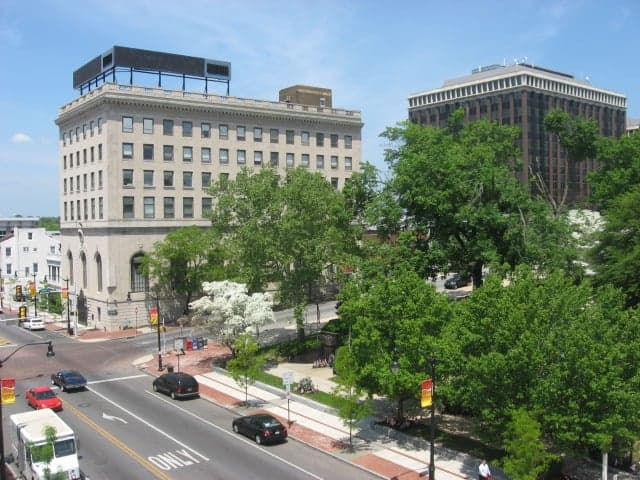
Photo: Wikipedia
Demographics of Norristown, PA
Affluence Level in Norristown, PA
A below-average socioeconomic profile. Incomes, home values, and educational attainment trail the U.S., with higher poverty and unemployment.
People of Norristown, PA
The people of Norristown, Pennsylvania today form a dense, majority-minority urban community of 35,782 residents, characterized by a near-even split between Hispanic (32.9%) and Black (32.2%) populations, with a White non-Hispanic share of 26.3%. The city is one of the most ethnically diverse in Montgomery County, with a foreign-born population of 11.9% and a distinctive identity as a working-class hub that has absorbed successive waves of immigrants and domestic migrants while retaining a compact, walkable urban core. Its population density—over 8,000 people per square mile—creates a palpable city feel that sets it apart from the surrounding suburban townships.
How the city was settled and grew
Norristown was founded in 1784 on land granted to the Norris family, who operated a ferry and grist mill on the Schuylkill River. The original population was overwhelmingly English, Welsh, and German—farmers and millers who built the early stone houses that still line Hancock Street and Powell Street in the historic core. The arrival of the Philadelphia and Reading Railroad in the 1830s transformed Norristown into a manufacturing and transportation center, drawing Irish immigrants who settled in the West End neighborhood around the rail yards. By the 1880s, Italian immigrants followed, establishing a tight-knit community in the East End along Main Street, where their descendants remained through the mid-20th century. The city’s industrial base—steel fabrication, textiles, and brewing—peaked around 1950, when Norristown’s population hit 38,000, and the workforce was overwhelmingly White, with small but established Black and Italian enclaves.
Modern era (post-1965)
The 1965 Hart-Cellar Act and the subsequent collapse of manufacturing triggered Norristown’s most dramatic demographic transformation. White flight accelerated through the 1970s and 1980s as middle-class families moved to East Norriton and West Norriton townships, leaving behind aging housing stock and a shrinking tax base. Black families, many from Philadelphia and the rural South, moved into the North End and Hawk Hill neighborhoods, drawn by affordable row homes and proximity to the regional rail line. Simultaneously, Puerto Rican migrants began arriving in the 1970s, settling in the West Marshall Street corridor, followed by Dominican and Mexican immigrants in the 1990s and 2000s. Today, the Hispanic population (32.9%) is concentrated west of Markley Street, while the Black population (32.2%) is more evenly distributed but heavily present in the North End and along the eastern edge of the city. The Asian population remains small—East/Southeast Asian communities (1.2%) are clustered near the Jeffersonville border, while Indian-subcontinent residents (0.7%) are scattered without a distinct enclave. The college-educated share (23.7%) is below the county average, reflecting a workforce still anchored in healthcare, retail, and logistics rather than professional services.
The future
Norristown’s population is stabilizing after decades of decline—the 2020 census count of 35,782 is virtually unchanged from 2010—but the composition continues to shift. The Hispanic share is growing steadily, driven by both immigration and higher birth rates, while the White non-Hispanic share is still slowly eroding. The Black population has plateaued, with some out-migration to more affordable suburbs like Pottstown and Coatesville. The city is not homogenizing; rather, it is tribalizing into distinct ethnic corridors: the West End is now predominantly Hispanic, the North End remains majority Black, and the East End is a mixed-race zone of White and Black renters. Gentrification pressure is minimal—Norristown lacks the historic architecture or riverfront cachet of nearby Conshohocken—but the county government’s presence (Montgomery County courthouse and offices) provides a stable employment base. Over the next 10-20 years, the city will likely become majority Hispanic, with a smaller but stable Black minority and a shrinking White population, while the foreign-born share may rise to 15-18% as Central American and West African immigrants arrive.
For someone moving in now, Norristown offers a genuinely diverse, urban environment at a fraction of Philadelphia’s cost, but with the trade-offs of higher crime rates, underfunded schools, and limited retail amenities. It is a city in transition—still gritty, still affordable, and still absorbing newcomers—rather than a place of settled affluence or rapid revitalization.

* Values derived from national, state, county, city and local statistics and may differ in a specific area. Last updated: 2026-05-01T06:28:07.000Z
Narrative content on this page is AI-generated and may contain mistakes. Verify any details that matter before acting on them.
ReloMaps may earn a commission from affiliate links at no extra cost to you.

