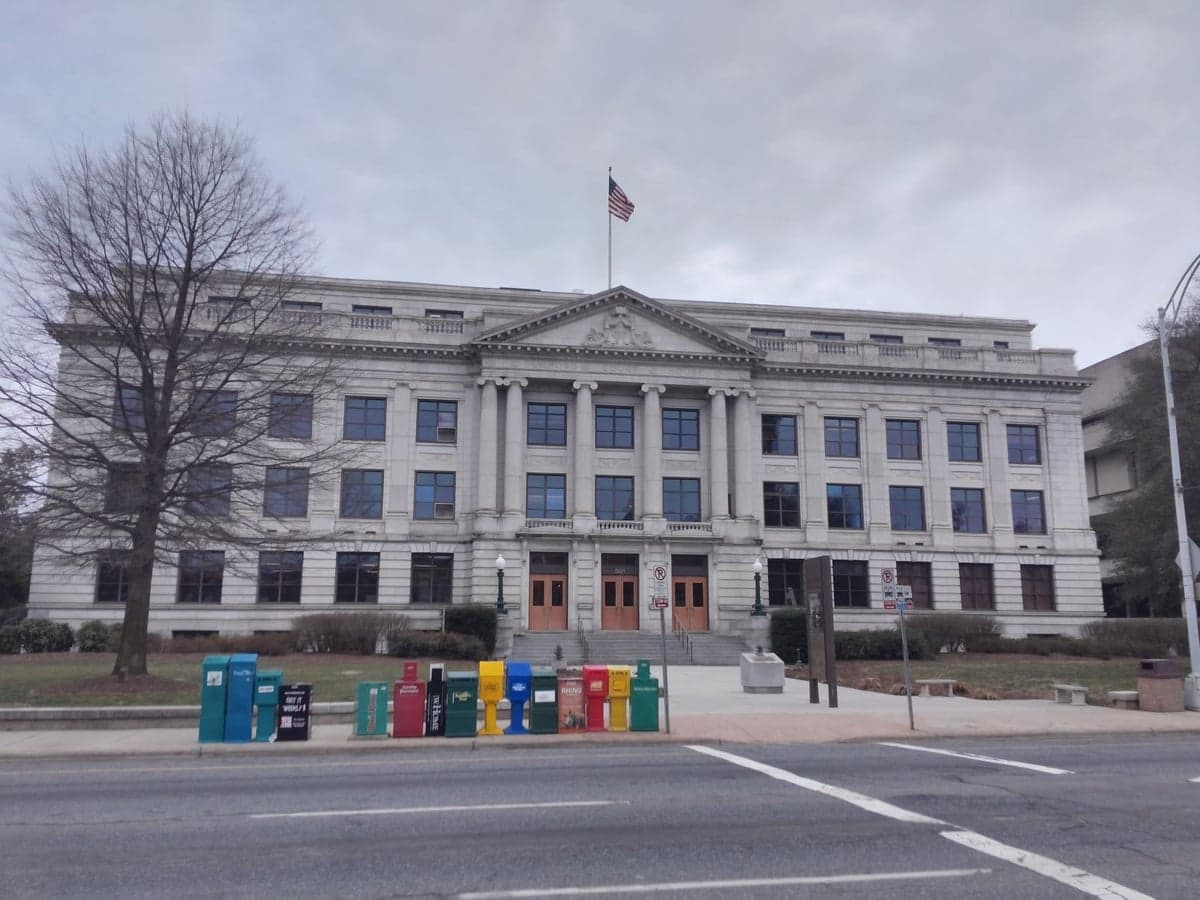
Photo: Wikipedia
Demographics of Guilford County
Affluence Level in Guilford County
A middle-class area roughly in line with national averages across income, home values, education, and employment.
People of Guilford County
Guilford County, North Carolina, is home to 542,987 residents, a population shaped by centuries of migration, industry, and strategic location. The county’s character is defined by a nearly even split between White (46.8%) and Black (33.5%) residents, a growing Hispanic community (9.8%), and smaller but notable East/Southeast Asian (3.2%) and Indian subcontinent (2.0%) populations. This diversity, concentrated in the urban core of Greensboro and spreading into suburbs like High Point, Jamestown, and Summerfield, reflects a history of successive waves arriving for land, manufacturing jobs, and educational opportunity.
Settlement & growth (pre-1960)
Before European settlement, the land now called Guilford County was home to the Saura and Keyauwee peoples, Siouan-speaking tribes who lived in small villages along the Haw and Deep Rivers. By the mid-1700s, these groups had been largely displaced by disease and conflict, opening the region to European colonists. The first major wave of settlers were Scots-Irish and German immigrants, who arrived from Pennsylvania and Virginia via the Great Wagon Road in the 1740s and 1750s. They were drawn by cheap, fertile land in the Piedmont and a desire to escape crowded coastal settlements. These early settlers founded the communities of Greensboro (originally called Martinsville), High Point, and Jamestown, establishing a pattern of small-scale farming and Presbyterian and Quaker meeting houses that still marks the county’s rural towns.
After the American Revolution, the county’s population grew slowly but steadily. The 1808 establishment of Greensboro as the county seat spurred development, and by the 1830s, the North Carolina Railroad’s route through the county turned Greensboro and High Point into transportation hubs. The Civil War and Reconstruction brought a dramatic demographic shift: the emancipation of enslaved people, who had made up roughly one-third of the county’s pre-war population, created a large free Black community. Many former slaves remained in the county, settling in neighborhoods like Greensboro’s East Side and High Point’s Washington Street area, where they built churches, schools, and businesses. The late 19th century saw the rise of the textile and furniture industries, which pulled in rural White and Black workers from across the Carolinas. By 1900, Guilford County had become a manufacturing center, with mills and factories in Greensboro, High Point, and Gibsonville attracting a steady stream of domestic migrants.
The Great Migration (1910–1970) brought tens of thousands of Black families from the Deep South to Guilford County, seeking higher wages and escape from Jim Crow. They settled primarily in Greensboro’s southern and eastern neighborhoods, such as Southside and Ole Asheboro, and in High Point’s West End. Meanwhile, the post-World War II boom accelerated suburbanization. The 1950s and 1960s saw the construction of interstate highways I-40 and I-85, which made commuting from outlying areas feasible. White families began moving to new subdivisions in Summerfield, Oak Ridge, and Stokesdale, while Black families were often restricted by redlining to older urban neighborhoods. By 1960, the county’s population had reached 246,000, with a White majority of about 70% and a Black minority of 29%.
Modern era (post-1965)
The 1965 Hart-Cellar Act fundamentally reshaped Guilford County’s demographics, though the effects were slower here than in coastal cities. The first post-1965 immigrants were small numbers of East/Southeast Asian professionals—primarily Chinese and Vietnamese—who arrived in the 1970s and 1980s, drawn by jobs in Greensboro’s growing healthcare and education sectors. They settled in Greensboro’s northwest neighborhoods and near the University of North Carolina at Greensboro campus. A larger wave of Hispanic immigrants, mostly from Mexico and Central America, began arriving in the 1990s, recruited by the county’s furniture, textile, and food-processing industries. They concentrated in High Point’s southwest side and Greensboro’s eastern corridor, forming the foundation of a community that now makes up 9.8% of the county’s population.
Domestic migration also accelerated after 1965. The decline of the Rust Belt in the 1970s and 1980s sent former manufacturing workers from Ohio, Pennsylvania, and New York to Guilford County, attracted by lower housing costs and a milder climate. This “reverse migration” was predominantly White and middle-class, settling in suburban towns like Summerfield and Oak Ridge. At the same time, the county’s Black population continued to grow through natural increase and continued migration from the South, reaching 33.5% by 2025. The Indian subcontinent community, now 2.0% of the population, began forming in the 1990s and 2000s, driven by tech and medical jobs. They are concentrated in Greensboro’s northwest suburbs and near the Piedmont Triad International Airport. The East/Southeast Asian population (3.2%) includes a notable Vietnamese enclave in High Point, centered around the St. Francis of Assisi Catholic Church, and a smaller Chinese community in Greensboro.
Suburbanization has been the dominant trend since 1965. The county’s population has more than doubled, but growth has been uneven: Greensboro and High Point have seen modest increases, while towns like Summerfield (population 12,000) and Oak Ridge (7,000) have grown rapidly as bedroom communities. The foreign-born share remains low at 5.9%, reflecting the county’s relatively limited draw for international immigrants compared to coastal metros. However, the Hispanic and Asian populations are growing faster than the White and Black populations, driven by both immigration and higher birth rates.
The future
Guilford County is likely to become more diverse but not dramatically so over the next 10–20 years. The Hispanic share is projected to rise to 12–14% by 2040, driven by continued immigration and natural increase, while the East/Southeast Asian and Indian subcontinent populations will grow more slowly, reaching 4–5% combined. The White population will continue to decline as a share, falling below 45%, while the Black population will remain stable or grow slightly. The county is not tribalizing into distinct enclaves—most neighborhoods are moderately integrated—but there are clear patterns: Hispanic families cluster in High Point’s southwest and Greensboro’s east, Indian families in northwest Greensboro, and White families in the northern suburbs. In-migration from the Northeast and Midwest is likely to continue, attracted by the county’s relatively low cost of living and growing logistics and healthcare sectors, but this flow is not large enough to fundamentally alter the county’s cultural identity. The county’s political character, historically moderate with a conservative tilt in rural areas, is likely to remain stable, as the growing Hispanic and Asian populations tend to vote Democratic but at lower rates than national averages.
For someone moving in now, Guilford County offers a population that is diverse but not fragmented, with a strong sense of local identity rooted in its manufacturing and civil rights history. The county is becoming more suburban and more diverse, but the pace of change is gradual, and the dominant culture remains a blend of Southern tradition and Mid-Atlantic pragmatism. New arrivals will find a place where community ties are still strong, and where the demographic shifts of the past 50 years have created a stable, if slowly evolving, social fabric.

* Values derived from national, state, county, city and local statistics and may differ in a specific area. Last updated: 2026-05-10T02:44:29.000Z
Narrative content on this page is AI-generated and may contain mistakes. Verify any details that matter before acting on them.
ReloMaps may earn a commission from affiliate links at no extra cost to you.

