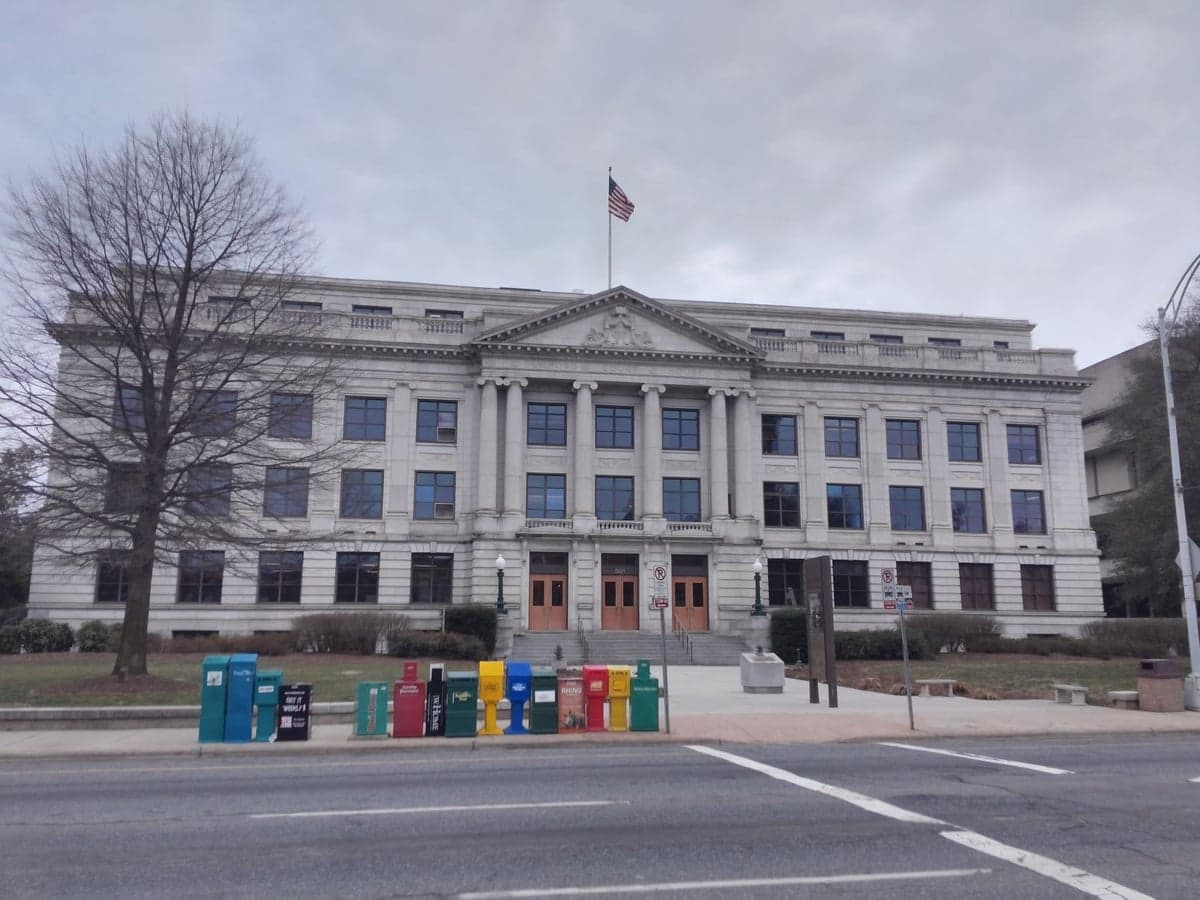
Photo: Wikipedia
Personal Sovereignty in Guilford County
Viable for self-reliance. Generally workable, though some barriers may limit total independence.
What does Personal Sovereignty tell us?
Personal Sovereignty measures your capacity for self-reliance and independence with minimal government friction. Higher scores mean fewer barriers between you and the way you want to live... but it assumes you have the space you need and good neighbors.
What does this tell us?
Personal Sovereignty measures your capacity for self-reliance and independence with minimal government friction. Higher scores mean fewer barriers between you and the way you want to live... but it assumes you have the space you need and good neighbors.
State Policy
Energy independence: Importer (15% of energy produced in-state)
Personal Liberty
Homesteading

Personal Liberty Analysis
Guilford County offers a mixed but workable environment for personal sovereignty, where North Carolina’s generally pro-liberty state laws provide a baseline of protection, but local municipal codes and county-level enforcement create meaningful variation across the area. For the conservative-leaning individual or parent prioritizing autonomy—whether in self-defense, medical choice, or self-reliant living—the county’s posture is best described as “defensible but not guaranteed.” The key is knowing which parts of Guilford County to target and which to avoid, because the difference between living under Greensboro’s city ordinances and operating in the unincorporated rural stretches near Pleasant Garden or Summerfield can be the difference between a life of quiet independence and one of constant regulatory friction.
Tax burden and regulatory posture: What keeps Guilford County competitive for liberty-minded residents
North Carolina’s state-level framework is a net positive for personal sovereignty. The state’s flat income tax rate of 4.5% (as of 2025, trending toward 3.99% by 2027) and a sales tax cap of 7.5% in Guilford County (6.75% state plus 0.75% local) keep the overall tax burden lower than most Northeastern or West Coast jurisdictions. Property taxes in Guilford County average around 0.72% of assessed value, which is moderate for the Piedmont Triad region. However, the regulatory posture varies sharply by jurisdiction. Greensboro and High Point both enforce zoning codes that restrict home-based businesses, limit accessory dwelling units, and impose setback requirements that make off-grid infrastructure like rainwater collection or solar panel arrays more difficult to permit. In contrast, unincorporated areas of the county—particularly around Oak Ridge and Stokesdale—operate under looser county-level zoning that allows for greater flexibility. The county’s planning board has historically been more permissive than city councils, meaning that a 10-acre parcel in rural Guilford County is far more sovereign-friendly than a similar lot inside the Greensboro city limits. For the prepper or homesteader, the regulatory takeaway is clear: avoid the urban cores and target the county’s rural fringe where code enforcement is minimal and neighborly tolerance for “unconventional” property use is higher.
Self-defense and gun law specifics: Where you can and cannot carry in Guilford County
North Carolina is a shall-issue state for concealed carry permits, and Guilford County’s sheriff’s office processes permits without the deliberate delays seen in some urban counties. The state also maintains preemption on most firearm regulations, meaning Greensboro and High Point cannot enact their own bans on concealed carry or magazine capacity—a critical protection for gun owners. However, local nuance matters. The city of Greensboro has a history of aggressive enforcement of “gun-free zone” signage at parks and government buildings, and the police department has been known to stop and question open carriers more frequently than in surrounding rural counties. High Point is slightly more permissive, but still has a higher-than-average number of posted no-gun businesses. For the most gun-friendly environment, head to Summerfield or Pleasant Garden, where local law enforcement is more aligned with rural gun culture and fewer businesses post restrictions. Stand-your-ground laws apply statewide, and castle doctrine protections are strong. The practical reality for a sovereignty-minded resident is that you can legally defend your home and person in Guilford County, but you must be strategic about where you carry and how you interact with local police in the more urbanized areas. The sheriff’s office in the county’s rural precincts is generally pro-2A; the Greensboro PD is not hostile, but is more procedurally cautious.
Self-reliance and homesteading viability: Lot sizes, zoning, and off-grid feasibility across the county
Homesteading viability in Guilford County is a tale of two landscapes. Inside the Greensboro city limits, minimum lot sizes are typically 6,000 to 10,000 square feet, and zoning prohibits keeping livestock (chickens are allowed in some zones with a permit, but goats, pigs, and larger animals are banned). Rainwater collection is legal but must be for non-potable uses only, and solar panel installations require building permits and electrical inspections that can take weeks. In contrast, the unincorporated areas of the county—especially around Stokesdale and Oak Ridge—allow for 2-acre minimum lot sizes in agricultural zoning, with no restrictions on livestock, beekeeping, or small-scale farming. Off-grid feasibility is highest in these areas: well water is common, septic systems are permitted, and the county does not require connection to municipal water or sewer if you can prove self-sufficiency. Solar arrays with battery storage are legal and encouraged by state tax credits, though the county requires a licensed electrician for grid-tied systems. For the serious prepper, Pleasant Garden offers the best balance of proximity to Greensboro’s hospitals and supply chains with the ability to run a fully self-reliant homestead. The key limitation across all of Guilford County is that the county fire marshal has authority to inspect and require fire suppression systems on properties over a certain size, which can add cost to off-grid builds. Still, compared to the regulatory nightmare of counties in the Pacific Northwest or Northeast, Guilford County is a relative haven for self-reliance.
Personal liberties: Parental rights, medical autonomy, speech, and property protections
North Carolina’s state-level protections for parental rights are strong. The Parents’ Bill of Rights (enacted in 2023) gives parents explicit authority over their children’s education, medical decisions, and records. Guilford County Schools, while large and urban, has not been a hotspot for the kind of curriculum battles seen in Wake County or Mecklenburg County. Homeschooling is straightforward: file a notice of intent with the state, maintain attendance records, and administer a standardized test annually. No local ordinances in Guilford County restrict homeschooling or require additional oversight. Medical autonomy is more contested. North Carolina has not expanded Medicaid under the traditional ACA framework, which keeps the state’s healthcare system more market-driven, but Guilford County’s hospital system (Cone Health) is a large, corporate entity that follows standard CDC and FDA guidelines. For those seeking medical freedom—vaccine exemptions, alternative treatments, or religious exemptions—the county’s providers are generally compliant with state law but not proactively supportive. The best bet is to establish care with a private practice in Summerfield or Oak Ridge, where rural doctors are more likely to respect patient autonomy. Property rights are well-protected under North Carolina’s eminent domain laws, which require a public purpose and just compensation. The county has not engaged in aggressive condemnation for private development, unlike some urban counties in the Northeast. Free speech is protected under the First Amendment, and Guilford County has no local ordinances that restrict political speech or assembly beyond standard time-place-manner regulations. The county’s public comment periods at board meetings are open and generally respectful, though the urban commissioners in Greensboro tend to be more progressive than their rural counterparts.
Overall, Guilford County offers a solid but not exceptional level of personal sovereignty compared to other areas in the Southeast. It is significantly more liberty-friendly than any county in California, New York, or Illinois, but it falls short of the near-total autonomy found in deep-red rural counties like Yadkin or Surry to the west. For the conservative-leaning individual or parent who values self-defense, homesteading, and parental rights, the smart play is to locate in the county’s rural towns—Summerfield, Stokesdale, Oak Ridge, or Pleasant Garden—while avoiding the regulatory gravity of Greensboro and High Point. The state’s preemption laws and flat tax structure provide a solid foundation, but local vigilance is required to maintain that sovereignty. If you are willing to drive 20 minutes for supplies and accept that the county fire marshal might ask questions about your off-grid setup, Guilford County can be a workable base for a life of self-reliance and personal freedom.

* Values derived from national, state, county, city and local statistics and may differ in a specific area. Last updated: 2026-05-10T02:44:29.000Z
Narrative content on this page is AI-generated and may contain mistakes. Verify any details that matter before acting on them.
ReloMaps may earn a commission from affiliate links at no extra cost to you.

