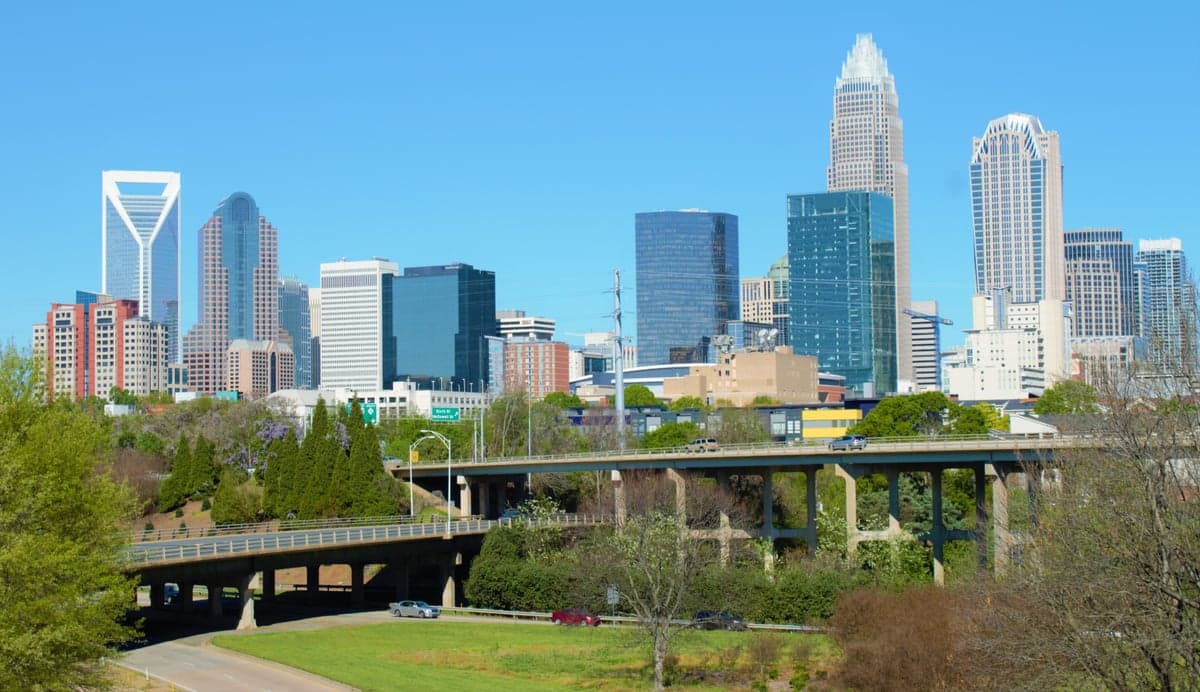
Photo: Wikipedia
Demographics of Mecklenburg County
Affluence Level in Mecklenburg County
A middle-class area roughly in line with national averages across income, home values, education, and employment.
People of Mecklenburg County
Today, Mecklenburg County is a rapidly diversifying, majority-minority urban hub where no single racial or ethnic group holds a numerical majority. With a population of over 1.1 million, the county is defined by its blend of native Southerners, a substantial Black community with deep roots, and a growing wave of Hispanic, East/Southeast Asian, and Indian-subcontinent immigrants drawn by the Charlotte metro's finance and tech economy. The county's identity is a dynamic tension between its historic role as a center of Southern commerce and its modern reality as a magnet for global talent, creating a place that feels both established and perpetually in transition.
Settlement & growth (pre-1960)
Before European contact, the land that is now Mecklenburg County was home to the Catawba Native American nation, a Siouan-speaking people who controlled much of the Piedmont region. Their primary settlements were along the Catawba River, which forms the county's western border, with villages near present-day Pineville and Fort Mill (just across the state line). The Catawba were largely displaced or confined to a reservation in South Carolina by the mid-18th century, as European settlers pushed inland.
The first major wave of European settlers arrived in the 1740s–1760s, primarily Scots-Irish and German Protestants migrating down the Great Wagon Road from Pennsylvania. These were frontier farmers seeking cheap land in the Carolina backcountry. They established the county's earliest settlements, including Charlotte (founded 1768), Huntersville, and Davidson. The Scots-Irish, in particular, shaped the county's fiercely independent political culture—Mecklenburg County was a hotbed of Revolutionary sentiment, and the 1775 Mecklenburg Declaration of Independence (though disputed) remains a point of local pride. German settlers, meanwhile, concentrated in the rural areas around Matthews and Mint Hill, where their Lutheran and Reformed churches still stand.
After the Civil War, the county's population shifted dramatically. Emancipated African Americans, who had been enslaved on cotton and tobacco plantations in the county's eastern and southern sections, formed freedmen's communities in Charlotte's Brooklyn and Biddleville neighborhoods and in rural hamlets like Paw Creek. By 1900, Black residents made up roughly 40% of the county's population. The early 20th century brought a smaller wave of European immigrants—mostly Italians and Greeks—who settled in Charlotte's growing commercial districts, working as laborers, grocers, and restaurateurs. However, Mecklenburg remained overwhelmingly native-born and biracial (Black and White) through the 1950s, with its economy anchored by textile mills, banking, and the regional cotton trade.
Modern era (post-1965)
The 1965 Hart-Cellar Act, combined with Charlotte's emergence as a national banking hub (Bank of America, Wachovia), fundamentally reshaped Mecklenburg County's demographics. The first major post-1965 wave was domestic: from the 1970s through the 1990s, a steady stream of White and Black migrants from the Rust Belt—especially New York, Ohio, and Pennsylvania—relocated to Charlotte for banking, insurance, and logistics jobs. This influx diluted the county's traditional Southern character and accelerated suburbanization, with new subdivisions spreading into Cornelius, Davidson, and Huntersville along Lake Norman.
International immigration began in earnest in the 1990s. Hispanic immigrants, primarily from Mexico and Central America, arrived to fill construction, landscaping, and service-industry jobs tied to Charlotte's building boom. They concentrated in Charlotte's east and south sides, particularly around Central Avenue and South Boulevard, forming vibrant enclaves with tiendas, taquerias, and Spanish-language churches. Today, 15.4% of the county's population is Hispanic, making it the fastest-growing demographic group.
East/Southeast Asian communities—largely Vietnamese, Chinese, and Korean—began arriving in the 1980s and 1990s, many as professionals in banking and tech or as small-business owners. They settled primarily in Charlotte's Ballantyne and SouthPark neighborhoods, as well as in Matthews, where Asian grocery stores and restaurants cluster along Independence Boulevard. The Indian-subcontinent community (from India, Pakistan, and Bangladesh) grew later, accelerating after 2000, as Charlotte's banking and consulting sectors recruited skilled workers on H-1B visas. Indian professionals concentrated in Charlotte's Arboretum and Providence Plantation areas, as well as in Fort Mill (just over the South Carolina line), drawn by top-rated schools and newer housing stock. Today, East/Southeast Asians make up 3.3% of the county's population, while Indian-subcontinent residents account for 2.8%—a nearly equal split that reflects two distinct migration streams.
The Black population, which had been a majority in Charlotte through the 1960s, declined as a share of the total due to White and Hispanic in-migration, but grew in absolute numbers. Many Black families moved from historic inner-city neighborhoods to suburbs like Mint Hill and Huntersville. The county's White population, now 43.9%, is a mix of long-standing Southern families, Northern transplants, and a smaller number of European immigrants. The foreign-born share stands at 10.2%, and 48.6% of adults hold a college degree, reflecting the knowledge-economy tilt of recent migration.
The future
Mecklenburg County is likely to continue its trajectory toward greater diversity and higher educational attainment, but with increasing geographic sorting. The Hispanic population is projected to grow steadily, driven by both immigration and higher birth rates, and is expected to become the county's largest single ethnic group within 20 years. East/Southeast Asian and Indian-subcontinent communities are also growing, though more slowly, as Charlotte competes with larger tech hubs for skilled immigrants. These groups are likely to remain concentrated in affluent south Charlotte suburbs and the Lake Norman towns, reinforcing a pattern of enclave formation rather than full assimilation.
The county's Black population is stable in absolute terms but declining as a share, as Hispanic and Asian in-migration outpaces natural increase. White flight to exurbs like Denver and Lincolnton (outside the county) may accelerate if housing costs continue to rise in Charlotte proper. The cultural identity of Mecklenburg County is becoming less distinctly Southern and more broadly American—a blend of Sun Belt pragmatism, global professional ambition, and immigrant entrepreneurship. For a conservative-leaning newcomer, this means a place where traditional values (church, family, gun rights) coexist with a rapidly changing social landscape, and where the political center of gravity is shifting leftward, especially in Charlotte's urban core.
What Mecklenburg County is becoming is a classic American melting pot with a Southern accent—a region where the old guard of native-born Whites and Blacks is being joined by a diverse, college-educated, globally connected population. For someone moving in now, the county offers economic opportunity and cultural variety, but also the reality of a place where neighborhoods are increasingly sorted by income and ethnicity, and where the pace of change can feel disorienting to those who remember a quieter, more homogeneous past.

* Values derived from national, state, county, city and local statistics and may differ in a specific area. Last updated: 2026-05-11T21:46:51.000Z
Narrative content on this page is AI-generated and may contain mistakes. Verify any details that matter before acting on them.
ReloMaps may earn a commission from affiliate links at no extra cost to you.

