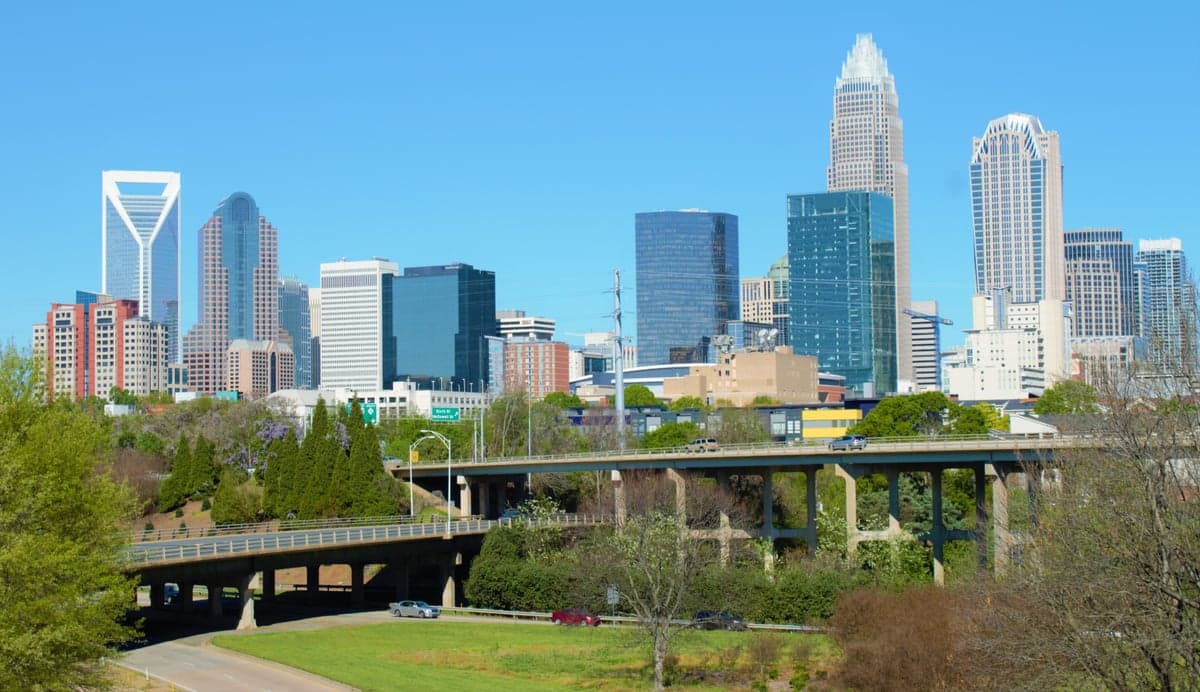
Photo: Wikipedia
Political ClimatePolitical Climate in Mecklenburg County
Showing district-level results — no local-only data available.
Local Political AnalysisPolitical Analysis of Mecklenburg County
Mecklenburg County has become one of the most reliably Democratic strongholds in the South, with a Cook Partisan Voting Index of D+24, meaning it votes about 24 points more Democratic than the national average. This is a massive shift from even 20 years ago, when the county was a genuine battleground. Today, the county’s political energy is overwhelmingly progressive, and that trajectory shows no signs of slowing down, especially as Charlotte’s urban core continues to expand and attract a younger, more transient population. For context, the rest of North Carolina sits at R+1, a true purple state that still leans slightly Republican in statewide races.
How it compares
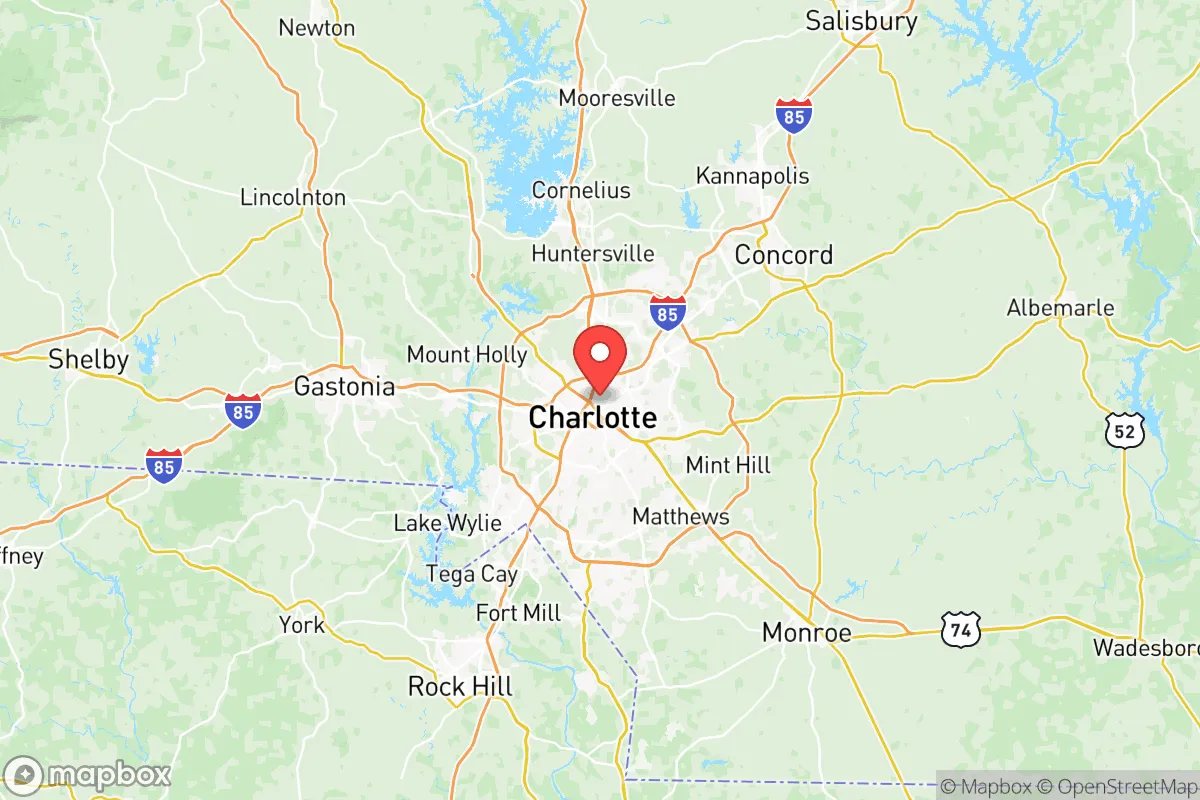
The contrast between Mecklenburg and the rest of North Carolina is stark. Drive 20 minutes outside the Charlotte city limits, and you’ll hit towns like Matthews and Cornelius, which still have pockets of conservative voters, but even those areas are trending blue. The real red holdouts are further out, in places like Mint Hill and Huntersville, where you’ll find precincts that reliably vote Republican in local races. But the county commission and most municipal governments are now dominated by Democrats, and the political culture in Charlotte proper—especially in neighborhoods like Dilworth, Plaza Midwood, and South End—is aggressively progressive. Statewide, Mecklenburg’s votes often cancel out the more conservative rural counties, making North Carolina a perpetual swing state. But within the county itself, there’s no real swing anymore; it’s a blue island in a purple-to-red state.
What this means for residents
For a conservative-leaning resident, living here means constantly feeling like your values are under siege. The local government has been pushing policies that feel like government overreach into personal freedoms—things like stricter zoning laws that limit property rights, mask mandates that lingered longer than in surrounding counties, and a general attitude that the state’s more traditional values are backward. Property taxes have climbed steadily to fund pet projects and light-rail expansions that many residents never asked for. The school board has become a battleground over curriculum and parental rights, with progressive members often dismissing concerns about critical race theory or gender ideology as “culture wars.” If you value limited government and personal liberty, you’ll find yourself on the losing end of most local elections. The county’s political machine is well-funded and coordinated, making it tough for grassroots conservative candidates to break through.
The cultural and policy distinctions are hard to miss. Charlotte’s city council has pushed for things like sanctuary city policies and defunding the police rhetoric, even if the latter didn’t fully materialize. The county health department has been aggressive with mandates, and there’s a palpable sense that the government knows what’s best for you. Meanwhile, the surrounding counties—like Union and Cabarrus—offer a more traditional, less intrusive approach to governance. If you’re a conservative considering a move to the area, you’ll want to look closely at the towns on the county’s fringe, like Weddington or Stallings, where you can still find a semblance of the old Mecklenburg. But the county as a whole is on a one-way track toward progressive dominance, and that’s unlikely to change anytime soon.

State Political ClimatePolitical Climate in North Carolina
State Political AnalysisPolitical Environment in the State
North Carolina has long been the quintessential swing state of the South, but over the last 10-20 years, it’s settled into a reliable R+1 lean that feels more like a battleground than a lock. The state’s political DNA is a tug-of-war between a rapidly growing, progressive-leaning urban crescent—stretching from Charlotte through the Triad and the Triangle to Raleigh—and a deeply conservative rural and suburban base that still holds the balance of power. The 2024 presidential race saw Donald Trump win the state by roughly 3 points, a margin that’s been shrinking from the 8-point wins of 2016 and 2020, driven by explosive growth in Mecklenburg and Wake counties. But don’t let the narrowing margins fool you: the state legislature remains firmly in GOP hands, with a supermajority that’s been able to override Democratic governors’ vetoes for years. For a conservative looking to relocate, the big picture is a state that’s still red enough to protect your freedoms, but with a blue tide rising fast in the cities.
Urban vs. rural divide
The political map of North Carolina is a story of two worlds. The urban crescent—Charlotte (Mecklenburg County), Raleigh and Durham (Wake and Durham counties), and Greensboro and Winston-Salem (Guilford and Forsyth counties)—is where the Democratic votes pile up. Mecklenburg alone delivered a 30-point margin for Biden in 2020, and Wake County was nearly as lopsided. These metros are magnets for out-of-state transplants from California, New York, and the Northeast, bringing progressive voting habits with them. Meanwhile, the rural east and west—places like Lumberton in Robeson County, Hickory in Catawba County, and Asheville’s surrounding mountain counties—vote reliably red. The real battleground is the suburbs: Union County (south of Charlotte) and Cabarrus County (north of Charlotte) are still solidly Republican, but their margins are thinning as Charlotte’s sprawl pushes out. Fayetteville, home to Fort Liberty, leans conservative on military issues but is becoming more purple with a growing minority population. If you’re looking for a place where your vote still counts, the exurbs and smaller cities are your best bet—the rural counties are holding the line, but the metros are slipping fast.
Policy environment
North Carolina’s policy environment is a mixed bag that’s been trending in the right direction for conservatives, but with some worrying cracks. The state has a flat income tax rate that was cut to 4.5% in 2024 and is scheduled to drop to 3.99% by 2027—a genuine win for taxpayers. There’s no state tax on Social Security benefits, and the standard deduction is generous. Property taxes are low by national standards, averaging around 0.75% of assessed value, though they vary wildly by county. On education, the state has a robust school choice program: the Opportunity Scholarship Program now provides vouchers of up to $7,468 per student for private school tuition, and it’s been expanded to all income levels as of 2024. That’s a huge plus for parents. Healthcare is a sore spot: the state finally expanded Medicaid under a Republican-led compromise in 2023, which many conservatives saw as a step toward big-government overreach, but it did come with work requirements and a sunset clause. Election laws are solid—voter ID is required (passed in 2018, finally implemented in 2023), and the state has fought off repeated attempts to weaken it. The regulatory environment is business-friendly, with a right-to-work law and no state-level minimum wage above the federal $7.25. Overall, the policy landscape is conservative-friendly, but the Medicaid expansion and the creeping influence of federal dollars are red flags to watch.
Trajectory & freedom
On the freedom front, North Carolina has been a mixed story over the last five years. The good news: gun rights are strong—the state has permitless carry (effective 2023), no red flag law, and a preemption law that stops local governments from passing their own gun restrictions. Parental rights got a boost with the 2023 Parents’ Bill of Rights, which requires schools to notify parents about medical or mental health services and prohibits instruction on gender identity and sexuality in K-4 classrooms. That’s a big win. Medical autonomy took a hit with the 2023 law banning abortion after 12 weeks (down from the previous 20-week limit), which conservatives generally support, but the law also included exceptions for rape and incest and a 20-week limit for fetal anomalies. Property rights are solid—the state has strong eminent domain protections and no statewide rent control. The bad news: the state’s COVID-era overreach was a wake-up call. Governor Roy Cooper’s executive orders shut down businesses and schools for months, and the legislature’s attempts to rein him in were largely symbolic. The HB 2 “bathroom bill” saga from 2016 still casts a long shadow—it was repealed in 2017, but the cultural battle over transgender issues is far from over. On taxation, the trajectory is good: the flat tax is dropping, but the state’s debt load is manageable. The biggest freedom concern is the growth of government in the cities: Charlotte and Raleigh are passing their own progressive ordinances (like paid sick leave and sanctuary policies), which the state legislature has been fighting with preemption laws. The trend is toward more local control in blue areas, which could create a patchwork of freedom levels depending on where you live.
Civil unrest & political movements
North Carolina has seen its share of political flashpoints. The 2020 protests in Charlotte and Raleigh over George Floyd’s death were large but mostly peaceful, though there were isolated incidents of property damage and looting. The “Moral Monday” movement, led by the NAACP and progressive clergy, has been a fixture since 2013, with regular protests at the state legislature over voting rights, Medicaid expansion, and education funding. On the right, the “We the People” rallies and Trump rallies in places like Fayetteville and Wilmington draw thousands. Immigration politics are a hot-button issue: the state has no sanctuary city laws, but Charlotte and Durham have declared themselves “welcoming cities,” refusing to cooperate fully with ICE. The state legislature has tried to pass a ban on sanctuary policies, but it’s been stalled by the governor’s veto. Election integrity remains a flashpoint: the 2020 election saw widespread allegations of irregularities in mail-in voting, and the state’s bipartisan election board has been a source of constant partisan bickering. The “Stop the Steal” movement had a strong presence in rural counties, and the 2024 election saw record turnout. Secession or nullification rhetoric is rare—North Carolina is too establishment for that—but there’s a growing “constitutional sheriff” movement in rural counties like Yadkin and Stokes, where sheriffs have refused to enforce certain state gun laws. The most visible flashpoint for a new resident would be the political signs—you’ll see Trump flags flying from pickup trucks in the exurbs and “In This House We Believe” signs in the cities. The divide is real and visible.
Projection
Over the next 5-10 years, North Carolina is on a trajectory to become more purple, but not necessarily blue. The demographic shift is the key driver: the state is adding about 100,000 new residents per year, mostly in the urban crescent. If those transplants continue to vote like they did in their home states (California, New York, etc.), the state could flip to D+1 or D+2 by 2032. But there’s a counter-trend: many of those transplants are moving to the exurbs—places like Holly Springs, Apex, and Waxhaw—which are still voting red, albeit by shrinking margins. The rural counties are losing population, which means their electoral weight is declining. The state legislature is likely to remain in GOP hands for the next decade due to gerrymandering, but the governor’s race in 2024 was a nail-biter (Josh Stein, a Democrat, won by 3 points), and future races will be close. On policy, expect continued fights over school choice (the voucher program will likely expand), abortion (the 12-week ban will face court challenges), and election laws (voter ID will be tested in court). The biggest wildcard is the growth of the tech and finance sectors in the Triangle and Charlotte, which are attracting a younger, more liberal workforce. If you’re moving in now, expect to see the state’s politics become more contentious, but the conservative infrastructure—the legislature, the courts, and the rural base—will hold the line for at least another decade.
For a conservative looking to relocate, North Carolina is still a solid bet, but you need to pick your county carefully. If you want to live in a place where your values are the norm, stick to the exurbs and rural areas—Union County, Cabarrus County, Johnston County, or the mountain counties west of Asheville. Avoid the urban cores of Charlotte, Raleigh, and Durham unless you’re prepared for a blue political environment. The state’s tax climate, school choice options, and gun laws are among the best in the Southeast, but the cultural and political battles are only going to intensify. Bottom line: North Carolina is still a freedom-friendly state, but it’s not the solid red it was 20 years ago. If you’re willing to fight for your values at the ballot box and in your community, it’s a great place to call home. If you’re looking for a place where you can just coast without political friction, you might want to look further west or south.
* Values derived from national, state, county, city and local statistics and may differ in a specific area. Last updated: 2026-05-11T21:46:51.000Z
Narrative content on this page is AI-generated and may contain mistakes. Verify any details that matter before acting on them.
ReloMaps may earn a commission from affiliate links at no extra cost to you.

