Photo: Wikipedia
Demographics of Norwalk, IA
Affluence Level in Norwalk, IA
A middle-class area roughly in line with national averages across income, home values, education, and employment.
People of Norwalk, IA
Norwalk, Iowa, is a predominantly white, family-oriented suburb of Des Moines with a population of 13,610 that is notably homogeneous — 94.9% white, 1.5% Hispanic, and less than 0.5% combined Black, East/Southeast Asian, and Indian subcontinent residents. The foreign-born population sits at just 0.1%, making it one of the least ethnically diverse cities in the Des Moines metro. Despite its proximity to a major city, Norwalk retains a small-town, conservative character shaped by generations of Midwestern families who value stability, schools, and low crime.
How the city was settled and grew
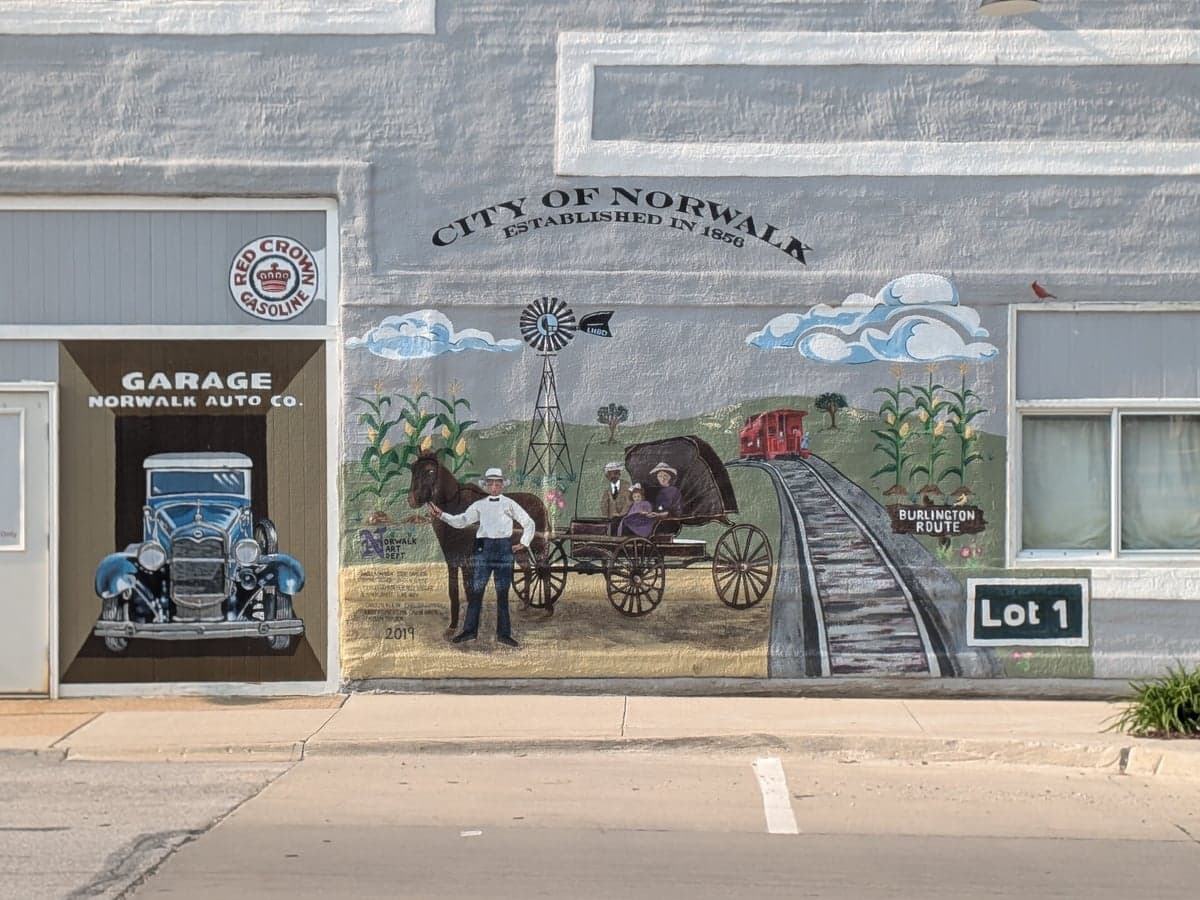
Norwalk’s human history begins with European-American settlers drawn to the fertile Des Moines River valley in the 1850s. The city was officially platted in 1856 by John and Mary Scott, who sold lots to farmers and tradesmen of primarily German, Irish, and English stock. The arrival of the Chicago, Burlington and Quincy Railroad in the 1870s turned Norwalk into a modest shipping point for grain and livestock, anchoring the original Old Town district around today’s Main Street. Early residents clustered in what is now the Historic Norwalk neighborhood, a grid of modest homes built between 1880 and 1920. The population remained under 500 until the mid-20th century, sustained by agriculture and a handful of local businesses. No significant immigrant wave arrived during this period; the city’s growth came entirely from native-born Iowans moving in from surrounding farms.
Modern era (post-1965)
Norwalk’s modern demographic story is one of suburban expansion, not immigration. After the 1965 Hart-Cellar Act reshaped U.S. immigration policy, Norwalk saw virtually no influx of foreign-born residents — the foreign-born share today is 0.1%, essentially unchanged from 1970. Instead, the city grew through domestic in-migration of white families from Des Moines and rural Warren County. The Lakewood Estates subdivision, developed in the 1970s and 1980s, absorbed many of these newcomers: young couples seeking larger lots and newer schools. The Sunset Ridge and Woodland Hills neighborhoods, built from the 1990s through the 2010s, continued this pattern, attracting families with children to Norwalk’s highly rated school district. Hispanic residents, now 1.5% of the population, are scattered across these newer subdivisions rather than concentrated in any single enclave. The Black population (0.1%) and East/Southeast Asian population (0.2%) are negligible, with no distinct ethnic neighborhood forming. Indian subcontinent residents are statistically absent at 0.0%. Norwalk’s homogeneity is not the result of exclusionary policy but of geography: it lacks the rental housing stock, public transit links, and industrial job base that typically attract immigrant communities to other Des Moines suburbs like Valley Junction or East Side.
The future
Norwalk’s population trajectory points toward continued homogenization, not diversification. The city’s master plan projects growth to roughly 18,000 by 2040, driven entirely by new single-family subdivisions on the city’s southern and western edges — areas like the planned Norwalk Crossing development. These subdivisions target the same demographic: white, married, home-buying families with school-age children. The Hispanic share may rise modestly as second-generation families move from Des Moines’ growing Latino neighborhoods, but the foreign-born population is unlikely to exceed 1% given the city’s lack of rental apartments and entry-level jobs. The East/Southeast Asian and Indian subcontinent populations will likely remain below 0.5% each, as these groups concentrate in Des Moines’ western suburbs (West Des Moines, Waukee) with more professional employment and ethnic infrastructure. Norwalk is not tribalizing into distinct enclaves — it is simply not attracting enough non-white residents to form any. The city’s college-educated share (40.2%) is above the state average, reinforcing a professional-class, culturally conservative character.
For a mover considering Norwalk, the bottom line is clear: this is a stable, overwhelmingly white suburb where demographic change is happening at a glacial pace. Families who value racial and ethnic homogeneity, strong schools, and low crime will find Norwalk a comfortable fit. Those seeking diversity — or any significant immigrant community — will need to look to Des Moines’ western suburbs or the city itself. Norwalk is becoming more populous, but not more diverse; its future is a larger version of its present.

* Values derived from national, state, county, city and local statistics and may differ in a specific area. Last updated: 2026-04-29T21:58:29.000Z
Narrative content on this page is AI-generated and may contain mistakes. Verify any details that matter before acting on them.
ReloMaps may earn a commission from affiliate links at no extra cost to you.

