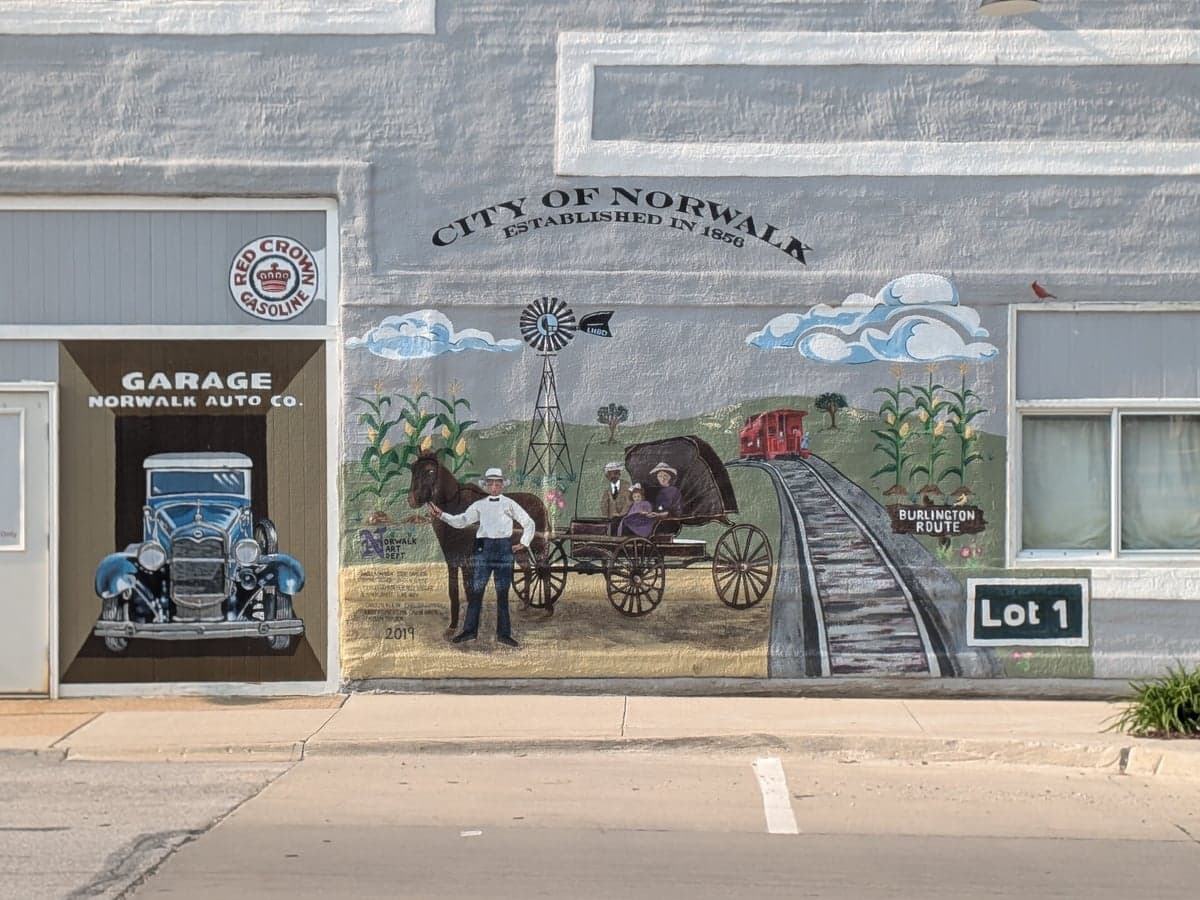
Photo: Wikipedia
Personal Sovereignty in Norwalk, IA
Viable for self-reliance. Generally workable, though some barriers may limit total independence.
What does Personal Sovereignty tell us?
Personal Sovereignty measures your capacity for self-reliance and independence with minimal government friction. Higher scores mean fewer barriers between you and the way you want to live... but it assumes you have the space you need and good neighbors.
What does this tell us?
Personal Sovereignty measures your capacity for self-reliance and independence with minimal government friction. Higher scores mean fewer barriers between you and the way you want to live... but it assumes you have the space you need and good neighbors.
State Policy
Energy independence: Importer (50% of energy produced in-state)
Personal Liberty
Homesteading

Personal Liberty Analysis
For the individual or family prioritizing maximum personal sovereignty, Norwalk, Iowa offers a notably high-autonomy environment within the broader context of a state that has consistently pushed back against federal overreach. Located in Warren County, just south of Des Moines, Norwalk provides a strategic balance: proximity to urban economic opportunity without the heavy regulatory and tax burdens typical of larger cities. The area’s legal and cultural framework strongly favors self-reliance, property rights, and the ability to live largely unbothered by government intrusion, making it a serious contender for those who view personal freedom as the primary metric for relocation.
Tax burden and regulatory posture: how Norwalk compares to surrounding areas
Iowa’s tax climate is a major draw for the sovereignty-minded. The state has been aggressively cutting income taxes, moving toward a flat 3.9% rate by 2026, with a path to a flat 3.5% by 2027. This is a direct reduction in the state’s claim on your earnings. Property taxes in Warren County are moderate, with Norwalk’s levy hovering around $35-$40 per $1,000 of assessed value, which is competitive for the metro area. Critically, Iowa is a right-to-work state, meaning you cannot be forced to join a union as a condition of employment. The regulatory environment is business-friendly, with no state-level rent control, no statewide mask or vaccine mandates currently in effect, and a general legislative posture of preempting local ordinances that would exceed state law. For a prepper or survivalist, this means fewer layers of local bureaucracy to navigate when building a shop, storing supplies, or running a home-based business. The state’s “regulatory sandbox” approach for small businesses also reduces the friction of starting a side hustle or trade operation.
Self-defense and gun law specifics: what you can and cannot do in Norwalk
Iowa is a “shall-issue” state for permits to carry, and as of 2021, it became a permitless carry state for anyone 21 or older who can legally possess a firearm. This means you can carry a concealed handgun without a permit, a license, or a training course. There is no state-level ban on standard-capacity magazines, no “assault weapon” registry, and no waiting period for firearm purchases from private sellers. Castle Doctrine and Stand Your Ground laws are fully codified in Iowa Code §704.1 and §704.2, meaning you have no duty to retreat from any place you are lawfully present, and you are legally presumed to have acted reasonably if an intruder unlawfully enters your home or vehicle. Norwalk itself has no local ordinances that restrict firearms beyond state law. For the survivalist, this legal framework means your ability to defend your home and family is not subject to the whims of a local city council. The only notable restriction: you must be 21 to carry without a permit, and private sales still require a background check if conducted through a licensed dealer, though person-to-person sales remain unregulated.
Self-reliance and homesteading viability: lot sizes, zoning, and off-grid feasibility
Norwalk’s zoning code is a mixed bag for the serious homesteader. Within the city limits, standard residential lots are typically one-quarter to one-third of an acre, which limits large-scale gardening or livestock. However, the city does allow for “urban agriculture” including chickens (hens only, no roosters) and beekeeping with a permit. For those seeking true self-reliance, the unincorporated areas of Warren County just outside Norwalk are where the real opportunity lies. There, you can find parcels of 2 to 10 acres with agricultural zoning that permits cattle, pigs, and larger gardens without the city’s restrictions. Off-grid feasibility is moderate: Iowa has no state law prohibiting rainwater collection, and solar panels are permitted without excessive red tape. However, building codes in the county require a septic system and well for any habitable structure, and you cannot legally live in a shipping container or RV as a permanent residence without a variance. The county’s stance on “tiny houses” is neutral—they are allowed if they meet minimum square footage requirements (typically 500 sq ft) and are on a permanent foundation. For the prepper, the sweet spot is a 5-acre parcel just outside the Norwalk city limits, where you can have a well, a septic system, a large garden, and a few head of livestock without the city’s nose in your business.
Personal liberties: parental rights, medical autonomy, speech, and property
Iowa has been a battleground for parental rights, and the current legal landscape strongly favors family autonomy. In 2023, the state passed a Parents’ Bill of Rights (HF 595), which explicitly affirms that parents have the fundamental right to direct the education, healthcare, and moral upbringing of their children. This includes the right to opt out of any school curriculum or activity, and the right to access all educational records. Medical autonomy is similarly robust: Iowa has no state-level vaccine mandate for adults, and while schools require standard immunizations for attendance, medical and religious exemptions are available and relatively easy to obtain. The state also passed a law in 2024 prohibiting the enforcement of any federal public health emergency order that would restrict individual freedoms, such as mask or vaccine mandates, without explicit legislative approval. Free speech is protected under the Iowa Constitution, which has its own free speech clause that has been interpreted more broadly than the First Amendment in some cases. Property rights are strong: Iowa has no state-level inheritance tax, and the state’s eminent domain laws require “just compensation” and a demonstrated public necessity. For the survivalist, this means your ability to homeschool, refuse medical treatments you disagree with, and speak your mind without fear of government retaliation is legally protected at a level that is increasingly rare in the United States.
Overall, Norwalk and its surrounding Warren County represent a high-sovereignty zone within the Midwest. The combination of permitless carry, strong Stand Your Ground laws, a Parents’ Bill of Rights, a flat income tax, and a regulatory environment that favors individual action over collective compliance places this area in the top tier of American municipalities for personal freedom. While it is not a libertarian utopia—you still have to pay property taxes, follow building codes, and register your vehicle—it is a place where a family can live largely on their own terms, with minimal interference from either the state or local government. For the strategic relocator who values autonomy over convenience, Norwalk is a serious option worth a hard look.

* Values derived from national, state, county, city and local statistics and may differ in a specific area. Last updated: 2026-04-29T21:58:29.000Z
Narrative content on this page is AI-generated and may contain mistakes. Verify any details that matter before acting on them.
ReloMaps may earn a commission from affiliate links at no extra cost to you.

