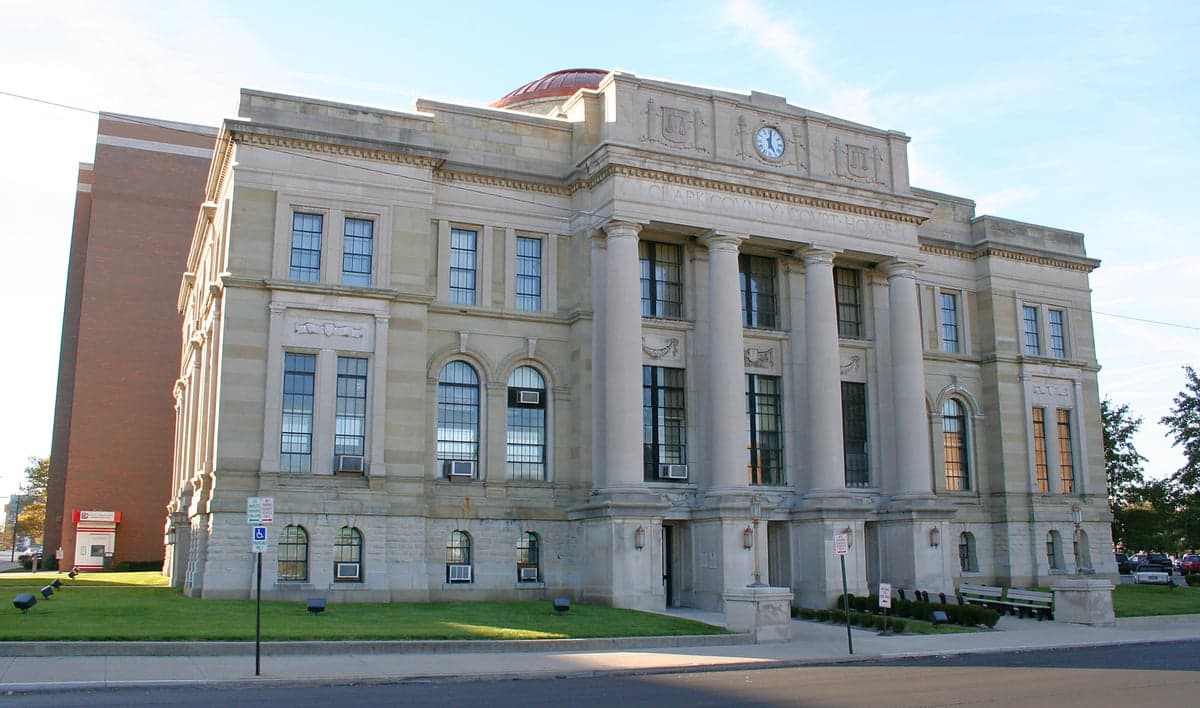
Photo: Wikipedia
Political ClimatePolitical Climate in Clark County
Showing district-level results — no local-only data available.
Local Political AnalysisPolitical Analysis of Clark County
Clark County, Ohio, has long been a bellwether for the state’s political mood, but it’s been drifting rightward in a way that mirrors the broader state trend, just a bit more cautiously. The county’s Cook Partisan Voting Index (PVI) of R+3 means it leans Republican, but it’s a full two points less red than Ohio’s overall R+5 rating. That gap tells you everything: Clark County is a place where the old-school, union-backed Democratic roots still have a pulse, but the conservative shift is real and accelerating, especially in the rural stretches outside the county seat of Springfield.
How it compares
When you stack Clark County against the rest of Ohio, the difference is mostly about the suburbs and small towns. The state as a whole has hardened into a solid R+5 block, driven by the deep-red rural counties and the exurban sprawl around Columbus and Cincinnati. Clark County, though, is a patchwork. Springfield itself is the blue anchor, with precincts around the downtown core and the university area (Wittenberg) still voting reliably Democratic, often by 10-15 points. But drive ten minutes out to New Carlisle or South Vienna, and you’re in Trump country, with margins of 20-30 points. The swing precincts are in the unincorporated areas like Park Layne and Northridge, where working-class voters who once voted for Clinton and Obama have flipped hard to the GOP. That’s the story: the county is R+3 because the rural and exurban vote is now strong enough to nearly cancel out Springfield’s blue vote, but it hasn’t fully tipped yet. Ohio’s R+5 reflects a state where that rural dominance is more complete.
What this means for residents
For folks living here, the political climate translates directly into how much government you feel in your daily life. The conservative majority on the county commission has kept property taxes relatively low and pushed back on state-level mandates for things like mask requirements and vaccine passports. Springfield’s city council, however, has been a different story, with progressive members pushing for things like “sanctuary city” resolutions and defunding police studies—both of which have failed, but the fights are exhausting. The real concern for conservatives is the creeping influence of state-level progressive policies, like the 2023 gun law changes that tightened background checks and the ongoing push for LGBTQ+ curriculum mandates in schools. Clark County’s R+3 lean means we’ve got a buffer, but it’s thin. If the county flips bluer—say, if Springfield’s population grows faster than the rural areas—you could see a repeat of what happened in neighboring Montgomery County (Dayton), where a once-moderate area has swung hard left on social issues.
On the cultural front, the biggest distinction is the strong union presence in Clark County, especially at the Navistar plant and the Honda transmission plant in nearby Anna. That keeps the local Democratic Party alive, but it’s a blue-collar, culturally conservative kind of Democrat—pro-Second Amendment, pro-life, skeptical of the national party’s woke turn. That’s why you see so many split-ticket voters here: they’ll vote for a Republican sheriff or county commissioner but a Democrat for township trustee. The policy upshot is that Clark County has resisted the kind of zoning and housing density mandates that Columbus has embraced, keeping neighborhoods more single-family and car-dependent. It’s a place where you can still buy a three-bedroom house for under $150,000 and not have to worry about a bike lane or a light-rail tax. For now, the R+3 rating feels like a fragile peace—a place where the old and new conservatisms are still figuring out how to coexist, but the trend line is clear: the county is getting redder, and the blue pockets are shrinking.

State Political ClimatePolitical Climate in Ohio
State Political AnalysisPolitical Environment in the State
Ohio leans Republican with a Cook PVI of R+5, but don't let that single number fool you — this state is a battlefield where the red rural heartland and blue urban cores fight for every inch. Over the last 20 years, Ohio has shifted from a classic bellwether (voting for the winner every cycle from 1964 to 2016) to a reliably red state in presidential races, with Trump winning it by 8 points in 2020 and by a similar margin in 2024. The dominant coalition is a mix of working-class voters in small towns and exurbs, plus a growing conservative base in the outer suburbs of Columbus and Cincinnati. But the blue strongholds of Cleveland, Columbus, and Cincinnati keep the state competitive at the state level, and recent ballot initiatives on abortion and marijuana show that progressive ideas can still win statewide when framed as personal freedom issues.
Urban vs. rural divide
The political map of Ohio is a tale of three metros and everything else. Cuyahoga County (Cleveland) is the deepest blue, delivering 66% for Biden in 2020, while Franklin County (Columbus) hit 62% blue and Hamilton County (Cincinnati) came in at 57%. Those three counties alone account for over a third of the state's vote. Meanwhile, the rural northwest — places like Mercer, Auglaize, and Van Wert counties — routinely vote 75-80% Republican. The Appalachian southeast is red too, except for Athens County, home to Ohio University, which flips blue. The real battlegrounds are the collar counties: Delaware County (north of Columbus) voted 55% Republican in 2020 but is trending purple as Columbus sprawl pushes in. Warren County (northeast of Cincinnati) is deep red at 67% GOP, a safe haven for conservatives. Dayton (Montgomery County) is a purple toss-up, while Toledo (Lucas County) leans blue. If you're moving here, your experience of Ohio's politics will depend entirely on whether you land in a red suburb like West Chester or a blue city like Cleveland.
Policy environment
Ohio's state-level policy leans conservative, but with some notable exceptions. The income tax was flattened and cut in 2023, with a top rate now at 3.5% — a win for fiscal conservatives. Sales tax is around 7.25% in most counties. The state is not right-to-work, but it did pass a 2011 law limiting public-sector union bargaining (SB 5), which was later repealed by voters — a reminder that Ohioans can push back. On education, the EdChoice voucher program is one of the most expansive in the country, allowing families in underperforming districts to take state funding to private or religious schools. That's a big draw for conservative parents. Healthcare: Ohio expanded Medicaid under Governor Kasich in 2013, a decision that still rankles some on the right. Election laws tightened in 2023 with SB 1, which requires photo ID for voting, limits drop boxes to one per county, and shortens the absentee ballot window. Gun rights are strong: constitutional carry (HB 227) became law in 2022, meaning no permit needed to carry a concealed firearm. On the flip side, voters passed Issue 1 in 2023, enshrining abortion rights in the state constitution, and Issue 2 legalizing recreational marijuana — both progressive wins that show the limits of Republican control.
Trajectory & freedom
Is Ohio becoming more or less free? It depends on which freedom you're measuring. On gun rights, the trajectory is clearly positive: constitutional carry passed, and there's no sign of rollback. On parental rights, the state passed a 2023 law requiring schools to notify parents of any changes to a student's health or well-being (the "Parents' Bill of Rights"), and a 2024 law bans classroom instruction on sexual orientation and gender identity in K-4 (similar to Florida's "Don't Say Gay"). These are wins for conservatives who see government overreach in schools. On economic freedom, the income tax cuts and deregulation under Governor DeWine have been modest but steady. However, the passage of Issue 1 (abortion) and Issue 2 (marijuana) via ballot initiative represents a significant expansion of personal liberty from a libertarian perspective — but it also signals that the legislature's conservative agenda can be overridden by direct democracy. That's a double-edged sword: the same mechanism that legalized weed could also be used to raise taxes or expand Medicaid. For a conservative worried about government overreach, the state legislature is generally on your side, but the ballot box is unpredictable.
Civil unrest & political movements
Ohio has seen its share of flashpoints. The 2020 George Floyd protests in Columbus turned violent, with looting and fires downtown, and the city still debates police reform. Cleveland has a long history of activist movements, both left (Black Lives Matter, immigrant rights) and right (pro-life rallies, Second Amendment sanctuary resolutions). Several rural counties have declared themselves "Second Amendment sanctuaries", vowing not to enforce future federal gun restrictions. Immigration politics are less intense than in border states, but Cleveland's status as a "welcoming city" (limiting cooperation with ICE) has drawn criticism from conservatives. Election integrity remains a hot topic: after 2020, Republican legislators pushed through SB 1 to tighten voting rules, citing concerns about drop boxes and mail-in ballots. You'll still see "Stop the Steal" signs in rural areas, and the 2024 election saw lawsuits over ballot counting in Cuyahoga County. For a new resident, the most visible sign of political division is the sheer number of yard signs and flags — in red Warren County, you'll see Trump flags on every other truck; in blue Columbus, you'll see Pride flags and Harris-Walz signs. It's a state that wears its politics on its sleeve.
Projection
Over the next 5-10 years, Ohio's political trajectory is a tug-of-war. In-migration is modest — the state is growing slowly, and most newcomers are moving to the Columbus suburbs (Delaware, Union, Licking counties) and the Cincinnati exurbs (Warren, Butler counties). These areas tend to be moderate to conservative, which could reinforce the red lean. However, the urban cores are growing younger and more diverse, especially Columbus, which is adding tech jobs and attracting out-of-state liberals. Franklin County could become even bluer, offsetting rural gains. The wild card is the state's aging population: rural counties are shrinking, and older voters are reliably Republican, but younger voters in cities lean left. Ballot initiatives will continue to be a battleground — expect fights over school vouchers, tax policy, and maybe even a right-to-work measure. For a conservative moving in now, the state will likely remain R+5 to R+7 for presidential races, but state-level control could flip if Democrats win back the suburbs. The key is to pick your county wisely:
* Values derived from national, state, county, city and local statistics and may differ in a specific area. Last updated: 2026-05-14T13:29:27.000Z
Narrative content on this page is AI-generated and may contain mistakes. Verify any details that matter before acting on them.
ReloMaps may earn a commission from affiliate links at no extra cost to you.

