 Popular
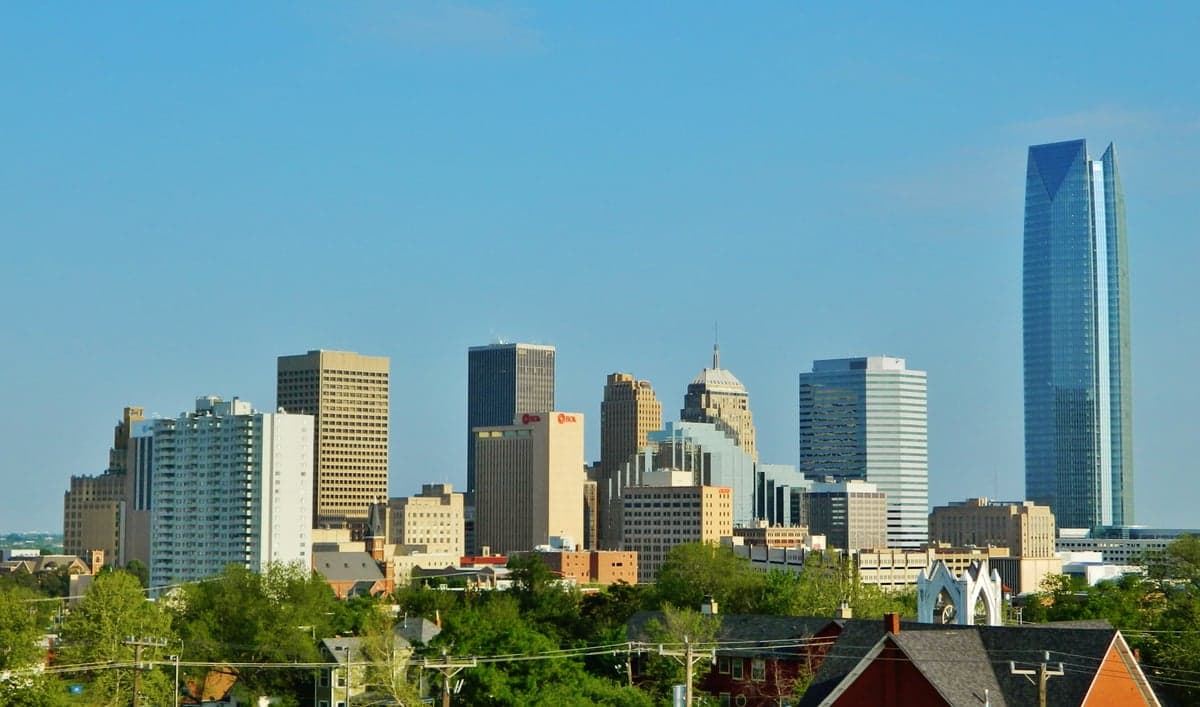
Photo: Wikipedia
Strategic Assessment of Oklahoma City, OK
Multiple tactical vulnerabilities. Population density, target proximity, or disaster risk are likely compounding. A retreat property and exit planning is required.
What does the Strategic Assessment tell us?
Our Strategic Assessment grades tactical survivability of an area. Major population centers, military targets, fallout zones, natural disasters, and border exposure all drive risk — lower exposure means a more defensible position in a crisis.
This is heavily inspired by Joel Skousen's Strategic Relocation book. Highly recommended you checkout the book ($)What does this tell us?
Our Strategic Assessment grades tactical survivability of an area. Major population centers, military targets, fallout zones, natural disasters, and border exposure all drive risk — lower exposure means a more defensible position in a crisis.
This is heavily inspired by Joel Skousen's Strategic Relocation book. Highly recommended you checkout the book ($)Strategic Pillars

Key Distances
Regional Safe Places
Below is our recommended "safe zones" in Oklahoma and the surrounding area based on our strategic heuristics. For most people, it's unrealistic to live in a “safe zone” full-time due to work, family or other personal reasons. They tend to be more rural. However, many of these areas are perfect for second homes and retreat properties that double as a vacation home or even a short-term rental.
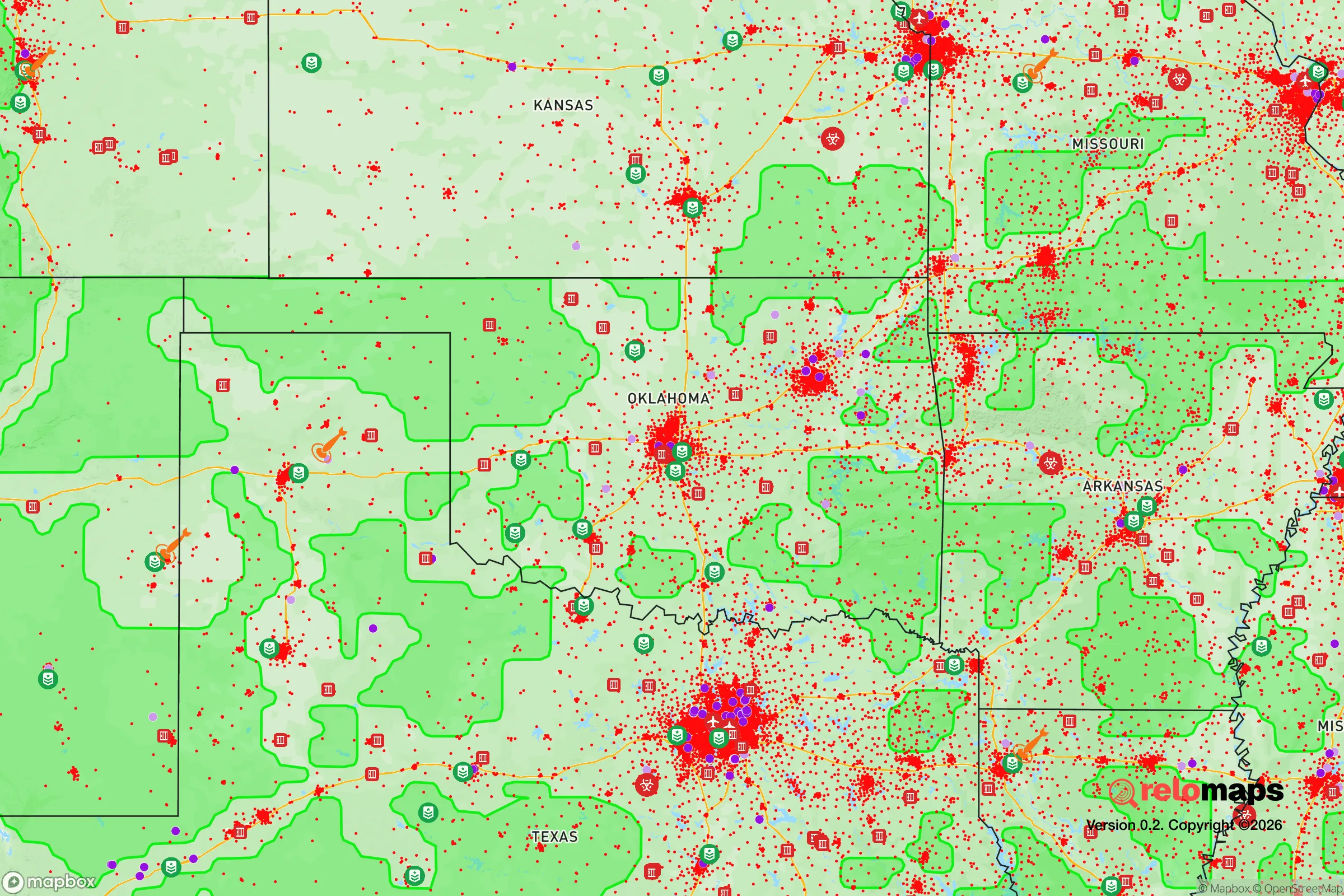
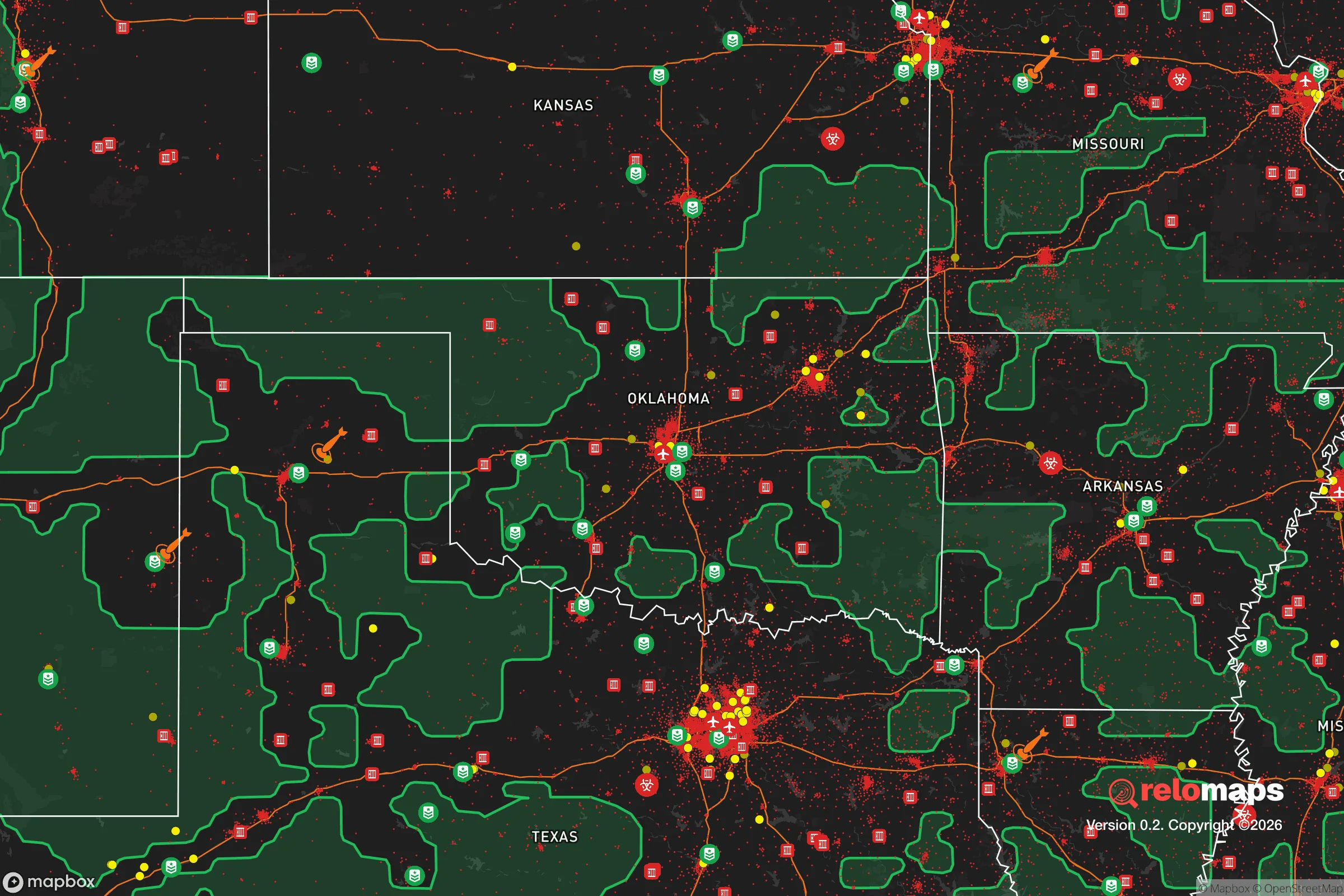


Important Note: For informational purposes only. This does not mean nothing bad ever happens in the green zones. Please use common sense. This is based on public data and modeled with AI. We tried to take a conservative approach but mistakes happen. We update this regularly as new information becomes available.
Solar Generator Recommendations
Backup power matters more here than in safer locations. We've picked three solar generators across budgets and capacity tiers — start with the budget unit if you only need a few essentials, or step up if you want to run a fridge and HVAC for days at a time.

Jackery Portable Power Station Explorer 300
Budget OptionPower on the Go: Weighing only 11 lbs, it's convenient to set up and store with book-sized foldable solar panels

BLUETTI Portable Power Station AC180
Designed for both indoor and outdoor scenarios, AC180 is highly capable as it has a robost capacity and continuous output power.

EF ECOFLOW DELTA Pro Ultra Power Station
Upgraded PickEcoFlow DELTA Pro Ultra is a whole-home energy system designed to grow with your family. Integrated with the Smart Home Panel 2, it scales to meet your evolving energy needs — keeping your home powered, intelligent, and secure through every stage of life.
We earn a commission, at no additional cost to you.
Strategic Assessment Analysis
Oklahoma City offers a surprisingly strong strategic position for those prioritizing resilience, offering a blend of geographic isolation from coastal threats, a robust energy sector, and a low population density that reduces the risks of cascading urban collapse. While not a mountain redoubt, it sits in the heart of Tornado Alley, which forces a culture of preparedness and infrastructure hardening that many other regions lack. For a conservative-leaning individual or family looking to weather civic unrest, supply chain disruptions, or natural disasters, Oklahoma City presents a viable middle-ground option—neither a remote bunker nor a vulnerable coastal metropolis.
Geographic position and natural advantages for long-term stability
Oklahoma City’s location in the central United States is its primary strategic asset. It lies over 1,000 miles from both the Atlantic and Pacific coasts, placing it far outside the blast radius of any nuclear-armed adversary targeting major ports or naval facilities. The city is also roughly 500 miles from the nearest major fault line (the New Madrid Seismic Zone), meaning it avoids the earthquake risks that plague the West Coast and parts of the Midwest. The surrounding terrain is flat to gently rolling plains, which offers excellent agricultural potential—a critical factor for long-term food security. The city sits atop the Anadarko Basin, one of the most productive natural gas and oil fields in the country, ensuring energy independence even if the grid falters. Water is less abundant than in the Great Lakes region, but the city draws from the Lake Hefner and Lake Thunderbird reservoirs, and the Ogallala Aquifer lies to the west, providing a backup for agriculture. The climate is semi-arid, with hot summers and cold winters, but the lack of dense forest cover reduces wildfire risk compared to the West.
Risks, exposures, and proximity to fallout-relevant landmarks
The most significant risk in Oklahoma City is tornadoes. The city lies in the heart of Tornado Alley, and the May 3, 1999, and May 20, 2013, outbreaks caused billions in damage. However, this risk is predictable and mitigable—most homes have basements or storm shelters, and the city’s building codes have been updated to require reinforced construction in high-risk zones. The threat of civil unrest is lower than in coastal cities, but not zero. Oklahoma City has a history of domestic terrorism, most notably the 1995 Alfred P. Murrah Federal Building bombing, which highlights that federal buildings and infrastructure are potential targets. The city is home to Tinker Air Force Base, a major logistics and maintenance hub for the U.S. Air Force, which could be a target in a conflict scenario. Proximity to this base means a higher likelihood of military activity and potential secondary effects if the base is attacked. The city is also within 200 miles of the Pantex nuclear weapons plant in Amarillo, Texas, and the Strategic Petroleum Reserve in Bryan Mound, Texas. While these are not immediate fallout dangers, they are high-value targets that could draw attention in a major conflict. The city’s reliance on a single interstate (I-35) for north-south travel is a vulnerability—if that corridor is blocked, movement becomes difficult.
Practical resilience for a relocator: food, water, energy, and defensibility
For a relocator focused on self-sufficiency, Oklahoma City offers several practical advantages. The surrounding agricultural land is fertile and affordable, with many rural properties available within a 30-minute drive of the city. The growing season is about 200 days, allowing for substantial home gardening and small-scale livestock operations. Water access is the main constraint—well drilling is common but can be expensive, and the Ogallala Aquifer is being depleted at an unsustainable rate. Rainwater catchment is feasible, with an average of 36 inches of precipitation per year. Energy is a strong point: natural gas is cheap and abundant, and solar potential is good, with over 230 sunny days per year. Many homes already have backup generators due to frequent storm-related outages. Defensibility is moderate. The flat terrain offers little natural cover, but the low population density (about 1,000 people per square mile in the city proper, much lower in the suburbs) means that a determined group could secure a perimeter. The city’s layout is sprawling, with many cul-de-sacs and rural subdivisions that are easier to defend than dense urban blocks. The local gun culture is strong, with high rates of firearm ownership and a permissive legal environment for concealed carry and stand-your-ground laws. The Oklahoma City Police Department is well-funded but stretched thin in rural areas, so personal security is largely the individual’s responsibility. The city has a robust network of farmers’ markets, co-ops, and local food producers, which reduces reliance on national supply chains.
The overall strategic picture for a conservative relocator
Oklahoma City is not a perfect redoubt, but it is a pragmatic choice for those who want to stay connected to the broader economy while maintaining a high degree of preparedness. The city’s energy independence, agricultural potential, and low risk of coastal or seismic disasters make it a solid base for weathering short-term disruptions. The main trade-offs are the tornado risk and the flat terrain, which limits natural defensibility. For a family or individual with a conservative worldview who values self-reliance, community ties, and a culture that respects firearms and preparedness, Oklahoma City offers a realistic path forward. It is not a bunker, but it is a place where you can build a life that is resilient to the shocks of the modern world—provided you invest in a storm shelter, a well, and a good set of neighbors. The city’s central location also means you can relocate further west or north if conditions deteriorate, giving you strategic flexibility. In a world where coastal cities are increasingly fragile, Oklahoma City stands out as a stable, if unglamorous, anchor for long-term survival planning.

* Values derived from national, state, county, city and local statistics and may differ in a specific area. Last updated: 2026-04-25T13:49:21.000Z
Narrative content on this page is AI-generated and may contain mistakes. Verify any details that matter before acting on them.
ReloMaps may earn a commission from affiliate links at no extra cost to you.

