 Popular
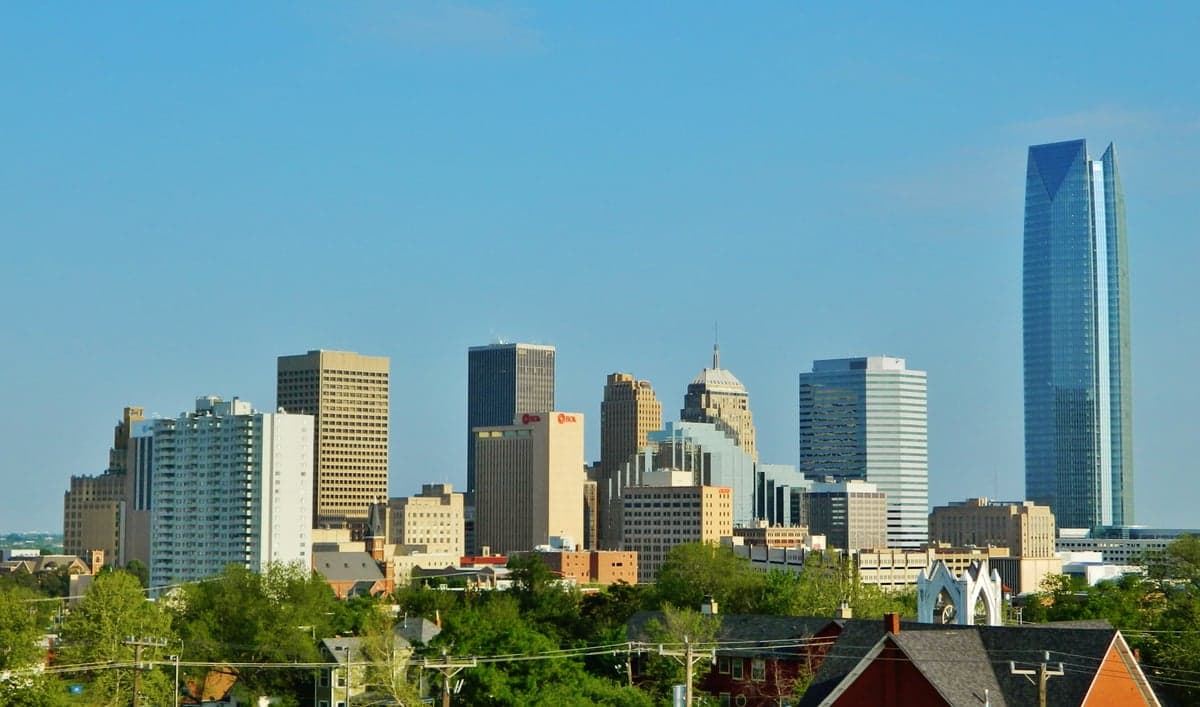
Photo: Wikipedia
Demographics of Oklahoma City, OK
Affluence Level in Oklahoma City, OK
A middle-class area roughly in line with national averages across income, home values, education, and employment.
People of Oklahoma City, OK
Oklahoma City’s 688,693 residents form a predominantly native-born, politically conservative population with a strong frontier and energy-sector character. The city is notably less diverse than the national average, with a foreign-born share of just 7.2% and a white population of 51.0%, though Hispanic residents (21.7%) and Black residents (13.1%) represent significant and growing communities. Distinctive markers include a sprawling, car-dependent layout, a deep-rooted evangelical Christian presence, and a population that skews younger than the national median age, driven by families seeking affordable housing and jobs in energy, aviation, and logistics.
How the city was settled and grew
Oklahoma City was born in a single day: April 22, 1889, when the federal government opened the Unassigned Lands to non-Native settlers in the Land Run. Tens of thousands of homesteaders, mostly white farmers from the Midwest and Upper South, staked claims on what had been Indian Territory. The city’s founding population was overwhelmingly native-born, Protestant, and rural. The discovery of oil beneath the city in 1928 transformed it into a boomtown, drawing workers from Texas, Kansas, and Arkansas. The historic Deep Deuce neighborhood became the heart of the Black community during the Jim Crow era, settled by African Americans who arrived during the Great Migration for railroad and oil-field jobs. Paseo Arts District and Heritage Hills were built by the white oil elite in the 1920s and 1930s, while working-class white families settled in Capitol Hill and Stockyards City, areas that remain heavily white and Hispanic today. The city’s growth was almost entirely domestic until the late 20th century; immigration was negligible.
Modern era (post-1965)
The 1965 Hart-Cellar Act had a modest effect on Oklahoma City compared to coastal metros. The foreign-born share remained below 5% through the 1990s. The most significant post-1965 shift was the rapid growth of the Hispanic population, driven by immigration from Mexico and Central America. By 2020, Hispanics made up 21.7% of the population, concentrated in Capitol Hill (south of the Oklahoma River) and South Oklahoma City, where Mexican grocery stores, taquerias, and Spanish-language churches are common. The Asian population (East and Southeast Asian, 3.2%) grew more slowly, with Vietnamese and Chinese families settling in northwest Oklahoma City near the Asian District along Classen Boulevard. The Indian subcontinent population (1.2%) is smaller and more dispersed, with clusters near the University of Oklahoma Health Sciences Center and in Edmond, a northern suburb. Suburbanization after 1970 hollowed out the urban core: white families moved to Edmond, Yukon, and Mustang, while Black families moved to northeast Oklahoma City and Midwest City. The city’s white share fell from 74% in 1990 to 51% in 2024, driven by both Hispanic growth and white out-migration to suburbs.
The future
Oklahoma City’s population is becoming more Hispanic and more suburban, but it is not tribalizing into sharply divided enclaves. The Hispanic population is projected to reach 25–28% by 2040, driven by higher birth rates and continued immigration. The white population will continue to decline as a share but remain the largest single group. The Black population is stable at roughly 13%, with growth in suburbs like Midwest City. East and Southeast Asian communities are growing slowly, mainly through professional migration to the health sciences and energy sectors. The Indian subcontinent population is small but growing, driven by tech and medical professionals. The city is not homogenizing: neighborhoods like Capitol Hill are becoming more Hispanic, while Edmond remains overwhelmingly white and Deep Deuce is gentrifying with a mix of white and Black young professionals. The foreign-born share will likely rise to 10–12% by 2040, still well below the national average. The city’s conservative political culture and low cost of living will continue to attract domestic migrants from California and the Northeast, who tend to be white and college-educated.
For a conservative-leaning mover, Oklahoma City is becoming a more diverse but still majority-white, family-oriented, and politically red city. The population is spreading outward into suburbs rather than densifying, and the immigrant communities are growing steadily but not rapidly. The city offers a stable, affordable environment where the dominant culture remains native-born, evangelical, and rooted in the energy and aviation industries. New arrivals will find a place where demographic change is gradual and largely uncontroversial, and where the biggest population story is still domestic in-migration from other states.

* Values derived from national, state, county, city and local statistics and may differ in a specific area. Last updated: 2026-04-25T13:49:21.000Z
Narrative content on this page is AI-generated and may contain mistakes. Verify any details that matter before acting on them.
ReloMaps may earn a commission from affiliate links at no extra cost to you.

