Photo: Wikipedia
Demographics of Old Town, ME
Affluence Level in Old Town, ME
A middle-class area roughly in line with national averages across income, home values, education, and employment.
People of Old Town, ME
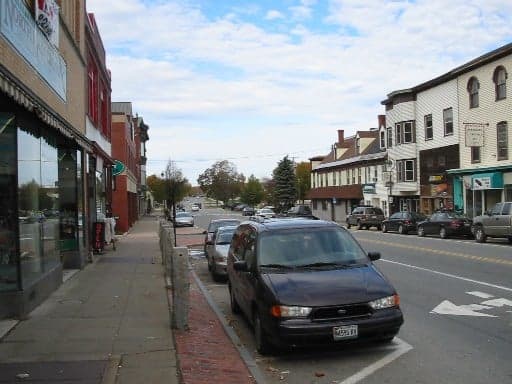
The 7,439 residents of Old Town, Maine, form one of the most ethnically homogeneous communities in the state, with a population that is 92.4% white and only 0.6% foreign-born. This is a working-class city with a strong Franco-American and Native American heritage, shaped by the Penobscot River and the lumber industry that once defined the region. Old Town’s character is distinctly local and rooted, with a density of about 200 people per square mile and a population that has been slowly declining since the 1970s. For a conservative-leaning audience, Old Town represents a stable, low-diversity environment where family ties and community institutions—like the University of Maine’s nearby Orono campus—anchor daily life.
How the city was settled and grew
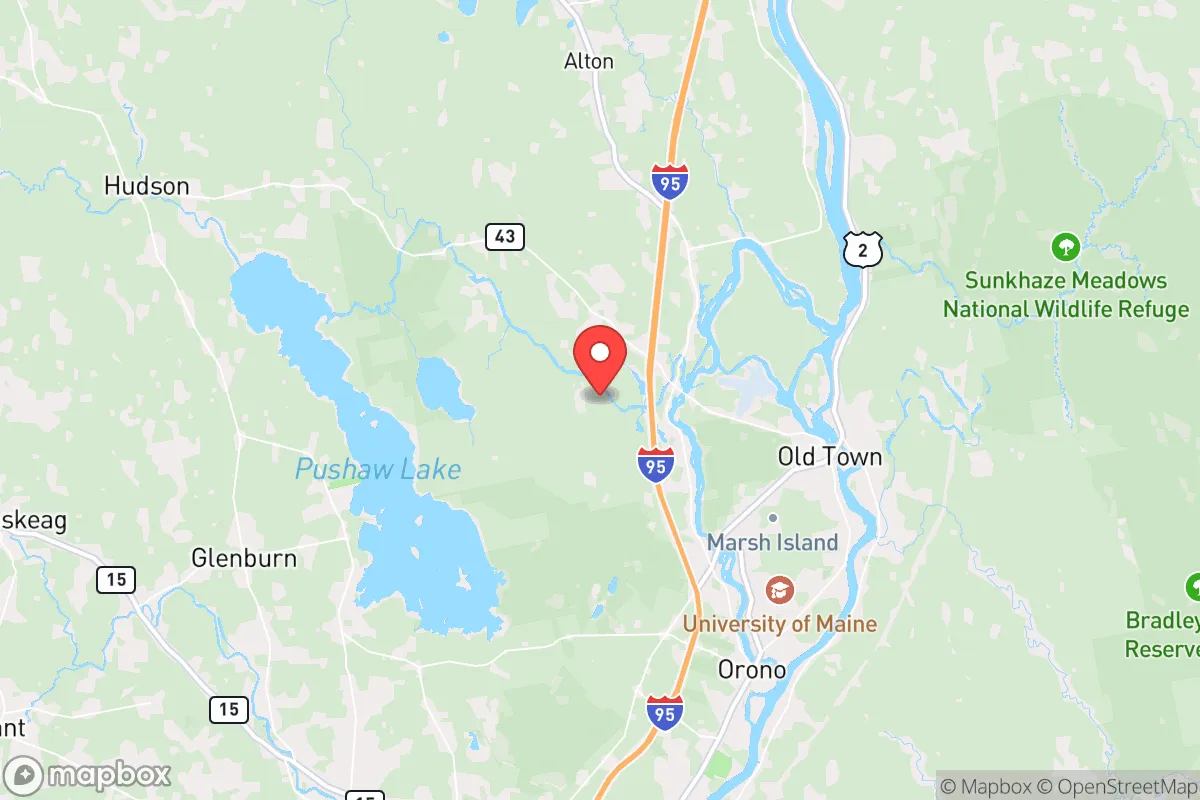
Old Town’s human history begins with the Penobscot Nation, whose ancestral lands along the Penobscot River included the area now known as Indian Island (within the Penobscot Indian Island Reservation), just east of the city center. European settlement began in the late 1700s, when Anglo-American farmers and millwrights arrived to exploit the river’s waterpower. The first major wave of non-Native settlers were Yankees from southern Maine and Massachusetts, who established sawmills and shipbuilding operations along the river in what is now downtown Old Town and the West Side neighborhood. By the mid-19th century, the lumber boom drew a second wave: French-Canadian immigrants from Quebec, who crossed the border to work in the mills. These Franco-Americans settled in dense clusters near the mills, particularly in the South Old Town area and along the riverfront, building Catholic parishes like Holy Family Church that still serve the community. A smaller wave of Irish immigrants arrived during the same period, settling in the North Old Town district near the railroad depot. The city incorporated in 1840 and peaked at roughly 8,500 residents in the 1960s, driven by the paper and lumber industries that employed generations of Franco-American families.
Modern era (post-1965)
After the 1965 Hart-Cellar Act, Old Town saw virtually no immigration-driven diversification. The foreign-born share remains at 0.6%, and the city’s Hispanic (1.9%), Black (0.7%), and East/Southeast Asian (0.1%) populations are negligible. The major demographic shift since the 1970s has been domestic out-migration: the closure of the Old Town Paper Mill in 2006 and the decline of the lumber industry triggered a population drop from 8,130 in 2000 to 7,439 today. Younger residents have left for Portland or Bangor, leaving an aging population. The Stillwater Avenue corridor, which connects Old Town to Orono and the University of Maine, has absorbed most of the modest in-migration—primarily university-affiliated faculty and staff, who are overwhelmingly white and college-educated (38.3% of residents hold a bachelor’s degree or higher). The Indian Island community remains a distinct enclave, with the Penobscot Nation maintaining its own governance and cultural institutions, though its population is small (roughly 400–500 residents) and has not grown significantly. The West Side and South Old Town neighborhoods have seen the most housing turnover, with older Franco-American homes being sold to younger families from within Maine, but the overall racial and ethnic composition has barely changed since 1990.
The future
Old Town’s population is projected to continue a slow decline, likely falling below 7,000 by 2035, as the city’s industrial base has not been replaced by new employers. The Penobscot Nation’s population on Indian Island is stable but not expanding, and the city’s 0.6% foreign-born share is among the lowest in New England—there is no sign of an immigrant-driven revival. The college-educated share (38.3%) is above the national average, driven by proximity to the University of Maine, but this group tends to be transient, renting in the Stillwater Avenue area and moving away after graduation. The city is not tribalizing into distinct ethnic enclaves; rather, it is homogenizing as the Franco-American majority ages and younger white families from elsewhere in Maine move into the North Old Town and West Side neighborhoods. The next decade will likely see a continued demographic plateau: a shrinking, aging, overwhelmingly white population with little racial or ethnic change, and a modest influx of university-connected professionals who do not stay long-term.
For someone moving to Old Town now, the city offers a stable, low-diversity environment with deep Franco-American and Native American roots, but it is a community in demographic stasis. The population is not growing, diversifying, or revitalizing—it is slowly contracting. New residents should expect a quiet, family-oriented city where community ties are strong but economic opportunities are limited, and where the population will look much the same in 20 years as it does today.

* Values derived from national, state, county, city and local statistics and may differ in a specific area. Last updated: 2026-05-01T10:16:34.000Z
Narrative content on this page is AI-generated and may contain mistakes. Verify any details that matter before acting on them.
ReloMaps may earn a commission from affiliate links at no extra cost to you.

