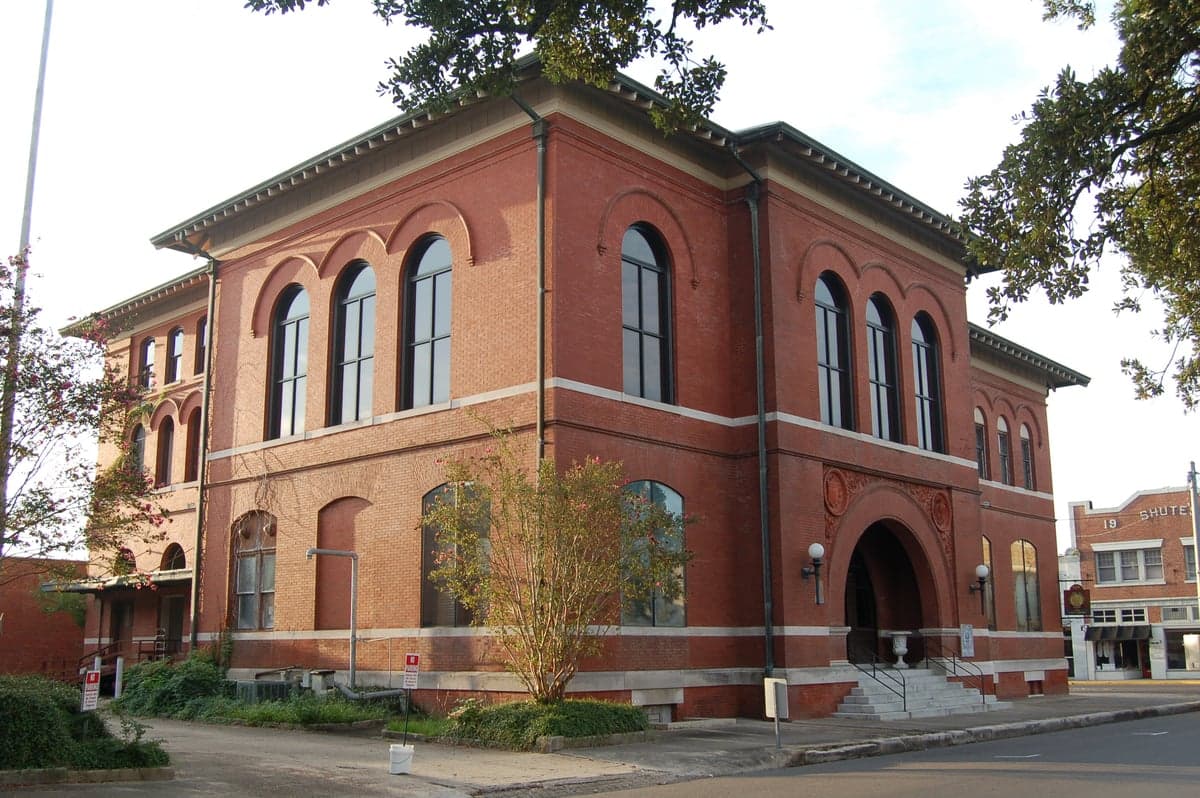
Photo: Wikipedia
Personal Sovereignty in Opelousas, LA
Strong independent fundamentals that actively favor personal liberty and low regulation.
What does Personal Sovereignty tell us?
Personal Sovereignty measures your capacity for self-reliance and independence with minimal government friction. Higher scores mean fewer barriers between you and the way you want to live... but it assumes you have the space you need and good neighbors.
What does this tell us?
Personal Sovereignty measures your capacity for self-reliance and independence with minimal government friction. Higher scores mean fewer barriers between you and the way you want to live... but it assumes you have the space you need and good neighbors.
State Policy
Energy independence: Net exporter (280% of energy produced in-state)
Personal Liberty
Homesteading

Personal Liberty Analysis
Opelousas, Louisiana, offers a personal sovereignty environment that is a study in contrasts—deeply rooted in a culture of self-reliance and local independence, yet operating within a state that has seen increasing federal and state-level encroachments on individual freedoms. For the strategic relocation researcher with a conservative, survivalist mindset, the city itself presents a mixed bag: the local ethos leans heavily toward "live and let live," but the legal and regulatory framework in Louisiana is not as libertarian as its reputation might suggest. The key to unlocking Opelousas as a viable base for personal autonomy lies in understanding where state law gives you room to maneuver and where it imposes constraints that require careful navigation. This analysis breaks down the critical factors—tax burden, gun laws, homesteading viability, and personal liberties—to give you a clear picture of what real sovereignty looks like on the ground in St. Landry Parish.
Tax burden and regulatory posture in St. Landry Parish
Louisiana's tax structure is a double-edged sword for the sovereignty-minded individual. On the positive side, the state has no personal property tax on vehicles or boats, and the homestead exemption on the first $75,000 of a home's assessed value is a significant boon for property owners. However, the state's combined state and local sales tax rate can exceed 10% in some parishes—St. Landry Parish sits at around 9.5%—which hits hard on everyday purchases and supplies, a critical consideration for preppers stockpiling goods. The state income tax is a flat 3% for individuals, which is moderate, but the regulatory posture in Louisiana is less friendly than its "business-friendly" marketing suggests. The state has a notoriously complex occupational licensing regime, and while Opelousas itself is not a hotbed of zoning enforcement, the parish government does impose building codes and permit requirements that can frustrate off-grid construction. The real burden, however, comes from property taxes: while the effective rate in St. Landry Parish is around 0.5% of assessed value—lower than the national average—the assessment process can be opaque, and reassessments are not always predictable. For the survivalist, the key takeaway is that Louisiana's tax burden is manageable but not negligible, and the regulatory posture is best described as "laissez-faire in theory, bureaucratic in practice." You can operate with relative freedom, but you must stay on top of local ordinances to avoid fines that could derail your plans.
Self-defense and gun law specifics in Louisiana
Louisiana is a strong Second Amendment state, and Opelousas reflects that culture. The state has permitless carry for anyone 18 or older who is not prohibited from possessing a firearm—no license, no training requirement, no waiting period for purchase. This is a foundational liberty for the prepper, as it means you can arm yourself immediately upon relocation without bureaucratic hurdles. Stand-your-ground laws are in full effect, with no duty to retreat in any place where you have a legal right to be. Castle doctrine protections extend to your home, vehicle, and workplace. However, there are nuances: Louisiana law prohibits carrying firearms in certain "gun-free zones" like schools, government buildings, and bars (unless you're the owner), and the state has a red flag law (Act 320 of 2024) that allows law enforcement to petition for temporary seizure of firearms based on a court order. This is a significant concern for those who view such laws as a slippery slope toward government overreach. Additionally, while private sales between individuals are legal without background checks, the state maintains a database of firearm purchases through the Louisiana Instant Check System (LICS), which some see as a de facto registry. For the strategic relocator, Opelousas offers a high degree of personal firearm freedom, but the red flag law and potential for future restrictions mean you should consider legal counsel familiar with Louisiana's evolving gun landscape. The local sheriff's office in St. Landry Parish is generally pro-Second Amendment, but enforcement of red flag orders has been inconsistent—a risk factor for those who prioritize absolute sovereignty.
Self-reliance and homesteading viability in Opelousas
Opelousas sits in the heart of Louisiana's agricultural region, and the potential for self-reliance is substantial if you can navigate the local land-use rules. Lot sizes in the rural parts of St. Landry Parish can be as small as one acre, but many properties available for purchase range from 5 to 20 acres, offering enough space for a substantial garden, small livestock, and even a modest orchard. Zoning in unincorporated areas is minimal—the parish has no comprehensive zoning code for agricultural land, meaning you can generally keep chickens, goats, and even a few head of cattle without permits. However, the city limits of Opelousas itself impose stricter rules: within town, you cannot keep livestock on lots under one acre, and there are noise ordinances that could affect roosters or guard dogs. Off-grid feasibility is mixed. Louisiana has no state-level ban on rainwater collection, but the state's Department of Health has guidelines that could be interpreted as restrictive for potable use. Solar panels are legal and common, but net metering policies are less favorable than in some western states—you can sell excess power back to the grid, but at a wholesale rate that is not economically attractive. The real challenge for the prepper is water: the water table in St. Landry Parish is high, which makes well drilling relatively easy and affordable (typically $3,000–$6,000 for a residential well), but the water quality can be variable due to agricultural runoff. Septic systems are permitted with a standard parish inspection, and composting toilets are legal but not widely used. For the homesteader, Opelousas offers a viable path to self-reliance, but you must be prepared to deal with humidity, hurricanes, and the occasional flood risk—FEMA flood zones are a reality in parts of the parish. The bottom line: you can achieve a high degree of food and energy independence here, but it requires active management of local conditions rather than a set-it-and-forget-it approach.
Personal liberties: parental rights, medical autonomy, speech, and property
On parental rights, Louisiana has been a battleground. The state passed the "Parents' Bill of Rights" (Act 466 of 2024), which affirms that parents have the fundamental right to direct the upbringing, education, and healthcare of their children. This includes the right to opt out of school curricula and medical treatments without state interference. However, enforcement has been uneven, and some school districts in St. Landry Parish have resisted full implementation. For the conservative parent, this means you can legally homeschool with minimal oversight—Louisiana requires only a simple notification and an annual standardized test or portfolio review—but you should be prepared to advocate for your rights at the local level. Medical autonomy is a mixed picture. Louisiana has no state-level vaccine mandate for adults, and the state has passed laws limiting the enforcement of federal vaccine mandates for state employees. However, the state's medical board has been aggressive in pursuing physicians who prescribe ivermectin or hydroxychloroquine for off-label use, a concern for those who prioritize medical freedom. The state also has a restrictive telemedicine law that can limit access to out-of-state providers. On speech and property rights, Louisiana is generally strong: there is no state-level hate speech law that criminalizes protected speech, and property rights are protected by the state constitution's "takings" clause, which requires just compensation for any regulatory taking. However, the state has a history of using eminent domain for economic development projects, and St. Landry Parish has seen controversial land acquisitions for industrial projects. For the sovereignty-minded individual, the key is to buy property with clear title and to avoid areas near proposed development corridors. Overall, Opelousas offers a solid foundation for personal liberties, but the devil is in the details—you must be proactive in asserting your rights, as the local legal culture can be slow to defend them.
In the broader landscape of American personal sovereignty, Opelousas ranks as a moderate option—better than the coastal blue states where regulatory overreach is suffocating, but not as free as the rural strongholds of Idaho or Montana. The city's advantage is its low cost of land and a culture that still values independence, but its disadvantages include a state government that is not uniformly libertarian and a legal system that can be unpredictable. For the strategic relocator, Opelousas is a viable base if you are willing to engage in local politics, build relationships with like-minded neighbors, and maintain a low profile. It is not a sanctuary from government overreach, but it is a place where you can carve out a significant degree of autonomy with careful planning. The real test will come in the next decade, as Louisiana's red flag law and other encroachments are tested in court. For now, Opelousas offers a reasonable balance of freedom and practicality for those who prioritize self-reliance and personal sovereignty.

* Values derived from national, state, county, city and local statistics and may differ in a specific area. Last updated: 2026-05-01T04:12:49.000Z
Narrative content on this page is AI-generated and may contain mistakes. Verify any details that matter before acting on them.
ReloMaps may earn a commission from affiliate links at no extra cost to you.

