Photo: Wikipedia
Political ClimatePolitical Climate in Opelousas, LA
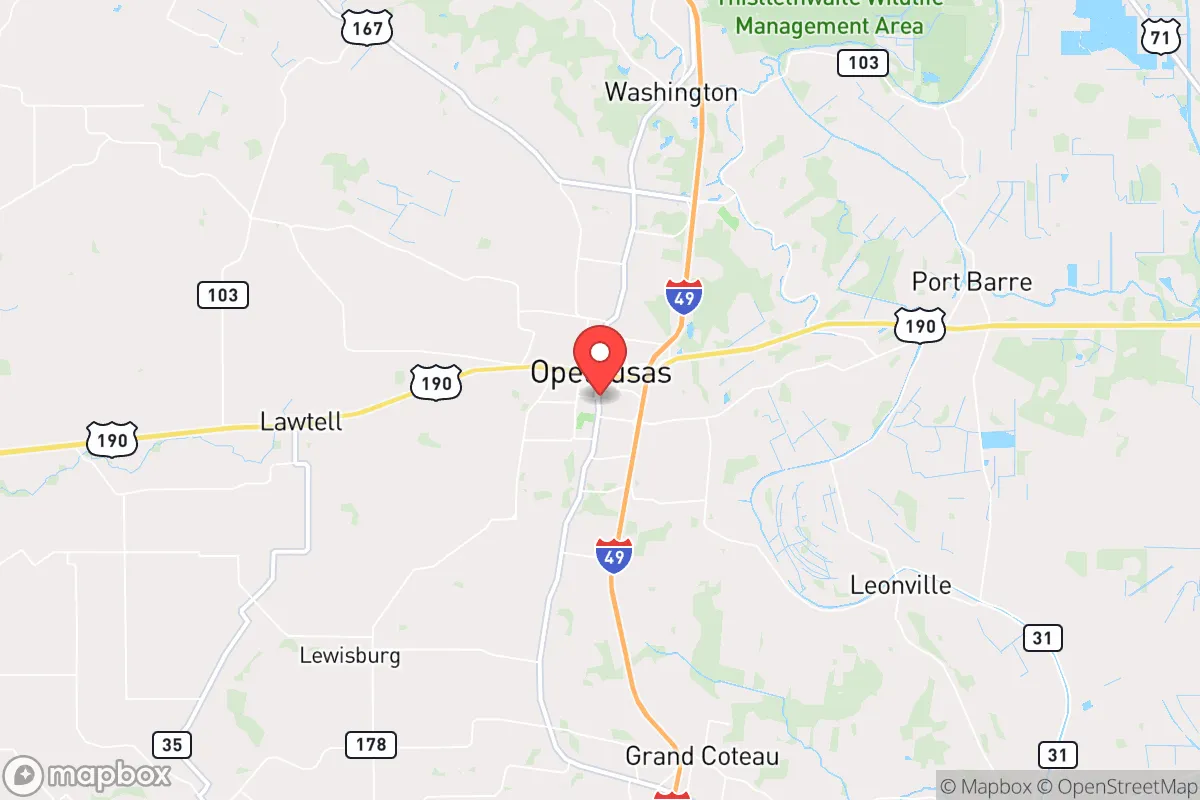
District shown is the primary district for this city’s centroid. Cities may span multiple districts.
Local Political AnalysisPolitical Analysis of Opelousas, LA
Opelousas sits in a reliably Democratic area, with a Cook PVI of D+8, but don’t let that number fool you into thinking it’s a progressive stronghold. The local political climate here is more of a mixed bag—historically conservative on social and cultural issues, but with a strong Democratic registration that’s been a fixture for generations. In recent years, you’ve seen a slow but noticeable shift, with younger folks and newcomers pushing for more progressive policies, especially around local government and school boards. It’s not a radical change overnight, but it’s enough to make a long-time resident like me keep a close eye on things, because once that ball starts rolling, it’s hard to stop.
How it compares
Drive 20 minutes north to Ville Platte, and you’ll find a place that’s even more Democratic on paper, but with a similar old-school, hands-off attitude toward government. Head south toward Lafayette, and the contrast is stark—Lafayette’s becoming more progressive by the year, with a younger, more diverse population pushing for things like expanded public transit and more city ordinances that feel like overreach to folks here. Opelousas, by comparison, still holds onto a “live and let live” vibe, but the pressure is mounting. The surrounding St. Landry Parish is more conservative than the city itself, with rural areas voting reliably Republican in recent presidential elections. That split creates a tension: the city council might lean left, but the parish government often pushes back on anything that smells like big-government solutions. It’s a tug-of-war that’s been going on for a while, and it’s getting harder to ignore.
What this means for residents
For someone who values personal freedoms and limited government, the biggest concern here is the slow creep of progressive policies into local schools and zoning laws. There’s been talk of more regulations on small businesses, like stricter health codes and licensing fees, which hits the mom-and-pop shops that are the backbone of this town. The school board has seen some heated debates over curriculum changes that lean toward progressive social agendas, and that’s a red flag for parents who want their kids taught the basics, not ideology. Property taxes are relatively low compared to nearby cities, but there’s always chatter about raising them for “community programs” that sound good on paper but often mean more bureaucracy. If you’re a conservative-leaning resident, you’re probably watching these trends with a wary eye, hoping the old-school common sense that’s kept Opelousas grounded for decades doesn’t get washed away by the tide of change coming from bigger cities.
Culturally, Opelousas still feels like a place where tradition matters—the Zydeco music, the Creole heritage, the family-owned businesses that have been around for generations. That’s the good part. But there’s a growing push to make the town more “inclusive” in ways that sometimes feel like they’re erasing that very culture. For instance, there’ve been efforts to rename streets and remove historical markers, which rubs a lot of locals the wrong way. The policy distinction that stands out most is the city’s relatively hands-off approach to gun laws and property rights—for now. But if the progressive trend continues, you can expect more ordinances that chip away at those freedoms. My advice? Keep your ear to the ground and your voice in local meetings, because this town’s character is worth fighting for, and it’s not going to defend itself.

State Political ClimatePolitical Climate in Louisiana
State Political AnalysisPolitical Environment in the State
Louisiana has long been a reliably Republican state at the presidential level, but its political climate is far from monolithic. The state voted for Donald Trump by about 19 points in 2020 and 16 points in 2024, a shift that reflects a slow but steady rightward drift in the rural and suburban parishes, even as New Orleans and Baton Rouge remain deep-blue strongholds. Over the past 20 years, the GOP has consolidated control of the state legislature, the governorship (now held by Jeff Landry, a conservative firebrand), and both U.S. Senate seats, while the Democratic Party has retreated to a handful of urban and majority-Black parishes. The result is a state that feels increasingly like two separate political worlds: a conservative, culturally traditionalist interior and a progressive, coastal urban core.
Urban vs. rural divide
The political map of Louisiana is starkly divided. The southeastern corner, anchored by New Orleans (Orleans Parish) and Baton Rouge (East Baton Rouge Parish), votes overwhelmingly Democratic — Orleans Parish gave Biden 83% in 2020. These cities are home to large Black populations, universities, and a growing progressive activist class. In contrast, the rest of the state — from the piney woods of Ruston and Monroe in the north, to the Cajun country of Lafayette and Lake Charles in the southwest, to the Florida Parishes like Livingston Parish — votes heavily Republican. The suburbs around New Orleans, particularly St. Tammany Parish (home to Covington and Mandeville), are some of the most reliably red areas in the South, often voting 70%+ Republican. The rural parishes along the Mississippi River and in the northern half of the state are even more conservative, with many precincts hitting 80% for Trump. The divide isn't just cultural — it's economic, with the oil-and-gas industry dominating the conservative parishes and the service-and-tourism economy shaping the liberal cities.
Policy environment
Louisiana's policy environment is a mixed bag for conservatives. On the plus side, the state has no personal property tax, and its corporate tax rate was cut from 8% to 4% in 2022 under a bipartisan deal. The state also has a right-to-work law and is a "shall-issue" concealed carry state. However, the state sales tax is high (over 9% in many parishes), and the income tax brackets are still relatively progressive, with a top rate of 4.25%. Education policy has been a battleground: Governor Landry signed a universal school choice voucher program in 2024, allowing state funds to follow students to private or religious schools — a major win for parental rights. But the state's public school system remains among the lowest-ranked nationally, and teacher unions still wield influence in Baton Rouge. On healthcare, Louisiana expanded Medicaid under the Affordable Care Act in 2016, a decision that many conservatives view as a costly expansion of government dependency. Election laws are moderately restrictive: voter ID is required, and early voting is limited to 7 days. There is no no-excuse absentee voting, which conservatives generally support as a safeguard against fraud.
Trajectory & freedom
On balance, Louisiana has been moving in a more conservative direction on personal liberty over the past five years. The most significant recent development is the passage of Constitutional Carry (Act 55 of 2024), which allows any adult who can legally possess a firearm to carry it openly or concealed without a permit. This was a top priority for the Louisiana Shooting Association and was signed by Landry with little opposition. On parental rights, the state passed the Parents' Bill of Rights (Act 459 of 2023), which requires schools to notify parents of any medical or mental health services offered to their children and prohibits classroom instruction on sexual orientation or gender identity in grades K-12. This law has already drawn lawsuits from the ACLU, but it remains in effect. On medical freedom, Louisiana banned COVID-19 vaccine mandates for state employees and contractors in 2023, and Landry has signaled support for a broader medical autonomy bill. However, the state still has a relatively high tax burden compared to other Southern states, and property taxes — while low — are supplemented by high sales and excise taxes on gasoline and alcohol. The trajectory is clearly toward more individual freedom on guns, education, and medical choice, but the tax structure remains a drag.
Civil unrest & political movements
Louisiana has seen its share of political flashpoints. The most visible in recent years was the 2020 protests in New Orleans following the murder of George Floyd, which included clashes with police, vandalism of Confederate monuments, and a sustained occupation of the city's Duncan Plaza. The city's Democratic leadership, including Mayor LaToya Cantrell, was criticized by conservatives for being slow to restore order. More recently, the 2023 election integrity debate erupted after a close state senate race in the New Orleans suburbs, where allegations of ballot harvesting surfaced. In response, the legislature passed a law (Act 123 of 2024) banning the collection of absentee ballots by third parties — a move that election integrity advocates praised. Immigration politics are less heated than in border states, but the influx of migrants into New Orleans via the federal busing program from Texas has strained local resources and sparked backlash in suburban parishes like Jefferson Parish. There is also a small but vocal secessionist movement in the northern part of the state, with some activists calling for the creation of a separate "North Louisiana" state, though this remains fringe. Overall, the political movements are polarized: urban progressives push for defunding police and sanctuary city policies, while rural conservatives organize around gun rights, school choice, and election integrity.
Projection
Over the next 5-10 years, Louisiana is likely to become more conservative, not less. The key demographic driver is the continued exodus of liberal-leaning residents from New Orleans and Baton Rouge to other states (Texas, Florida, Georgia), while the rural and suburban parishes are growing modestly. The in-migration from other states is small but tilts conservative — retirees and remote workers drawn by low housing costs and the new constitutional carry law. The Republican supermajority in the legislature is expected to hold, and Governor Landry's aggressive agenda on school choice, gun rights, and tax cuts will likely continue. The biggest wild card is the state's fiscal health: if the sales tax base erodes due to e-commerce and the oil-and-gas industry declines, the state may face pressure to raise income taxes or cut services, which could spark a backlash. But for now, the political winds are blowing rightward. A new resident moving to Lafayette or Shreveport can expect a state that is increasingly friendly to conservative values, with fewer restrictions on firearms, more school choice, and a government that is skeptical of federal overreach.
Bottom line for a new resident: If you're a conservative looking for a state that respects your right to keep and bear arms, choose your child's school, and keep your medical decisions private, Louisiana is a solid bet — especially if you avoid the urban cores of New Orleans and Baton Rouge. The taxes are higher than in Texas or Florida, but the cost of living is lower, and the cultural conservatism is genuine. Just be prepared for a humid summer and a state government that, while moving in the right direction, still has a long way to go on fiscal discipline.
* Values derived from national, state, county, city and local statistics and may differ in a specific area. Last updated: 2026-05-01T04:12:49.000Z
Narrative content on this page is AI-generated and may contain mistakes. Verify any details that matter before acting on them.
ReloMaps may earn a commission from affiliate links at no extra cost to you.

