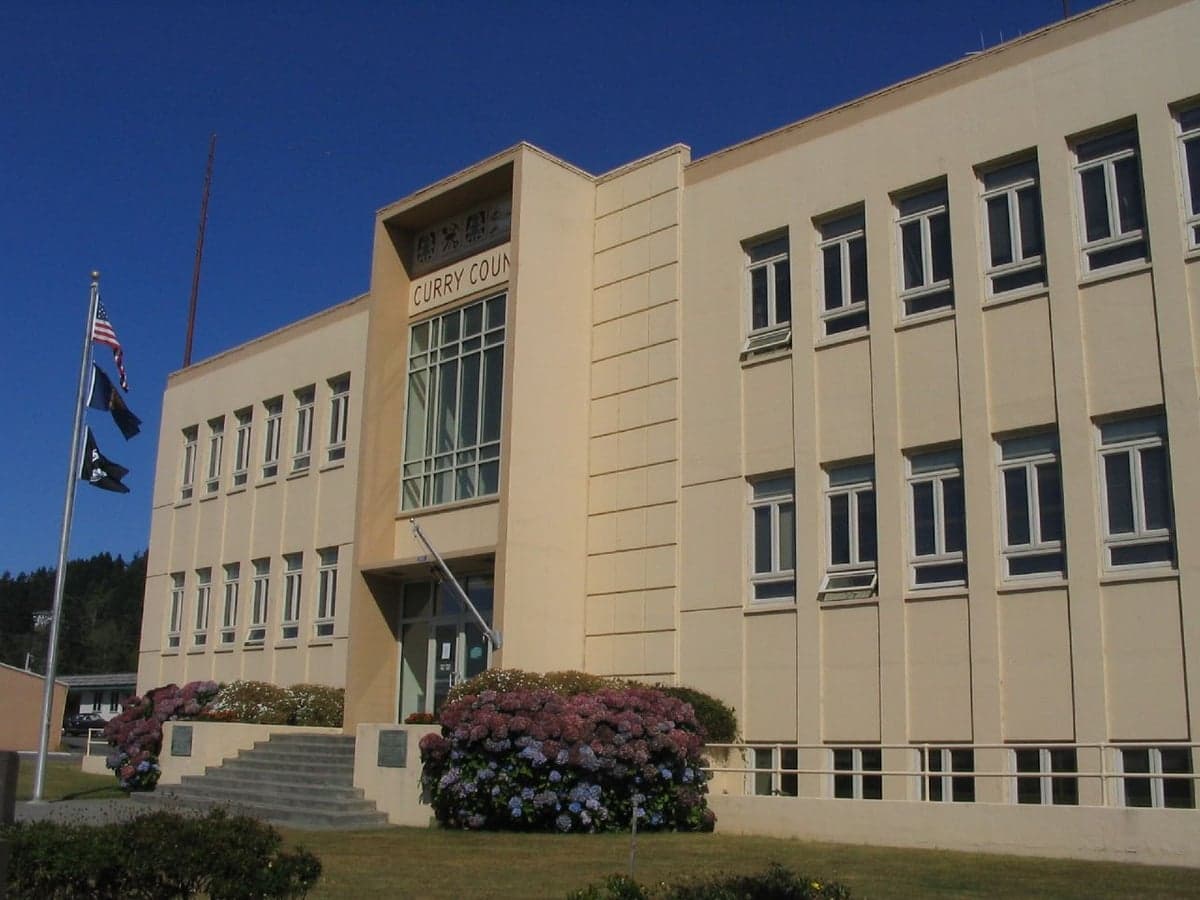
Photo: Wikipedia
Demographics of Curry County
Affluence Level in Curry County
A middle-class area roughly in line with national averages across income, home values, education, and employment.
People of Curry County
Curry County, Oregon, is home to roughly 23,463 people spread across a rugged, sparsely populated stretch of the southern Oregon coast. The population is overwhelmingly white (83.1%) and native-born, with a foreign-born share of just 2.1% — among the lowest in the state. Its identity is shaped by a century of timber, fishing, and small-town independence, anchored by the county seat of Gold Beach and the larger community of Brookings, with a distinctly older, quieter, and more politically conservative character than Oregon's Willamette Valley metros.
Settlement & growth (pre-1960)
Long before European settlement, the Rogue River and coastal areas of what is now Curry County were home to the Tututni, Chetco, and Tolowa peoples, who lived in permanent villages along the rivers and bays. Their world ended abruptly in the 1850s when the Rogue River Wars (1855–1856) resulted in the forced removal of nearly all Native people to the Siletz and Grand Ronde reservations. By 1860, the indigenous population of the county had been reduced to a small remnant, and the land was opened to white settlement.
The first permanent American settlers arrived in the 1850s, drawn by the discovery of gold along the beaches and river bars. Placer mining camps sprang up at Whiskey Creek, Randolph, and the mouth of the Rogue River, and for a brief period, Randolph was the largest town in the county. These early settlers were overwhelmingly Anglo-American — mostly from Missouri, Kentucky, and Tennessee — who came overland via the Applegate Trail. When the beach gold played out by the 1870s, most moved on, leaving a thin scattering of homesteaders who turned to subsistence farming, cattle, and fishing.
The county's modern population base formed in the early 20th century, driven by two industries: timber and salmon. The arrival of the railroad at the county line in 1915 (at Harbor, just north of Brookings) and the construction of the Roosevelt Highway (U.S. 101) in the 1920s opened the coast to commercial logging. Mills opened in Brookings, Gold Beach, and Port Orford, drawing workers from the declining timber towns of the Upper Midwest — Minnesota, Wisconsin, and Michigan — as well as from the Ozarks and the Deep South. These were largely white, working-class migrants, many of Scots-Irish and German descent, who came for steady mill wages and cheap land.
The 1930s brought a second wave: Dust Bowl refugees from Oklahoma, Arkansas, and the Texas Panhandle, who followed U.S. 101 north in search of work. Many settled in the Wedderburn and Ophir areas, where they took up fishing, crabbing, and small-scale farming. By 1940, the county's population had reached roughly 5,000, still overwhelmingly white, native-born, and rural. The post-war era saw modest growth as returning veterans took advantage of the GI Bill to buy land, but Curry County remained a backwater — isolated, heavily forested, and dependent on a boom-and-bust timber economy.
Modern era (post-1965)
The 1965 Hart-Cellar Act, which abolished national-origin quotas, had almost no direct effect on Curry County. Unlike Portland, Seattle, or the agricultural valleys of California, the Oregon coast never became a destination for post-1965 immigration. The county's foreign-born population today stands at just 2.1%, and the largest immigrant group is not from Asia or Latin America but from Canada and Northern Europe — retirees and second-home owners, not labor migrants.
The demographic story of modern Curry County is not immigration but domestic in-migration and aging. Beginning in the 1970s, the county became a magnet for retirees from California — particularly from the Bay Area and Los Angeles — drawn by cheap coastal property, mild winters, and a slower pace of life. This wave concentrated in Brookings and Harbor, which grew from a small mill town into a retirement hub with golf courses, RV parks, and medical clinics. A second, smaller wave of retirees came from the inland West — Idaho, Nevada, and Arizona — settling in Gold Beach and Port Orford.
At the same time, the collapse of the timber industry in the 1980s and 1990s triggered a slow out-migration of working-age families. Mill closures in Brookings and Gold Beach eliminated thousands of jobs, and younger residents left for Medford, Grants Pass, or out of state. The result is a county that is simultaneously growing and aging: the population has crept upward since 2000, but the median age (about 54) is among the highest in Oregon. The Hispanic population, at 7.5%, is the only non-white group of any size, and it is concentrated in the agricultural and service sectors around Brookings and the Illinois Valley border area — largely Mexican-American families who arrived in the 1990s and 2000s for work in nurseries, fishing, and hospitality. East/Southeast Asian residents make up just 0.6% of the population, and Black residents 0.3%, with Indian-subcontinent residents at 0.1% — tiny communities that are dispersed rather than clustered in any single neighborhood.
The future
Curry County is not becoming more diverse; if anything, it is becoming whiter and older relative to the rest of Oregon. The Hispanic share is stable at roughly 7–8%, but the county's overall growth is driven almost entirely by white retirees and remote workers from California and the Pacific Northwest. The next 10–20 years will likely see continued slow growth in Brookings and Harbor, which have the infrastructure, medical services, and coastal amenities to attract newcomers, while Gold Beach, Port Orford, and the interior communities of Agness and Powers continue to lose population or hold steady at best.
The cultural identity of the county is likely to remain distinctly conservative, rural, and independent — a place where the timber and fishing heritage is still celebrated, where property rights are fiercely defended, and where the political divide between the coast and Oregon's urban centers is wide and growing. The arrival of remote workers may bring some demographic softening, but the county's housing stock, limited broadband, and lack of urban amenities will keep growth modest. The Indian-subcontinent and East/Southeast Asian populations are likely to remain negligible, as there is no economic engine — no university, no tech sector, no major employer — to attract skilled immigration.
For someone moving to Curry County today, the bottom line is this: you are joining a small, aging, overwhelmingly white community where the economy is driven by healthcare, tourism, and public services rather than industry. The people are friendly but guarded, the politics are conservative, and the nearest big city is a two-hour drive. If you are looking for a quiet, affordable coastal retirement or a remote-work base with dramatic scenery, Curry County offers a genuine, if insular, community. If you are seeking diversity, urban amenities, or a fast-growing job market, this is not the place.

* Values derived from national, state, county, city and local statistics and may differ in a specific area. Last updated: 2026-10-16T03:26:48.000Z
Narrative content on this page is AI-generated and may contain mistakes. Verify any details that matter before acting on them.
ReloMaps may earn a commission from affiliate links at no extra cost to you.

