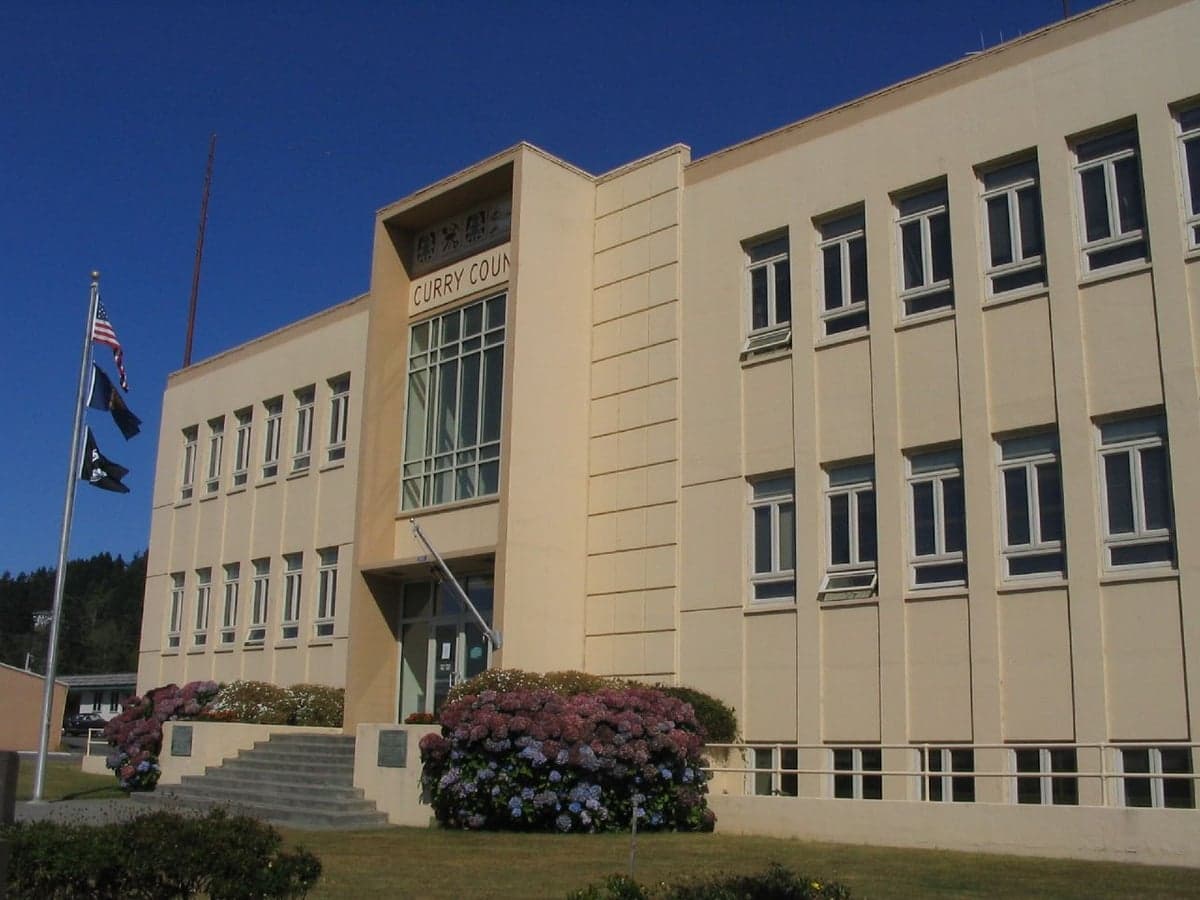
Photo: Wikipedia
Political ClimatePolitical Climate in Curry County
Showing district-level results — no local-only data available.
Local Political AnalysisPolitical Analysis of Curry County
Curry County, Oregon, is a fascinating political outlier on the southern coast—a place where the national Democratic lean of the state collides with a fiercely independent, rural frontier identity. While the state of Oregon carries a Cook PVI of D+8, Curry County sits at a slightly more competitive D+6, but that single number masks a deeply divided local landscape. The real story is in the precinct-level trenches: the county has been drifting rightward in recent cycles, even as the state as a whole has held firm, making it one of the most politically volatile stretches of coastline in the Pacific Northwest.
How it compares
On paper, a D+6 versus D+8 spread looks like a modest difference, but in practice, Curry County feels like a different country from Portland or Eugene. The county seat, Gold Beach, and the larger town of Brookings are the population centers, and they are where the political fault lines run deepest. Brookings, with its heavy concentration of retirees and veterans, leans noticeably more conservative—think Trump signs on Highway 101 and a strong local GOP presence. Gold Beach, meanwhile, is the more moderate-to-liberal anchor, home to county government workers, teachers, and a small but vocal progressive community that keeps the county from flipping fully red. The swing precincts are the rural stretches between the two towns—places like Ophir, Wedderburn, and the Pistol River area—where independent voters decide every election. These are the folks who split tickets, voting for a Democratic county commissioner one year and a Republican state senator the next, driven more by local issues than national party loyalty.
What this means for residents
For conservative residents, the D+6 lean means they are perpetually in the minority at the state level, but they hold real power locally. The Curry County Board of Commissioners has trended conservative in recent years, and the local GOP is well-organized, particularly around gun rights and timber policy. For liberal residents, the reality is that they can win countywide races in Gold Beach and hold their own in Brookings, but they face an uphill battle in statewide contests. The practical upshot is a politics of pragmatism: both sides know they need to court the independent swing voters in the rural precincts, which keeps the rhetoric more measured than in deep-blue or deep-red counties. The county has also become a flashpoint for coastal land-use debates—curry county residents on the left push for marine sanctuary protections, while those on the right fight for expanded fishing and logging access—and those fights often transcend party lines.
What daily life is like for families
For families, the political climate translates into a school board that is often the most contested local battleground. The Brookings-Harbor School District and the Central Curry School District in Gold Beach have seen heated debates over curriculum and funding, with conservative parents pushing for more vocational programs and liberal parents advocating for expanded arts and social services. The county's small population—around 23,000—means everyone knows everyone, and political disagreements rarely stay in the voting booth. It is not uncommon to see a neighbor with a "Don't Tread on Me" flag living next door to a house flying a Pride flag, and for the most part, they coexist because the economy depends on it. Tourism, fishing, and healthcare are the big employers, and those industries do not care about your party registration.
Looking ahead, the trajectory is toward a tighter margin. The county's growing retiree population from California and Washington tends to bring moderate-to-conservative fiscal views, while younger residents who stay or move back for remote work lean progressive. The wildcard is the coastal climate—as sea-level rise and wildfire risk become more pressing, environmental policy could reshuffle the coalitions. For now, Curry County remains a place where the D+6 label is just a starting point; the real politics are lived out in town halls, harbor commission meetings, and the long drives between Gold Beach and Brookings. It is a community that votes its interests, not its identity, and that makes it one of the most genuinely competitive corners of Oregon.

State Political ClimatePolitical Climate in Oregon
State Political AnalysisPolitical Environment in the State
Oregon is a solidly Democratic state with a Cook PVI of D+8, but that single number hides a deeply fractured political landscape. The state has voted for the Democratic presidential nominee in every election since 1988, yet that blue veneer is powered almost entirely by the Portland metro area, while vast stretches of the state — from Medford to Pendleton — vote as red as any county in Texas or Idaho. Over the last decade, the state has drifted further left on policy while the rural-urban divide has widened into something closer to a cold civil war, with talk of rural counties joining Idaho becoming a mainstream topic rather than a fringe joke.
Urban vs. rural divide
The political map of Oregon is essentially a story of three regions. The Portland tri-county area — Multnomah, Washington, and Clackamas — contains roughly half the state's population and drives the Democratic margin. Multnomah County alone gave Joe Biden 79% of the vote in 2020, and it's the engine of nearly every statewide Democratic victory. The Willamette Valley cities of Eugene, Salem, and Corvallis add another layer of blue, anchored by the University of Oregon and Oregon State University. But drive over the Coast Range or the Cascades and the landscape flips hard. Eastern Oregon — places like Bend, Redmond, and Pendleton — is deeply conservative, with Deschutes County being the only real political battleground in the region as California transplants have turned Bend into a purple island in a red sea. Southern Oregon's Jackson and Josephine counties, home to Medford and Grants Pass, are reliably Republican, and the rural coastal counties like Curry and Douglas vote red by wide margins. The 2022 gubernatorial race told the story: Democrat Tina Kotek won statewide by just 3.5 points, but she lost 31 of Oregon's 36 counties, winning only the Portland metro, Eugene, and Benton County. That's the reality of Oregon politics — a state where the urban core decides everything and the rural majority is permanently outvoted.
Policy environment
Oregon's policy environment is among the most progressive in the nation, and it shows in the tax code and regulatory structure. There is no state sales tax, which sounds appealing, but the state makes up for it with the fifth-highest personal income tax rate in the country — the top marginal rate hits 9.9% — and property taxes that are capped by Measure 5 but still rank above the national average. The regulatory posture is aggressively green: Oregon was the first state to pass a cap-and-trade style carbon reduction program through executive action after the legislature failed to pass it, and the state has some of the strictest land-use laws in the country, with the Urban Growth Boundary limiting development around Portland and other cities. Education policy is dominated by the teachers' unions, and the state consistently ranks near the bottom nationally in graduation rates despite spending above the national average per pupil. Healthcare is heavily regulated, with Oregon operating one of the earliest Medicaid expansion programs under the Affordable Care Act, and the state has some of the strongest abortion protections in the country, codified into law in 2017 and expanded further in 2023. Election law is notably progressive: Oregon was the first state to adopt vote-by-mail entirely in 1998, and it has automatic voter registration through the DMV, same-day voter registration, and no voter ID requirement — a fact that frustrates conservatives who see the system as ripe for fraud, though the state's elections have shown no evidence of widespread irregularities.
Recent policy direction
The last five years have seen Oregon's legislature push hard left on nearly every front, and the results are concrete and measurable. On gun policy, Oregon passed Measure 114 in 2022, which requires a permit to purchase a firearm, a background check, and a completed safety training course — though it's currently tied up in federal court and not being enforced. On drug policy, Oregon became the first state to decriminalize possession of small amounts of hard drugs like heroin and methamphetamine through Measure 110 in 2020, then partially walked it back in 2024 after overdose deaths spiked and public backlash grew. On parental rights, the state passed the "Parents Bill of Rights" in 2023, which requires schools to notify parents of curriculum changes and health services, but it stopped short of the broader transparency laws seen in red states. On speech and privacy, Oregon has some of the strongest privacy protections in the country with the Oregon Consumer Privacy Act, but it also passed a law in 2021 that makes it a crime to "interfere" with a person entering an abortion facility, effectively creating a buffer zone that restricts free speech near clinics. Property rights are heavily constrained by land-use laws, and the state's rent control law, passed in 2019, caps annual rent increases at 7% plus inflation. On voting, Oregon continues to expand access, adding automatic voter registration and pre-registration for 16-year-olds, while the state has no signature verification requirement beyond a basic match — a point of contention for election integrity advocates.
Civil unrest & political movements
Oregon has a well-earned reputation for political volatility, and the flashpoints are impossible to miss. The 2020 protests in Portland — which ran for over 100 consecutive nights following the murder of George Floyd — drew national attention and turned the city into a symbol of left-wing activism, with the federal government deploying agents to protect the federal courthouse. The movement has cooled significantly, but the infrastructure remains: groups like the Portland General Defense Committee and the Pacific Northwest Youth Liberation Front are still active, and the city's politics remain dominated by progressive activists who have pushed the city council to defund the police — the police bureau's budget was cut by $15 million in 2020, though it has since been partially restored. On the right, the Oregon Republican Party has moved sharply toward the Trump wing, and the rural counties have responded with a growing "Greater Idaho" movement — a serious proposal to move 13 rural counties into Idaho, which has been approved for study by several county commissions and has the backing of the Idaho legislature. The movement is unlikely to succeed — it would require approval from both state legislatures and Congress — but it reflects a genuine alienation among rural Oregonians who feel their votes are meaningless. Immigration politics are less heated than in border states, but Oregon is a sanctuary state, with a 1987 law prohibiting state and local law enforcement from using resources to enforce federal immigration law, and Portland has repeatedly resisted federal immigration enforcement efforts. The state also saw a controversial 2023 law that allows non-citizens to obtain driver's licenses, which passed along party lines.
Projection
Looking ahead five to ten years, Oregon's political trajectory is likely to remain on its current course, but with some meaningful shifts. The Portland metro continues to grow, driven by in-migration from California and other blue states, which reinforces the Democratic majority — the state's population grew by about 10% between 2010 and 2020, almost entirely in the urban centers. However, there are signs of a suburban backlash: Washington County, once reliably blue, has seen its margins tighten as tech workers and families express frustration with homelessness, drug policy, and rising crime in Portland proper. The 2024 election saw Donald Trump improve his margins in every Oregon county compared to 2020, including Multnomah, suggesting that even the urban core is not immune to national trends. The Greater Idaho movement will continue to gain rhetorical traction but is unlikely to produce actual change. The most realistic scenario is a state that remains solidly Democratic at the statewide level — the D+8 PVI is unlikely to shift more than a point or two — but with a more competitive suburban ring around Portland and a rural population that grows increasingly alienated. A new resident moving to Oregon today should expect to live in a state where the political culture is defined by the Portland metro, where progressive policies on drugs, abortion, and climate are locked in, and where the rural-urban divide will remain the defining political fault line for the foreseeable future.
For a new resident, the bottom line is this: Oregon is a state where your political experience depends almost entirely on where you live. If you're a conservative moving to Portland, you'll be in the minority, and you'll find that state policy on guns, taxes, and education runs against your preferences — but you'll also find a functioning city with a strong economy and a growing community of like-minded people in the suburbs. If you're a conservative moving to Bend, Redmond, or Medford, you'll find a more welcoming political environment, but you'll still be governed by a legislature in Salem that doesn't represent you. If you're a liberal, Oregon is about as close to your ideal as you'll find in the United States, with the caveat that the state's progressive governance has produced real problems — homelessness, drug addiction, and a housing crisis — that even the most committed Democrats acknowledge are out of control. Oregon is a beautiful state with a lot to offer, but it's also a state where politics is never far from the surface, and the choice of where to put down roots matters more than in most places.
* Values derived from national, state, county, city and local statistics and may differ in a specific area. Last updated: 2026-10-16T03:26:48.000Z
Narrative content on this page is AI-generated and may contain mistakes. Verify any details that matter before acting on them.
ReloMaps may earn a commission from affiliate links at no extra cost to you.

