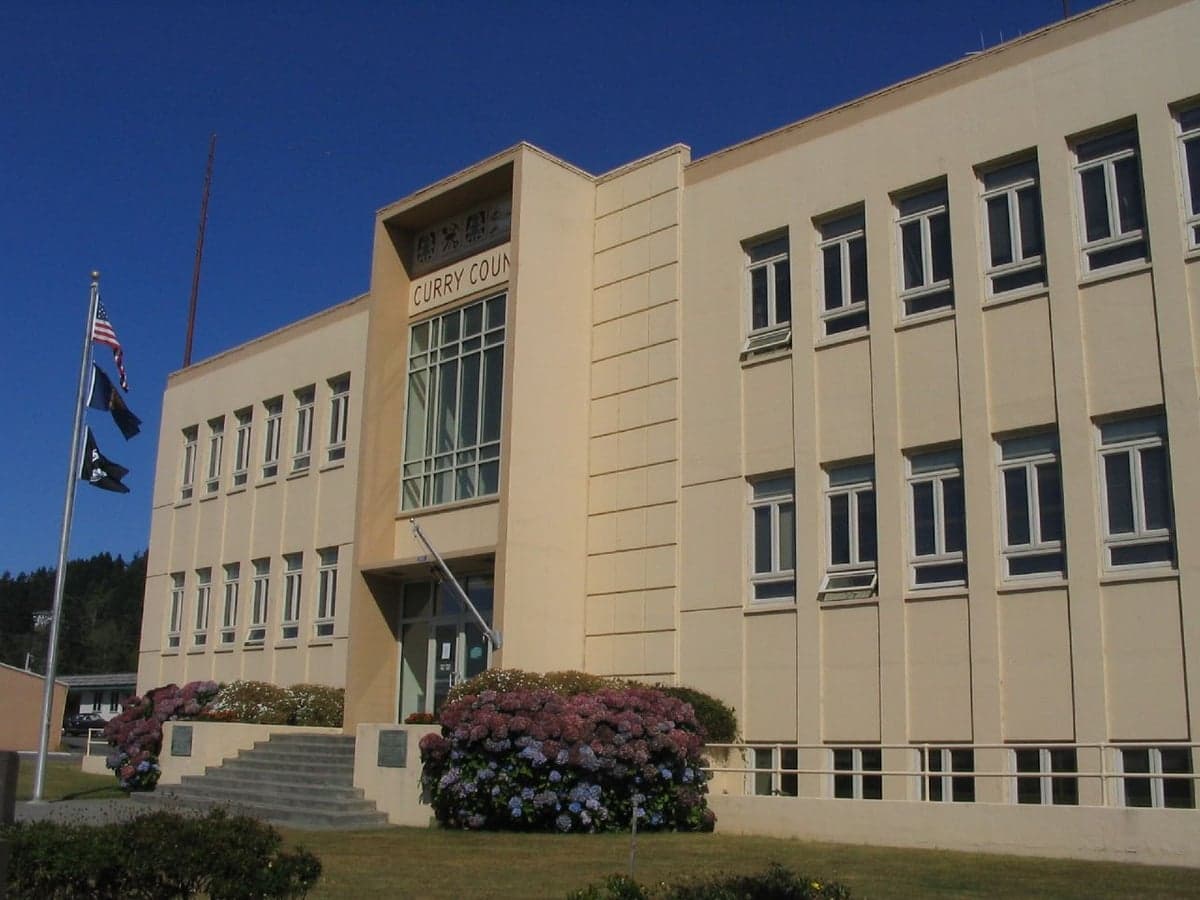
Photo: Wikipedia
Personal Sovereignty in Curry County
Viable for self-reliance. Generally workable, though some barriers may limit total independence.
What does Personal Sovereignty tell us?
Personal Sovereignty measures your capacity for self-reliance and independence with minimal government friction. Higher scores mean fewer barriers between you and the way you want to live... but it assumes you have the space you need and good neighbors.
What does this tell us?
Personal Sovereignty measures your capacity for self-reliance and independence with minimal government friction. Higher scores mean fewer barriers between you and the way you want to live... but it assumes you have the space you need and good neighbors.
State Policy
Energy independence: Importer (35% of energy produced in-state)
Personal Liberty
Homesteading

Personal Liberty Analysis
Curry County, Oregon, offers one of the most autonomy-friendly environments on the West Coast, combining Oregon’s relatively permissive land-use laws with a remote coastal geography that keeps state oversight at arm’s length. For individuals and families weighing personal sovereignty, the county’s unincorporated areas—stretching from the Sixes River valley down to the Pistol River basin—operate with a lighter regulatory touch than nearly anything found in the Willamette Valley. The trade-off is real: this is a rugged, sparsely populated corner of the state where self-reliance isn’t a lifestyle choice so much as a baseline requirement, and the nearest major services are a 90-minute drive over the Coast Range to Grants Pass or Medford.
Tax burden and regulatory posture: how Curry County compares to Oregon’s urban core
Oregon has no sales tax, and Curry County’s property tax rate is among the lowest in the state—typically hovering around 0.85% of assessed value, compared to Multnomah County’s 1.2% or higher. The county’s total levy, which funds the road district, the port of Gold Beach, and rural fire protection, adds roughly $2.50 to $3.50 per $1,000 of assessed value on top of the base rate. For a $350,000 home, that translates to an annual bill near $3,000—a figure that undercuts most of the Portland metro by 25-30%. Income tax remains the state’s primary revenue engine, with a top marginal rate of 9.9% kicking in above $125,000 for single filers, so high earners won’t find the tax shelter they might in Nevada or Texas. But for middle-income households, the absence of sales tax and the county’s lean property assessments make the total burden competitive with many inland Western counties.
Regulatory posture is where Curry County truly diverges from Oregon’s urban centers. The county’s land-use ordinance, last comprehensively updated in 2021, designates roughly 85% of its land area as exclusive farm use or forestland, which sounds restrictive but in practice means fewer zoning overlays and less discretionary review than the urban growth boundaries that choke the Willamette Valley. Building permits in unincorporated areas like Nesika Beach or Ophir are processed by a three-person planning department in Gold Beach, with typical turnaround times of 2-4 weeks for standard residential construction—versus 3-6 months in Jackson County or Washington County. The county has also declined to adopt statewide mandatory septic inspection programs, leaving on-site wastewater decisions to the homeowner and a licensed designer rather than a county inspector. State-level building codes still apply, but enforcement is complaint-driven in practice; the county does not run proactive code enforcement sweeps in rural areas.
Self-defense and gun law specifics: what the Second Amendment looks like on the south coast
Oregon’s Measure 114, passed in 2022, introduced permit-to-purchase requirements and a magazine capacity limit of 10 rounds, but its implementation has been mired in litigation, and as of early 2026 the permitting scheme remains enjoined by a Harney County circuit court ruling. In Curry County, the practical effect is minimal: the sheriff’s office in Gold Beach has stated publicly that it will not enforce magazine restrictions pending final appellate review, and the county’s two Federal Firearms Licensees—one in Brookings, one in Gold Beach—report normal inventory turnover. Oregon remains a shall-issue state for concealed carry, and Curry County’s sheriff issues licenses within the statutory 45-day window, typically faster. There is no county-level gun registration, no waiting period beyond the federal NICS check, and no local ordinance restricting open carry, which is legal statewide without a permit.
The cultural posture differs meaningfully between the county’s two population centers. Brookings, the larger city at the California border, has a more mixed demographic and a slightly more cautious approach—the city council declined to pass a Second Amendment sanctuary resolution in 2023, though the county as a whole did. Gold Beach, the county seat, is more overtly gun-friendly; the local shooting range at the Curry County Fairgrounds hosts monthly matches, and the sheriff’s office runs a free youth hunter safety program each fall. Unincorporated areas like Wedderburn and Carpenterville have no local firearm ordinances whatsoever, and rural landowners routinely shoot on their own property without neighbor complaints—a stark contrast to the noise and discharge restrictions common in Jackson County’s suburban zones. For self-defense law, Oregon’s Castle Doctrine applies to both home and vehicle, and the state’s use-of-force statute (ORS 161.219) permits deadly force against unlawful intrusion into occupied dwellings without a duty to retreat.
Self-reliance and homesteading viability: lot sizes, zoning, and off-grid feasibility
Curry County is one of the last places in Oregon where a family can buy a 5- to 20-acre parcel with water rights and reasonable road access for under $150,000. The unincorporated areas around Agness, along the Rogue River, and the uplands above Port Orford offer the most viable homesteading prospects, with minimum parcel sizes of 5 acres in the county’s exclusive farm use zone and no requirement for a minimum square footage on a primary dwelling. Off-grid living is explicitly legal: the county allows permanent residences without utility hookups, provided the homeowner installs an approved septic system and obtains a well permit from the Oregon Water Resources Department. Solar installations require an electrical permit but no county-level special use review, and several off-grid communities—notably the area around Cape Sebastian and the Hunter Creek drainage—have operated without grid power for decades.
The zoning map tells a nuanced story. The coastal strip from Brookings to Gold Beach is zoned rural residential with 1- to 2.5-acre minimums, which attracts retirees and telecommuters but limits serious agricultural activity. Inland, along the Illinois River and the lower Rogue, the exclusive farm use zone permits not just dwellings but also accessory farmworker housing, roadside farm stands, and value-added processing without conditional use permits. The county’s agricultural land is marginal—mostly timber soils and steep slopes—so the practical homesteading focus is on livestock, orchard crops, and timber management rather than row crops. Agness, accessible only by boat or gravel road, represents the extreme end of the sovereignty spectrum: no county building inspections are performed there, and the community maintains its own volunteer fire response. The trade-off is isolation; Agness is 45 minutes from the nearest grocery store in Gold Beach, and winter storms can close the access road for days.
Personal liberties: parental rights, medical autonomy, speech, and property
Oregon’s statewide policies on medical autonomy and parental rights are more progressive than the local culture, creating a patchwork that residents navigate carefully. The state’s 2023 law codifying abortion access and gender-affirming care protections applies in Curry County, but the county’s only hospital—Curry General in Gold Beach—does not offer abortion services, and the nearest provider is in Grants Pass, a 90-minute drive. Vaccine mandates for school attendance were eliminated by the Oregon legislature in 2024, and Curry County’s two school districts (Brookings-Harbor and Central Curry) both allow broad religious and philosophical exemptions. Parental rights in education are comparatively strong: Oregon’s 2021 law requiring schools to adopt policies on parental notification for student health services was implemented conservatively in Curry County, with both districts notifying parents of any counseling referrals involving minors.
Property rights are the county’s strongest liberty guarantee. Oregon’s Measure 37/49 framework requires the county to either waive land-use regulations that reduce property value or pay compensation, and Curry County has processed over 200 claims since 2007—the highest per-capita rate of any Oregon county. In practice, this means a landowner in Pistol River or Sixes can often obtain a waiver to build a second dwelling or expand a non-conforming use that would be flatly denied in Lane or Deschutes counties. Speech and assembly are protected under standard First Amendment jurisprudence, and the county’s small population means no permit is required for gatherings under 100 people on private property. The county commission holds public comment at every meeting, and the Gold Beach and Brookings city councils have both adopted rules requiring agenda items to be heard within 60 days of request—a responsiveness that larger jurisdictions rarely match.
Relative to the rest of Oregon, Curry County ranks in the top tier for personal sovereignty, comparable to Lake or Harney counties in the eastern part of the state but with the advantage of coastal rainfall and milder winters. The regulatory environment is light-touch without being lawless, the tax burden is modest, and the county’s remote geography naturally filters out the density-driven restrictions that characterize the I-5 corridor. For a family or individual who values self-reliance, the practical sovereignty here is substantial—but it comes with the expectation that you handle your own water, power, and emergency preparedness, because the county’s resources are thin and the nearest urban center is hours away.

* Values derived from national, state, county, city and local statistics and may differ in a specific area. Last updated: 2026-10-16T03:26:48.000Z
Narrative content on this page is AI-generated and may contain mistakes. Verify any details that matter before acting on them.
ReloMaps may earn a commission from affiliate links at no extra cost to you.

