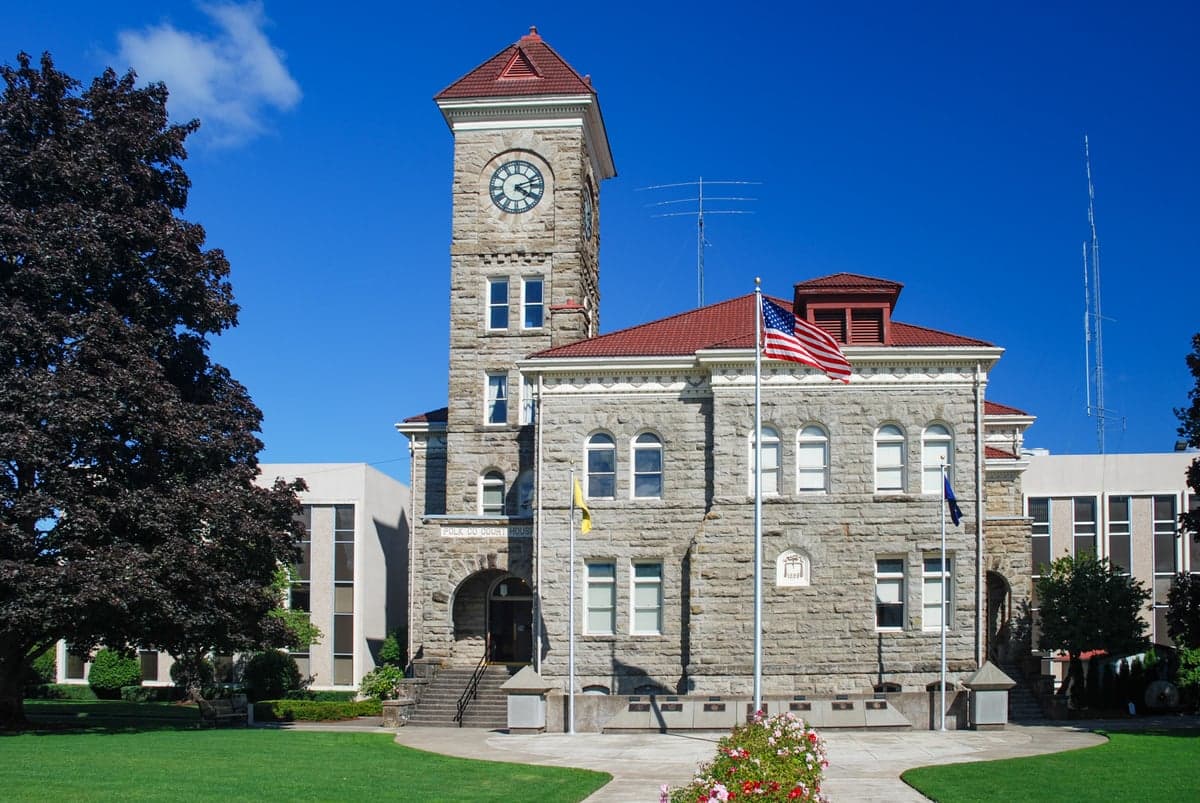
Photo: Wikipedia
Demographics of Polk County
Affluence Level in Polk County
A middle-class area roughly in line with national averages across income, home values, education, and employment.
People of Polk County
Polk County, Oregon, is a predominantly white, rural-suburban community of 88,553 residents, characterized by a strong agricultural heritage and a growing commuter population tied to the Salem and Portland metro areas. With a foreign-born population of just 2.7% and a Hispanic community of 15.2%, the county retains a distinctly non-diverse, family-oriented character, anchored by the county seat of Dallas and the historic town of Independence. The population is notably less college-educated (30.6%) than the state average, reflecting a blue-collar and agricultural economic base that has shaped its conservative-leaning political identity.
Settlement & growth (pre-1960)
The original inhabitants of the area were the Kalapuya people, who lived in seasonal villages along the Willamette River and its tributaries, including the Luckiamute and Rickreall Creeks. Their population was decimated by disease and displacement following Euro-American contact, and by the 1850s, the Kalapuya were largely removed to the Grand Ronde Reservation, which lies partially within modern Polk County.
American settlement began in earnest after the Oregon Donation Land Claim Act of 1850, which granted 320 acres to married couples who would farm the land. The first major wave of settlers were white Americans from the Midwest and Upper South—primarily from Missouri, Illinois, and Kentucky—who arrived via the Oregon Trail between 1845 and 1860. These families established the county's earliest towns: Dallas (platted 1852) became the county seat, while Monmouth (founded 1853) was settled by a group of Oregon Trail pioneers who later founded what is now Western Oregon University. Independence (founded 1845) grew as a river port on the Willamette, shipping wheat and lumber to Portland.
A second wave arrived between 1880 and 1910, driven by the expansion of the railroad and the timber industry. The Oregon and California Railroad reached Dallas in 1880, opening the county to more intensive logging and milling. This period brought a modest influx of German and Scandinavian immigrants, who settled in farming communities like Falls City (founded 1893) and Willamina (partially in Polk County). These groups were drawn by cheap land and work in the sawmills, and their descendants remain concentrated in the rural western half of the county. The population grew slowly but steadily, reaching 22,873 by 1950, with the economy dominated by agriculture (hops, berries, and grass seed) and timber.
No significant Dust Bowl or Great Migration waves reached Polk County; its population remained overwhelmingly white and native-born through the 1960s. The county's isolation from major urban centers and its lack of heavy industry meant it was largely bypassed by the 20th-century demographic shifts that reshaped coastal Oregon cities.
Modern era (post-1965)
The 1965 Hart-Cellar Act had a minimal direct impact on Polk County. The foreign-born population today is just 2.7%, far below the national average of 13.7%. The most notable post-1965 change has been the growth of the Hispanic population, which rose from negligible levels in 1970 to 15.2% by 2025. This growth is almost entirely driven by Mexican-American and Mexican immigrant families who arrived from the 1980s onward, drawn by agricultural labor in the county's berry, nursery, and grass-seed fields. These workers settled primarily in Independence and Monmouth, where they formed a visible but not segregated community; many work in the fields or in food processing plants in nearby Salem.
Domestic migration has been the larger force reshaping the county since 1990. The expansion of the Salem metropolitan area and the growth of Portland's exurban fringe have pushed commuters into Polk County, particularly along the Highway 22 corridor. Dallas has seen the most suburban-style growth, with new subdivisions built for families seeking lower housing costs and larger lots than Salem offers. Monmouth has grown steadily as a college town, with Western Oregon University attracting students and faculty from across the state. The county's white population share has declined from roughly 90% in 1990 to 74.9% today, driven almost entirely by Hispanic in-migration and a slight increase in East/Southeast Asian residents (1.3%) and Indian-subcontinent residents (0.4%), the latter concentrated in professional roles at the university and in Salem's healthcare sector.
The Black population remains negligible at 0.5%, and there is no significant Arab or other immigrant enclave. The county has not experienced the coastal flight or Rust Belt migration that has reshaped other parts of Oregon; its growth has been organic, driven by natural increase and the slow spillover of Salem's suburban expansion.
The future
Polk County's population is projected to continue growing slowly, likely reaching 100,000 by 2040, driven by continued exurban spillover from Salem and Portland. The Hispanic share is expected to rise to 20-22% over the next two decades, as younger Hispanic families have higher birth rates and continued agricultural labor demand. However, this growth is unlikely to create distinct ethnic enclaves; the county's small size and rural character mean that assimilation into the broader white-majority culture is the dominant pattern, with Spanish-language use declining by the third generation.
The white population will continue to shrink as a share of the total, but the county will remain overwhelmingly white and native-born. The East/Southeast Asian and Indian communities will likely grow modestly, tied to professional opportunities at Western Oregon University and Salem's expanding healthcare and tech sectors, but they will remain small and dispersed. The county is not tribalizing into distinct ethnic neighborhoods; instead, it is slowly homogenizing into a broader Hispanic-white blended culture, particularly in Independence and Monmouth.
In-migration from more liberal urban areas (Portland, Seattle, California) is a minor but growing factor, particularly in Dallas and Monmouth, where new subdivisions attract remote workers and retirees. These newcomers are slightly more college-educated and politically moderate than the native population, but they are being absorbed into the county's existing cultural fabric rather than transforming it. The county's conservative political identity is likely to soften slightly but remain intact, as the agricultural and blue-collar base persists.
For someone moving in now, Polk County offers a stable, low-diversity, family-oriented environment where the population is slowly diversifying along Hispanic lines but remains culturally anchored in its white, agricultural, and small-town roots. The next decade will see more suburban-style development in Dallas and Monmouth, but the county's essential character—quiet, rural, and politically conservative—is unlikely to change dramatically.

* Values derived from national, state, county, city and local statistics and may differ in a specific area. Last updated: 2026-05-18T02:41:34.000Z
Narrative content on this page is AI-generated and may contain mistakes. Verify any details that matter before acting on them.
ReloMaps may earn a commission from affiliate links at no extra cost to you.

