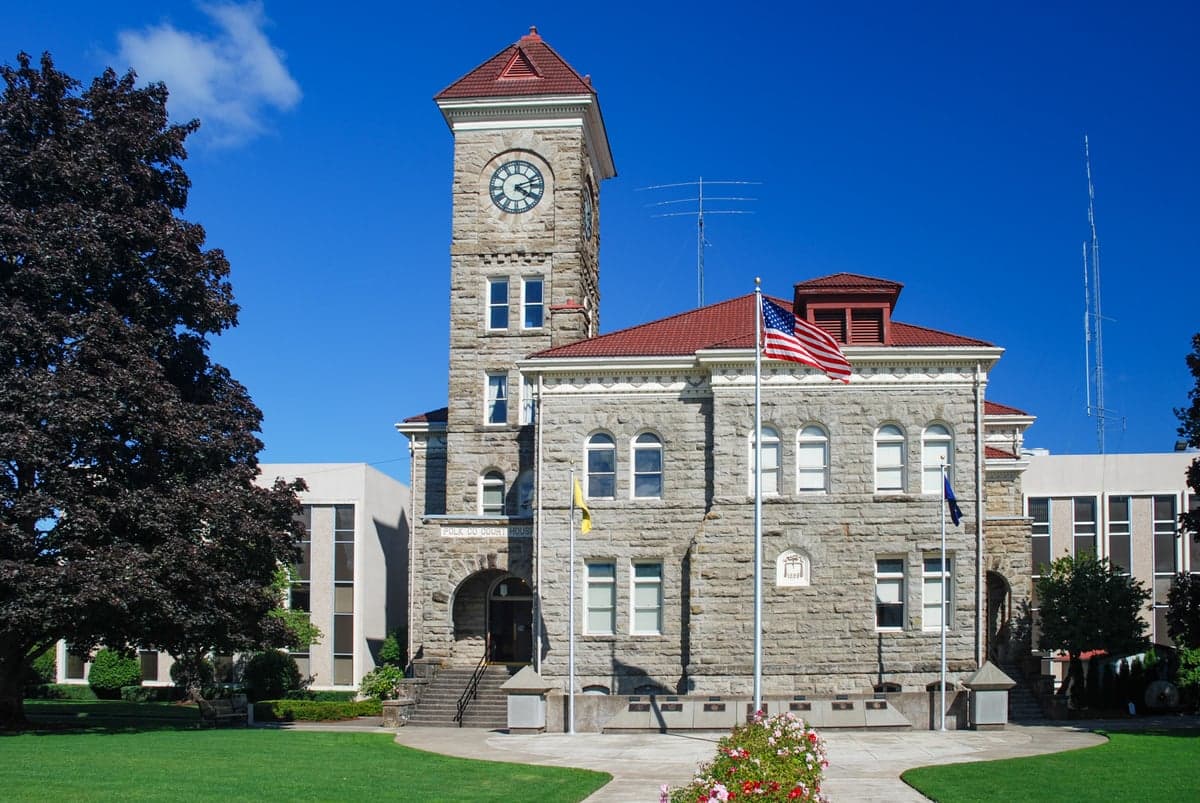
Photo: Wikipedia
Personal Sovereignty in Polk County
Viable for self-reliance. Generally workable, though some barriers may limit total independence.
What does Personal Sovereignty tell us?
Personal Sovereignty measures your capacity for self-reliance and independence with minimal government friction. Higher scores mean fewer barriers between you and the way you want to live... but it assumes you have the space you need and good neighbors.
What does this tell us?
Personal Sovereignty measures your capacity for self-reliance and independence with minimal government friction. Higher scores mean fewer barriers between you and the way you want to live... but it assumes you have the space you need and good neighbors.
State Policy
Energy independence: Importer (35% of energy produced in-state)
Personal Liberty
Homesteading

Personal Liberty Analysis
Polk County, Oregon, offers a notably higher degree of personal sovereignty than the Willamette Valley’s urban cores, but it is not a libertarian free zone. The county’s rural character, combined with Oregon’s increasingly centralized state government, creates a tension that residents navigate daily. For those prioritizing autonomy—whether in self-defense, homesteading, or resisting government overreach—Polk County provides a meaningful buffer from Portland’s regulatory reach, though it still operates under Salem’s thumb. The key is understanding where local enforcement and culture diverge from state law, and which specific towns offer the most breathing room.
Tax burden and regulatory posture in Polk County vs. the Willamette Valley
Oregon’s lack of a sales tax is a double-edged sword: it keeps consumption costs low, but the state’s income tax—among the highest in the nation at a top marginal rate of 9.9%—funds a sprawling bureaucracy that increasingly preempts local control. Polk County’s property tax rates are moderate, averaging around 1.1% of assessed value, but the county’s regulatory posture is more permissive than Multnomah or Washington counties. The city of Dallas, the county seat, has a relatively hands-off approach to home-based businesses and small-scale agriculture, while Monmouth—home to Western Oregon University—leans slightly more progressive on land-use enforcement. Independence, with its historic riverfront, has stricter floodplain regulations that can complicate building permits. For those seeking minimal interference, unincorporated areas like Falls City or the rural stretches near Willamina offer the lightest touch, where county planning staff are more focused on timber and farm uses than urban-style code enforcement. Oregon’s statewide land-use laws (Goal 3 and Goal 4) still apply, meaning you cannot simply build a cabin on any parcel—but Polk County’s planning department is known for working with landowners rather than against them, especially on farm-forest parcels of 20 acres or more.
Self-defense and gun law specifics in Polk County’s rural communities
Oregon’s Measure 114, which passed in 2022 and remains tied up in court, threatens to impose a permit-to-purchase system and magazine capacity limits, but as of 2026, it is still not fully enforced. Polk County Sheriff Mark Garton has publicly stated his office will not enforce any gun control measure he deems unconstitutional, a stance that carries weight in the county’s rural precincts. Open carry is legal without a permit in Oregon, and Polk County’s sheriff’s office issues concealed handgun licenses (CHLs) efficiently—typically within 30 days. The culture in Dallas and Falls City is heavily pro-Second Amendment; you will see firearms displayed in pickup windows and at local hardware stores without a second glance. Monmouth is the outlier, with a more college-town vibe that can feel less welcoming to open carry, though legal rights remain intact. For preppers, the key advantage is that Polk County’s rural geography—dense forests and isolated valleys—means that self-defense scenarios are more likely to involve wildlife or trespassers than urban crime. The county’s stand-your-ground protections are governed by Oregon’s “Make My Day” law, which provides a strong presumption of self-defense in your home, but does not extend to vehicles or public spaces as broadly as in Texas or Florida. If you are serious about firearms as a pillar of personal sovereignty, Polk County’s sheriff’s office is an ally, not an obstacle.
Self-reliance and homesteading viability: lot sizes, zoning, and off-grid feasibility
Polk County’s zoning code is a patchwork that rewards those who do their homework. In unincorporated areas, farm-forest parcels of 20 acres or more allow for a single-family dwelling, barns, and accessory structures without a conditional use permit. Smaller lots—down to 5 acres in some exclusive farm use (EFU) zones—can support a home and limited agriculture, but you will need to prove a farm income to qualify for a dwelling permit. Falls City and the Little Luckiamute River valley are hotspots for off-grid living; many residents use solar panels, rainwater catchment, and composting toilets without interference, as long as they meet basic health department requirements for septic. Willamina, on the county’s western edge, has more relaxed enforcement of building codes, with many older homes operating on well water and propane. The county does not actively prohibit tiny homes or RVs as permanent dwellings on rural land, but you must have a septic system approved by the county health department—a hurdle that can cost $5,000–$10,000. For those seeking total grid independence, the Grand Ronde area (near the tribal reservation) offers large, affordable parcels with minimal county oversight, though the tribal government has its own jurisdiction. The bottom line: Polk County is one of the more homestead-friendly counties in western Oregon, but you need acreage and a willingness to navigate the state’s land-use appeals process if a neighbor complains.
Personal liberties: parental rights, medical autonomy, speech, and property
Oregon’s state government has aggressively expanded its reach into areas that conservatives view as parental rights and medical autonomy. The state mandates comprehensive sex education, allows minors to consent to certain medical procedures without parental notification, and has a strict vaccine schedule for school attendance. Polk County’s school districts—particularly Dallas School District and Falls City School District—have pushed back against some state mandates, with school boards that are more responsive to parental concerns than those in Portland. Homeschooling is straightforward: you file a notice of intent with the local Education Service District (ESD) and provide annual assessments, but there is no state curriculum requirement. Medical autonomy is more constrained; Oregon’s assisted suicide law and broad vaccine mandates are state-level realities you cannot opt out of by moving to Polk County. However, the county’s health department is less aggressive in enforcement than Multnomah County’s, and many rural doctors are willing to work with patients on alternative treatment plans. Free speech is protected, but Oregon’s bias crime laws are broad, and local law enforcement in Monmouth has been known to investigate politically charged speech more actively than in Dallas. Property rights are the strongest pillar: Oregon’s property tax system (Measure 5 and Measure 50) caps annual increases at 3%, and Polk County’s planning department rarely initiates enforcement actions without a complaint. If you want to build a fence, keep livestock, or post political signs, you will have few issues outside of Monmouth’s city limits.
Compared to the Portland metro area or even Salem, Polk County offers a substantially higher degree of personal sovereignty—particularly in self-defense, homesteading, and property rights. The trade-off is that Oregon’s state-level overreach on medical mandates, education, and taxation remains a constant pressure, one that requires active engagement with local politics to preserve. For a prepper or conservative family looking to escape urban control without leaving the Pacific Northwest entirely, Polk County’s rural towns—especially Falls City, Willamina, and the unclaimed stretches near Grand Ronde—provide a viable base of operations. Just know that the fight for autonomy here is not won; it is maintained, one county commission meeting and one sheriff’s election at a time.

* Values derived from national, state, county, city and local statistics and may differ in a specific area. Last updated: 2026-05-18T02:41:34.000Z
Narrative content on this page is AI-generated and may contain mistakes. Verify any details that matter before acting on them.
ReloMaps may earn a commission from affiliate links at no extra cost to you.

