
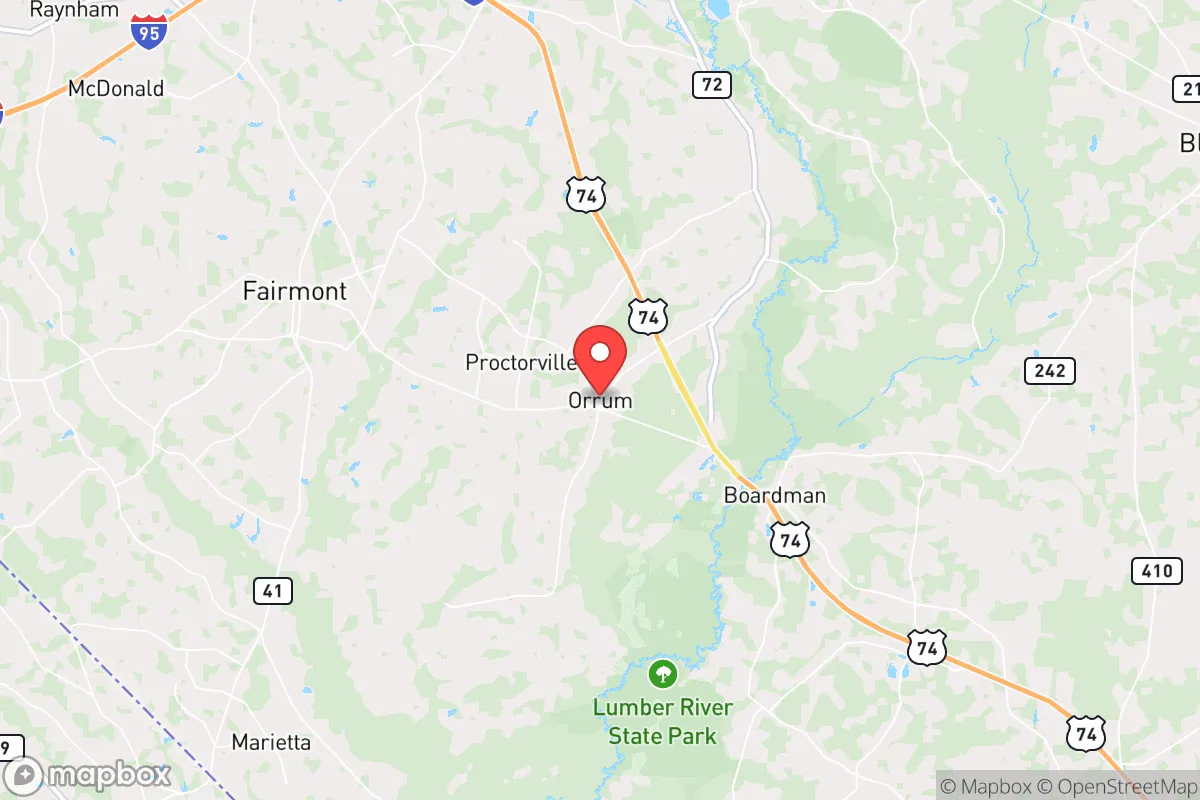
Photo by Parsa Mahmoudi on Unsplash
Quality of Life in Orrum, NC
A high quality of life with strong walkability, manageable living costs, healthy neighborhood signals, and solid amenity access.
What does Quality of Life tell us?
Quality of Life blends cost of living, nearby amenities, socioeconomic signals, and neighborhood character. City-level scores represent the whole municipality; individual neighborhoods can differ.
What does this tell us?
Quality of Life blends cost of living, nearby amenities, socioeconomic signals, and neighborhood character. City-level scores represent the whole municipality; individual neighborhoods can differ.
Cost of Living
73% below national average
The Real Cost of Living in Orrum, NC for 2026
| Tier | Individual | Family (4) |
|---|---|---|
| Survival | $19k | $35k |
| Comfortable | $29k | $42k |
| Luxury | $42k+ | $64k+ |
55%
The Area Signal
A metric tracking the socioeconomic signals of the area.


Hobbies
Explore the areaGroceries
0 within 10 miles
Gas
0 within 10 miles
Hospital
3 within 20 miles
Airport
RDU — Raleigh–Durham International
Post Office
USPS — Lumberton, NC
Critical Amenities
Quality-of-Life Analysis
Orrum, North Carolina, is a deeply affordable, low-density rural community in Robeson County where the cost of living index sits at just 27—73 percent below the U.S. average—making it one of the most budget-friendly places in the state. The population hovers around 90 residents, and the area attracts a mix of retirees seeking quiet, families priced out of nearby metros, and workers in agriculture, manufacturing, and the Lumbee tribal economy. With a median home value of $77,500, Orrum offers a level of housing affordability that is virtually unmatched in the Carolinas, though this comes with trade-offs in terms of local amenities and employment diversity.
Cost of living, housing, and how Orrum compares to Lumberton and Fairmont
Orrum’s cost of living index of 27 means everyday expenses—groceries, utilities, transportation, and healthcare—are roughly one-quarter of the national norm. The median home value of $77,500 is dramatically lower than the North Carolina median of roughly $290,000 (2025 estimate) and even undercuts nearby Lumberton’s median of about $115,000. Renters can find two-bedroom units for $500–$700 per month, compared to $1,100+ in Fayetteville. However, the low housing costs reflect an older housing stock—many homes were built before 1980—and limited new construction. Property taxes in Robeson County are among the state’s lowest, with an effective rate around 0.65%, keeping annual tax bills on a $77,500 home near $500. For buyers willing to invest in renovations, Orrum offers a path to homeownership that is nearly impossible in most of the Southeast.
Local amenities, schools, and what daily life feels like in Orrum
Orrum itself has no grocery store, gas station, or restaurant—residents drive 10–15 minutes to Fairmont (population 2,600) for basic shopping, or 20 minutes to Lumberton for Walmart, chain dining, and the Southeastern Regional Medical Center. The local school system is Robeson County Schools; Orrum Elementary School serves grades K–5 with a student-teacher ratio of roughly 14:1, but the district overall faces challenges with funding and test scores below state averages. High school students attend Fairmont High School (about 12 miles away). Daily life is quiet and car-dependent—there is no public transit, and the nearest interstate (I-95) is a 20-minute drive east. Outdoor recreation centers on the Lumber River State Park, 15 minutes south, offering canoeing, fishing, and hiking. The area has a strong sense of community anchored by small churches and the nearby Lumbee tribal cultural events in Pembroke (20 minutes west).
Orrum is best suited for buyers and renters who prioritize extreme affordability and rural quiet over access to urban jobs, nightlife, or top-tier schools. Retirees on fixed incomes, remote workers with reliable internet (Starlink is common here), and families who value low housing costs and a slow pace will find the trade-offs worthwhile. Those needing frequent medical specialists, diverse employment, or walkable amenities should look toward Lumberton or Fayetteville. For the right person, Orrum offers a rare chance to own a home for under $80,000 in a state where that is increasingly impossible.

Crime in Orrum, NC
Crime rates similar to the national median for U.S. locations.
Violent CrimeViolent Crime Analysis
Property CrimeProperty Crime Analysis
Crime Analysis
Orrum, North Carolina, presents a mixed safety profile that requires careful consideration for potential residents. The town's violent crime rate of 299.4 incidents per 100,000 residents is notably lower than the national average, but its property crime rate of 1,659.9 per 100,000 exceeds both state and national benchmarks, indicating a higher risk for theft and burglary. This combination means that while violent encounters are less common than in many parts of the country, residents face a tangible threat to their personal property and sense of security at home.
Crime in context
Orrum's violent crime rate sits well below the U.S. average of approximately 380 per 100,000, offering a statistical advantage over many similarly sized communities. However, the property crime rate is a clear outlier, running roughly 30% higher than the North Carolina state average. This disparity suggests that while the town is not a hotbed of violent conflict, it struggles with property-related offenses—likely including larceny, vehicle break-ins, and residential burglaries—that can erode daily quality of life. For context, the national property crime rate hovers around 1,950 per 100,000, placing Orrum slightly below that figure but still above the safer rural pockets of the state. The elevated property crime numbers may reflect broader regional economic pressures or proximity to larger transit corridors that facilitate criminal activity.
What residents experience
For those living in Orrum, the practical experience of safety is shaped more by property crime than by the threat of violence. Residents report that securing homes, vehicles, and outdoor equipment is a routine concern, with thefts from sheds and unlocked cars being the most common incidents. The town's small size means that many crimes are known locally, which can foster a sense of vigilance but also a perception that the justice system may not be fully responsive. Given that Orrum is a small town near larger metro areas like Lumberton and Fayetteville, the influence of more progressive judicial philosophies in those surrounding counties is a legitimate concern. Progressive district attorneys and judges in nearby jurisdictions often prioritize diversion programs and reduced sentencing, which can result in repeat property offenders cycling back into communities like Orrum without meaningful accountability. This dynamic directly impacts residents by increasing the likelihood that a burglar or thief will return to the same neighborhood, undermining both justice for victims and the general deterrent effect of prosecution.
Neighborhood-level variation in Orrum is not extensively documented, but anecdotal reports suggest that areas closer to the town's main thoroughfares and commercial zones experience higher rates of property crime than more secluded residential streets. Proximity to Highway 74 and the Lumber River may also correlate with transient criminal activity, as these routes provide easy access for offenders from outside the immediate community. For the most current block-level data, consulting the Lumberton Police Department's crime mapping or the Robeson County Sheriff's Office is recommended, as local reporting can reveal pockets where break-ins are concentrated. Overall, while Orrum is not a high-violence area, its property crime problem—compounded by lenient regional justice policies—demands that newcomers invest in solid home security and remain engaged with neighborhood watch efforts.
* Values derived from national, state, county, city and local statistics and may differ in a specific area. Last updated: 2026-04-19T01:10:50.000Z
Narrative content on this page is AI-generated and may contain mistakes. Verify any details that matter before acting on them.
ReloMaps may earn a commission from affiliate links at no extra cost to you.

