
Photo by Parsa Mahmoudi on Unsplash
Demographics of Orrum, NC
Affluence Level in Orrum, NC
A low-income area with significant economic hardship. Household wealth and educational attainment are well below national averages.
People of Orrum, NC
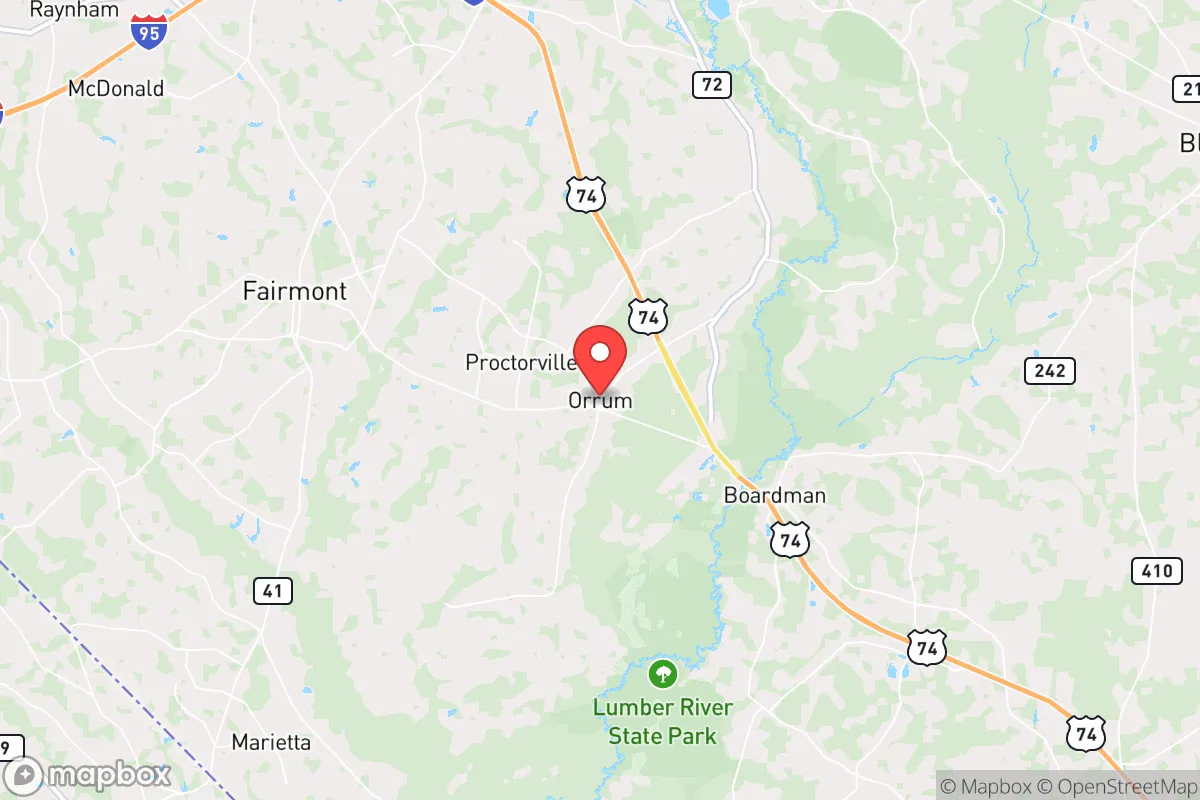
Orrum, North Carolina, is a small, unincorporated community of just 56 residents in Robeson County, where the population is split almost evenly between White (42.9%) and Hispanic (42.9%) residents, with a significant Black minority (14.3%). The community is defined by its rural, low-density character and a very low college attainment rate of 2.0%, reflecting a history of agricultural labor and limited economic diversification. A notable 5.4% of residents are foreign-born, a figure that points to a recent, specific immigration wave rather than a long-standing pattern. The people of Orrum today are a mix of long-standing Lumbee and White families and a newer Hispanic population drawn to the area's agricultural and light-industrial work.
How the city was settled and grew
Orrum's settlement history is rooted in the post-Civil War expansion of the railroad and the timber industry in the Lumber River region. The area was originally inhabited by the Lumbee Tribe, whose descendants remain a significant presence in Robeson County, though they are not separately enumerated in Orrum's census data. The community was formally established in the late 19th century as a stop on the Wilmington, Charlotte and Rutherford Railroad, which brought White and Black laborers to work in the region's vast pine forests and sawmills. The original core of Orrum, centered around the railroad depot and what is now Old Orrum Road, was built by these timber workers. A distinct Black neighborhood, historically known as the "Back Street" area (now largely absorbed into unincorporated residential lots), housed many of the African American families who worked in the mills and as sharecroppers on surrounding farms. White families, many of Scots-Irish descent, settled along the main road and on larger farm tracts to the north, an area still referred to locally as Orrum Heights. The community never incorporated as a town, remaining a census-designated place, which limited its ability to attract infrastructure investment and kept its population small and tied to the land.
Modern era (post-1965)
The most significant demographic shift in Orrum began in the 1990s and accelerated after 2000, driven by the expansion of industrial hog farming and poultry processing in southeastern North Carolina. The 1965 Immigration and Nationality Act had little immediate effect on Orrum, but the subsequent growth of agribusiness in Robeson County created a demand for low-wage labor that drew Hispanic immigrants, primarily from Mexico and Central America. These new residents settled in the South Orrum area, a cluster of mobile homes and small rental houses along Highway 130, and in the Riverbend Mobile Home Park, a small unincorporated subdivision near the Lumber River. The 2010 Census showed Orrum's Hispanic population at roughly 30%, but by the 2020 estimates, it had risen to 42.9%, matching the White population share. The Black population, which was likely around 25% in the 1980s, has declined to 14.3% as younger African American families moved to larger towns like Lumberton for better jobs and schools. The foreign-born share of 5.4% is almost entirely Hispanic, as the community has seen no significant East/Southeast Asian or Indian subcontinent immigration.
The future
Orrum's population is likely to continue its trend toward a Hispanic-majority or near-majority status, driven by ongoing agricultural labor demand and the relatively low cost of rural housing. The White population, many of whom are older and have deep family roots in the area, is slowly declining as younger generations leave for urban centers. The Black population is stable but not growing, as the community offers few professional opportunities. The Hispanic community is not tribalizing into a separate enclave but is instead integrating into the existing residential fabric, particularly in South Orrum and Riverbend, though language and economic barriers persist. The very low college attainment rate (2.0%) suggests that the next generation will face similar economic constraints, likely perpetuating the cycle of low-wage labor and limiting in-migration from higher-income groups. No significant new housing developments or commercial projects are planned, so the population is expected to remain under 100 for the foreseeable future.
For someone moving into Orrum now, the community is a quiet, rural crossroads where the population is becoming more Hispanic and the economy remains tied to agriculture and manual labor. It is not a place of rapid change or upward mobility, but rather a stable, low-cost environment where long-time residents and newer arrivals coexist in a landscape shaped by the timber and hog industries. The lack of a municipal government means services are minimal, and the nearest amenities are a 15-minute drive to Fairmont or Lumberton. This is a place for those seeking isolation and affordability, not for those expecting demographic diversity or economic dynamism.

* Values derived from national, state, county, city and local statistics and may differ in a specific area. Last updated: 2026-04-19T01:10:50.000Z
Narrative content on this page is AI-generated and may contain mistakes. Verify any details that matter before acting on them.
ReloMaps may earn a commission from affiliate links at no extra cost to you.

