
Photo: Wikipedia
Strategic Assessment of Ossining, NY
Multiple tactical vulnerabilities. Population density, target proximity, or disaster risk are likely compounding. A retreat property and exit planning is required.
What does the Strategic Assessment tell us?
Our Strategic Assessment grades tactical survivability of an area. Major population centers, military targets, fallout zones, natural disasters, and border exposure all drive risk — lower exposure means a more defensible position in a crisis.
This is heavily inspired by Joel Skousen's Strategic Relocation book. Highly recommended you checkout the book ($)What does this tell us?
Our Strategic Assessment grades tactical survivability of an area. Major population centers, military targets, fallout zones, natural disasters, and border exposure all drive risk — lower exposure means a more defensible position in a crisis.
This is heavily inspired by Joel Skousen's Strategic Relocation book. Highly recommended you checkout the book ($)Strategic Pillars

Key Distances
Regional Safe Places
Below is our recommended "safe zones" in New York and the surrounding area based on our strategic heuristics. For most people, it's unrealistic to live in a “safe zone” full-time due to work, family or other personal reasons. They tend to be more rural. However, many of these areas are perfect for second homes and retreat properties that double as a vacation home or even a short-term rental.
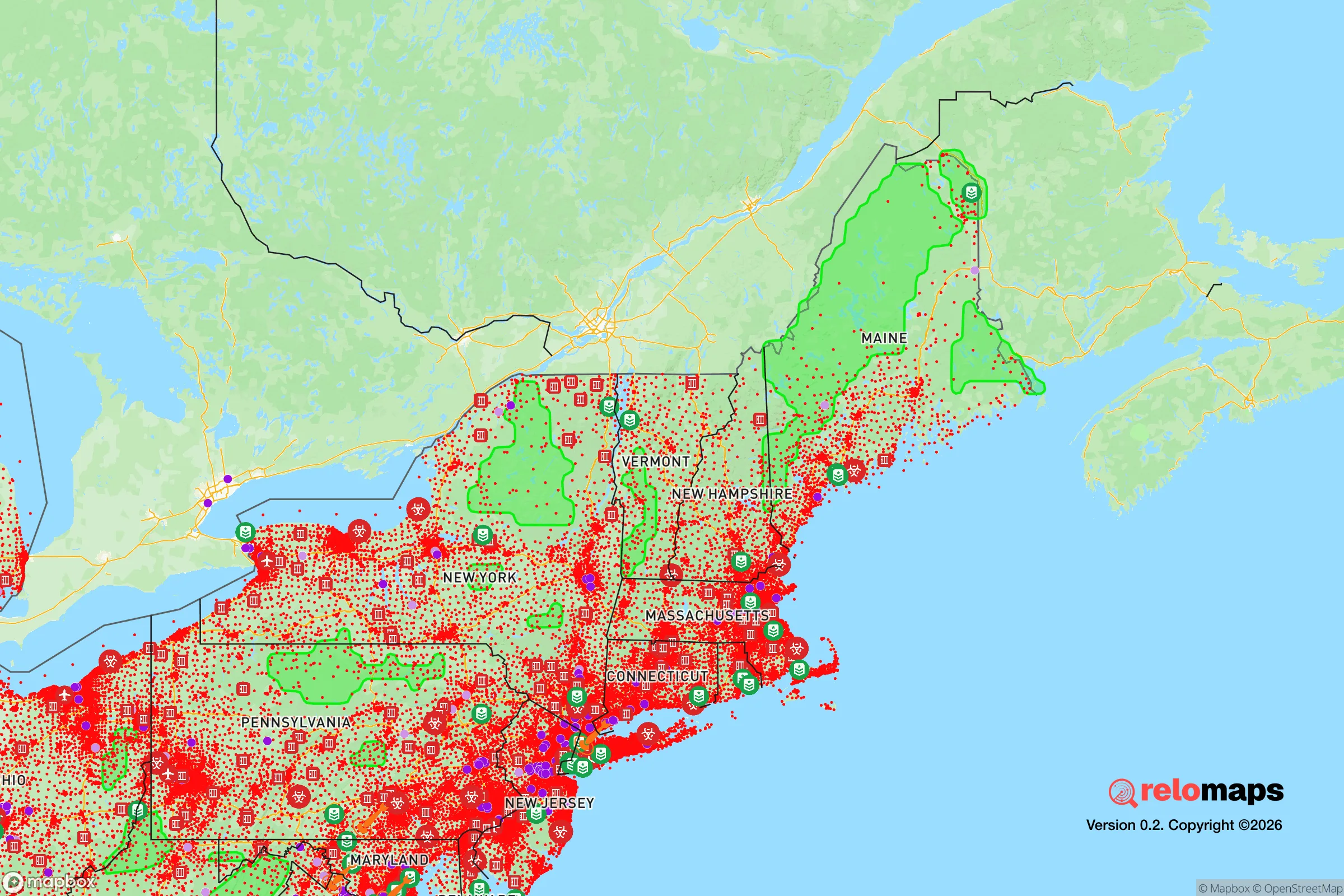
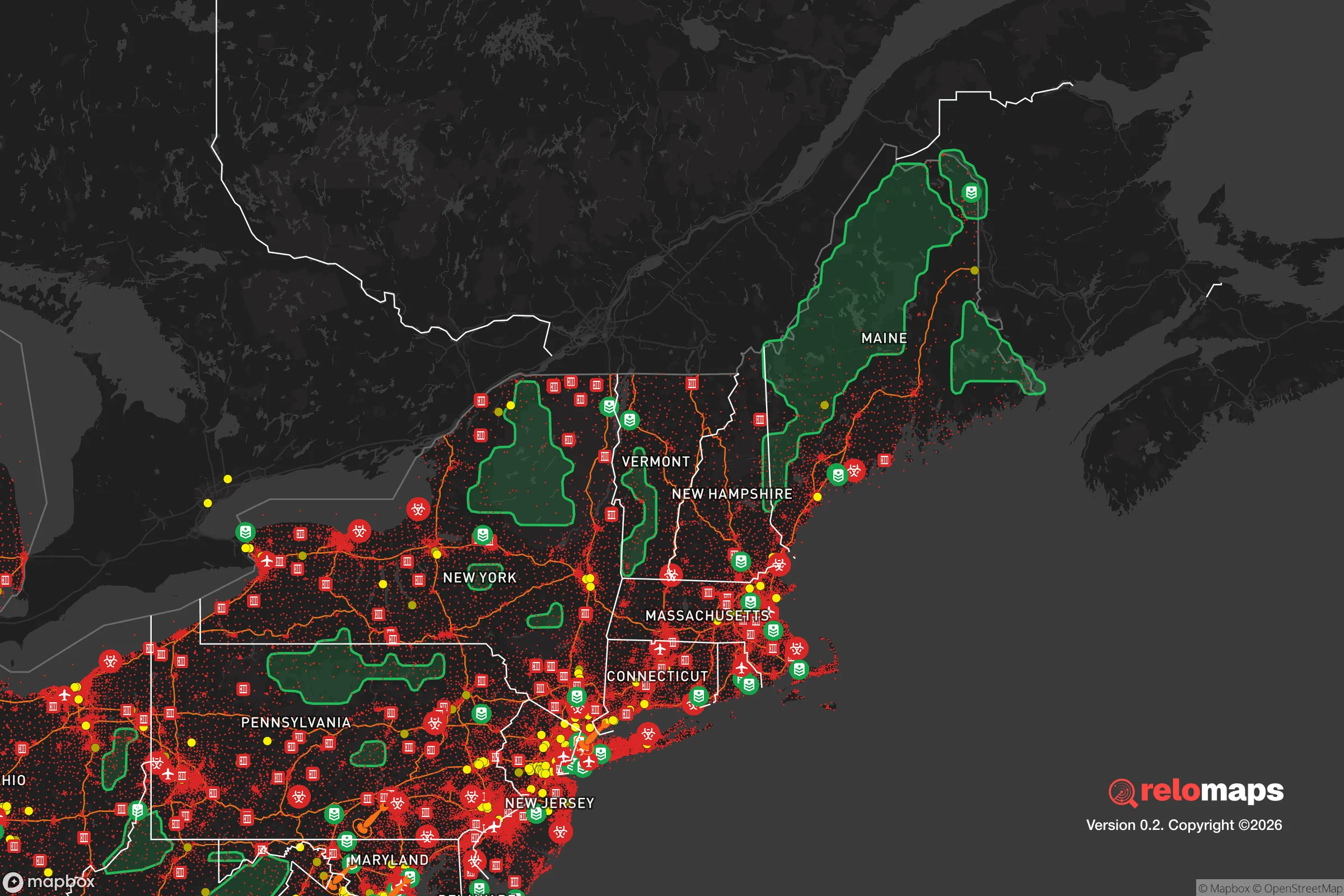


Important Note: For informational purposes only. This does not mean nothing bad ever happens in the green zones. Please use common sense. This is based on public data and modeled with AI. We tried to take a conservative approach but mistakes happen. We update this regularly as new information becomes available.
Solar Generator Recommendations
Backup power matters more here than in safer locations. We've picked three solar generators across budgets and capacity tiers — start with the budget unit if you only need a few essentials, or step up if you want to run a fridge and HVAC for days at a time.

Jackery Portable Power Station Explorer 300
Budget OptionPower on the Go: Weighing only 11 lbs, it's convenient to set up and store with book-sized foldable solar panels

BLUETTI Portable Power Station AC180
Designed for both indoor and outdoor scenarios, AC180 is highly capable as it has a robost capacity and continuous output power.

EF ECOFLOW DELTA Pro Ultra Power Station
Upgraded PickEcoFlow DELTA Pro Ultra is a whole-home energy system designed to grow with your family. Integrated with the Smart Home Panel 2, it scales to meet your evolving energy needs — keeping your home powered, intelligent, and secure through every stage of life.
We earn a commission, at no additional cost to you.
Strategic Assessment Analysis
Ossining, New York, presents a complex strategic picture for the conservative relocator who prioritizes resilience and self-sufficiency. While its location in Westchester County places it within the gravitational pull of New York City—a major liability in any collapse or unrest scenario—the village itself offers a surprising set of natural advantages that a savvy prepper can leverage. The key is understanding that Ossining is not a retreat; it is a forward operating base with specific, exploitable geographic features, but also with significant exposure to the risks of a densely populated, politically volatile region.
Geographic position and natural advantages for a strategic relocation
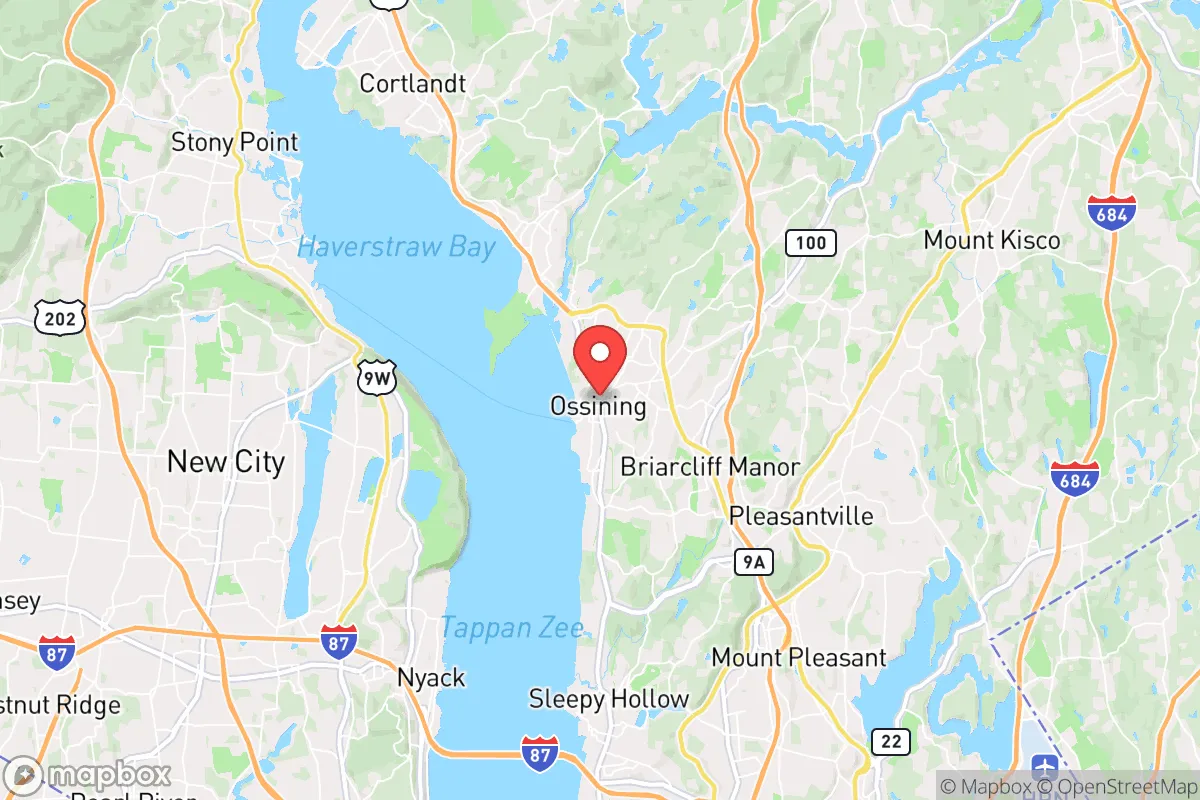
Ossining sits on the eastern bank of the Hudson River, roughly 30 miles north of Midtown Manhattan. This proximity is a double-edged sword, but from a survivalist perspective, the river itself is a critical asset. The Hudson provides a massive, reliable water source for filtration and, in a grid-down scenario, a potential transportation corridor that avoids clogged roadways. The village is built into the steep, wooded hills of the Hudson Highlands, offering natural elevation and defensible terrain. The surrounding area, particularly to the east and north, includes large tracts of state parkland like the Teatown Lake Reservation and the Croton Gorge Park, which provide game, forage, and a buffer against suburban sprawl. The underlying geology is primarily bedrock—schist and gneiss—which means well water is generally reliable and deep, and the terrain offers natural chokepoints for anyone approaching from the south or west. For a relocator, the ability to control access via the few roads that wind through the hills is a tangible defensive advantage, something flat, open suburbs cannot offer.
Risks, exposures, and proximity to fallout-relevant landmarks
This is where the analysis turns sobering. Ossining’s greatest strategic weakness is its proximity to multiple high-value, high-risk targets. The village is directly adjacent to the Indian Point Energy Center (now decommissioned, but the spent fuel remains on site in dry casks), a legacy nuclear site that, while not an active reactor, still represents a radiological hazard in the event of a deliberate attack or catastrophic accident. Furthermore, Ossining lies within the fallout plume zone of any major incident at the New York City metropolitan area, which includes multiple active reactors (Indian Point’s decommissioned status reduces but does not eliminate this risk). The village is also within 10 miles of the Westchester County Airport (HPN), a general aviation and corporate jet hub that could be a target or a source of chaos during an evacuation. The Croton-Harmon Metro-North station, a major rail hub just south of the village, is a critical infrastructure node that would be a focal point for mass transit failures and refugee flows during a crisis. For the prepper, the primary concern is not a direct strike on Ossining, but the secondary effects: a mass exodus from New York City that would choke the Saw Mill River Parkway, Route 9, and the Taconic State Parkway, turning the village into a bottleneck. The political climate of Westchester County, with its high taxes and progressive governance, also means that local authorities may impose restrictive emergency measures (confiscation of supplies, mandatory evacuations) that a conservative relocator would find untenable.
Practical resilience for a relocator: food, water, energy, and defensibility
For a relocator willing to invest in hardening a property, Ossining offers a mixed bag. Water is abundant—the Hudson is a non-potable source requiring heavy filtration (reverse osmosis or distillation), but the village’s steep slopes mean many homes have access to deep bedrock wells with excellent yield. Food security is limited; the village has a small farmers market and some local farms (e.g., Stone Barns Center for Food & Agriculture in nearby Pocantico Hills), but it is not an agricultural hub. A relocator would need to establish a substantial garden, greenhouse, and food storage system, as reliance on local supermarkets (which are vulnerable to supply chain disruption) is a failure point. Energy independence is achievable but expensive. The wooded hillsides are ideal for a wood-burning stove or outdoor boiler, and solar panels can be mounted on south-facing roofs, though the tree cover can limit yield. A backup generator with a buried propane tank is a near-necessity for any serious prepper here. Defensibility is the strongest card Ossining holds. The village’s layout—a dense, walkable downtown with narrow, winding streets climbing into the hills—creates natural defensive positions. A property on a dead-end road with a steep driveway and a clear line of sight to the approach is worth a premium. However, the village’s density (roughly 25,000 people in a 6.5-square-mile area) means that during a prolonged crisis, you cannot simply disappear. You will have neighbors, and you will have to deal with the realities of a community that is not uniformly aligned with a survivalist mindset. The local police department is professional but small; in a major event, they will be overwhelmed. The strategic play here is to be part of a small, trusted network of like-minded households, not a lone wolf.
The overall strategic picture for Ossining is one of high risk but high potential reward for the disciplined relocator. It is not a bug-out location; it is a live-in, harden-in-place position for someone who can afford the tax burden (Westchester County property taxes are among the highest in the nation) and who is willing to invest heavily in off-grid infrastructure. The proximity to New York City is a liability that cannot be fully mitigated, but the natural terrain, water access, and defensible geography are genuine assets that few other locations within a two-hour drive of the Northeast Corridor can match. For the conservative prepper who understands that true safety is an illusion and that resilience is about stacking advantages, Ossining offers a viable, if demanding, option. The key is to treat it as a fortress in a contested zone, not a sanctuary. If you are prepared for the noise, the taxes, and the neighbors, the hills of Ossining can be made to work for you. If you want quiet and isolation, look further north.

* Values derived from national, state, county, city and local statistics and may differ in a specific area. Last updated: 2026-04-19T03:29:03.000Z
Narrative content on this page is AI-generated and may contain mistakes. Verify any details that matter before acting on them.
ReloMaps may earn a commission from affiliate links at no extra cost to you.

