
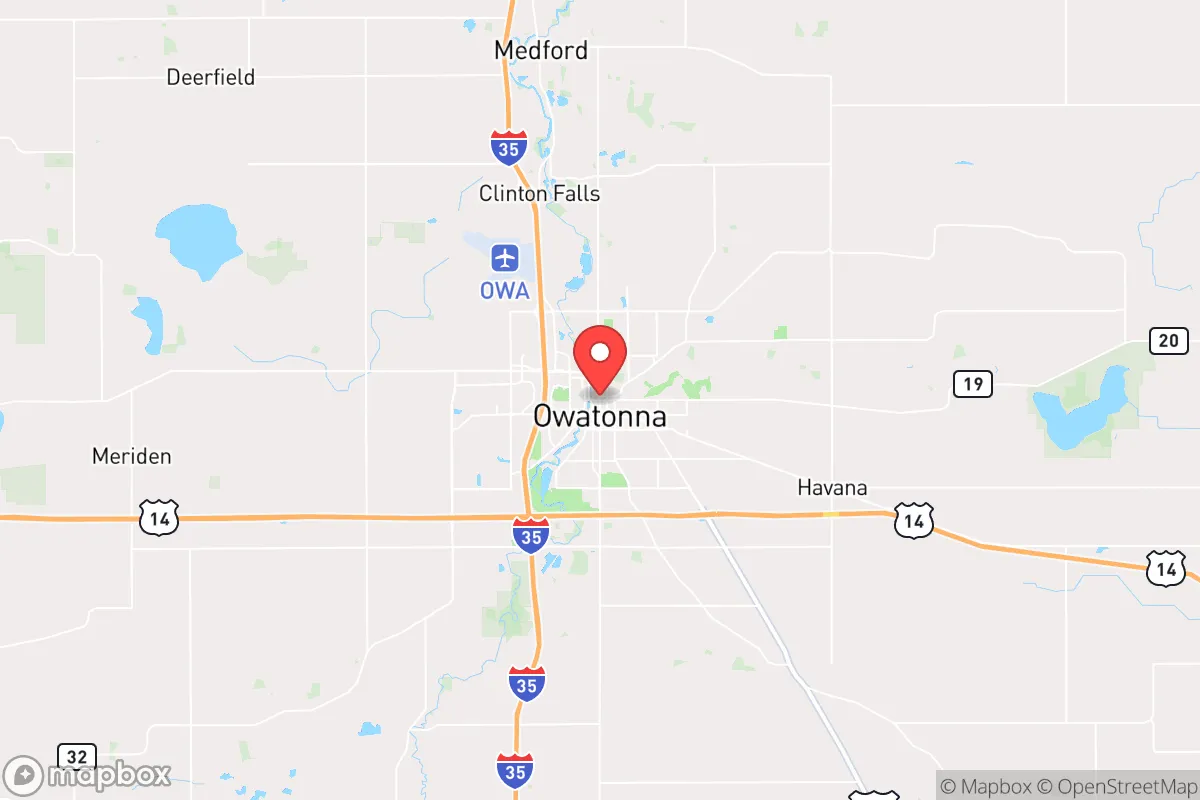
Photo: Wikipedia
Personal Sovereignty in Owatonna, MN
Viable for self-reliance. Generally workable, though some barriers may limit total independence.
What does Personal Sovereignty tell us?
Personal Sovereignty measures your capacity for self-reliance and independence with minimal government friction. Higher scores mean fewer barriers between you and the way you want to live... but it assumes you have the space you need and good neighbors.
What does this tell us?
Personal Sovereignty measures your capacity for self-reliance and independence with minimal government friction. Higher scores mean fewer barriers between you and the way you want to live... but it assumes you have the space you need and good neighbors.
State Policy
Energy independence: Importer (20% of energy produced in-state)
Personal Liberty
Homesteading

Personal Liberty Analysis
For the individualist or prepper evaluating Owatonna, Minnesota, the personal sovereignty picture is a mixed bag—strong on community self-reliance and property rights at the local level, but constrained by a state government that has steadily tightened its grip on firearms, medical choice, and taxation. Owatonna itself, a manufacturing and agribusiness hub in Steele County, offers a relatively low-crime environment and a culture of neighborly independence, but you cannot ignore the fact that you are operating under the authority of St. Paul, which has trended left on key liberty issues. The key to thriving here is understanding which freedoms are locally protected and which are preempted by state law, then planning your life accordingly.
Tax burden and regulatory climate for a self-reliant household
Minnesota’s tax burden is among the highest in the nation, and Owatonna residents feel it. The state income tax tops out at 9.85% on high earners, and while Owatonna’s property tax rates are moderate for the region—roughly 1.1% of assessed value—the combination of state sales tax (6.875%) and local levies can push the effective rate near 8%. For a prepper household, this means every dollar earned is heavily taxed before you can put it toward land, supplies, or infrastructure. On the regulatory side, Minnesota has a robust state preemption law that prevents local governments from enacting their own gun or zoning ordinances that are stricter than state law—a double-edged sword. It blocks Minneapolis-style overreach from creeping into Owatonna, but it also means you cannot rely on local officials to carve out exemptions for off-grid living or home-based businesses if the state decides to crack down. The state’s environmental and building codes are also more stringent than many southern or western states, so any homesteading project will require permits and inspections that a survivalist might find intrusive. That said, Steele County’s planning department is known for being pragmatic and business-friendly compared to the metro area, so with proper paperwork, you can still build a self-sufficient setup—just not without some bureaucratic friction.
Self-defense rights and Minnesota gun law specifics
Minnesota is a “shall-issue” state for concealed carry permits, and Owatonna residents can obtain one with a clean background check and a short training course. However, the state has moved in a restrictive direction: permitless carry is not legal, and in 2023, the legislature passed a “red flag” law (Extreme Risk Protection Order) that allows courts to temporarily seize firearms from individuals deemed a risk by family or law enforcement. For the liberty-minded, this is a direct threat to due process and a tool that can be abused by bad actors. Additionally, private firearm sales now require a background check through a licensed dealer, and the state maintains a permit-to-purchase system for handguns. Owatonna itself has no additional local gun ordinances, and the Steele County Sheriff’s Office is generally supportive of Second Amendment rights—they process permits efficiently and do not engage in the kind of anti-gun activism seen in Hennepin or Ramsey counties. For the prepper, the practical takeaway is that you can legally own and carry firearms in Owatonna, but you must stay on top of state-level changes. Stockpiling ammunition and building a defensive plan is feasible, but you are one legislative session away from magazine capacity limits or an “assault weapons” ban, which have been proposed repeatedly. The local gun culture is strong—there are multiple ranges and gun shops in the area—but the legal foundation is not as solid as in, say, Texas or Idaho.
Self-reliance and homesteading viability: lot sizes, zoning, and off-grid feasibility
Owatonna’s zoning code is a critical factor for anyone wanting to live off-grid or with significant acreage. Inside city limits, standard residential lots are typically one-quarter to one-half acre, and the city enforces building codes that require connection to municipal water and sewer—no composting toilets or rainwater collection as a primary water source. For true self-reliance, you need to look at the unincorporated areas of Steele County, where you can find parcels of 5 to 40 acres for $5,000–$10,000 per acre. County zoning is more permissive: you can keep livestock, install solar panels, and drill a well, but you must still comply with state septic system regulations (which are expensive, often $10,000–$20,000 for a mound system). Off-grid electricity is legal, but Minnesota’s net metering laws make it easier to stay grid-tied with battery backup than to go fully independent. The growing season is short (about 140 frost-free days), so serious food production requires greenhouses or cold frames. For the prepper, the best strategy is to buy land just outside Owatonna’s extraterritorial jurisdiction—typically 2–3 miles from city limits—where you have more freedom to build a homestead without city interference. The local Amish and Mennonite communities are a testament to what is possible here; they live largely off-grid and without modern conveniences, and they have navigated the regulatory landscape for generations. Their presence also means you can source quality tools, lumber, and labor from a culture that values self-reliance over government approval.
Personal liberties: parental rights, medical autonomy, speech, and property
Minnesota’s state government has been aggressive in asserting authority over areas traditionally left to families and individuals. Parental rights have eroded: the state does not require parental consent for minors to obtain birth control or abortion services, and in 2023, a law was passed that allows the state to remove children from parents who provide “gender-affirming care” if the state deems it necessary—a clear overreach for any conservative family. Medical autonomy is also limited; Minnesota has a vaccine mandate for schoolchildren (with exemptions that are increasingly hard to obtain), and during the pandemic, the state imposed lockdowns and mask mandates that were among the longest in the Midwest. For the prepper who values medical freedom, this means you may need to homeschool or seek alternative medical providers who operate outside the mainstream system. On the positive side, property rights are relatively strong in Steele County. There is no county-wide zoning overlay that restricts what you can do on your land, and the local assessor’s office is transparent about valuations. Free speech is protected, but the state has enacted “campaign finance” laws that some argue chill political speech, and there is no state-level Religious Freedom Restoration Act, so religious liberty protections are weaker than in many southern states. Owatonna’s local culture is more libertarian than the state as a whole; town hall meetings are well-attended, and residents are not shy about voicing opposition to state mandates. If you want to live your life without government interference, you can do so here—but you must be vigilant and willing to push back at the ballot box and in the courts.
Overall, Owatonna offers a higher degree of personal sovereignty than the Twin Cities metro, but it is still a blue-state environment where your freedoms are subject to the whims of St. Paul. For the survivalist or prepper, the calculus is this: you get a strong local community, affordable land, and a culture of self-reliance, but you must accept a higher tax burden, a restrictive gun legal framework, and a state government that is actively hostile to parental and medical autonomy. Compared to a place like rural Texas or Idaho, Owatonna is a compromise—you trade absolute freedom for lower crime, better infrastructure, and a more temperate climate. If you are willing to work within the system, build relationships with local officials, and stay politically active, you can carve out a sovereign life here. But if you want to minimize government contact entirely, you would be better served looking at states with no income tax, constitutional carry, and stronger parental rights protections. Owatonna is a solid B-minus for liberty—livable, but not a sanctuary.

* Values derived from national, state, county, city and local statistics and may differ in a specific area. Last updated: 2026-10-10T16:28:36.000Z
Narrative content on this page is AI-generated and may contain mistakes. Verify any details that matter before acting on them.
ReloMaps may earn a commission from affiliate links at no extra cost to you.

