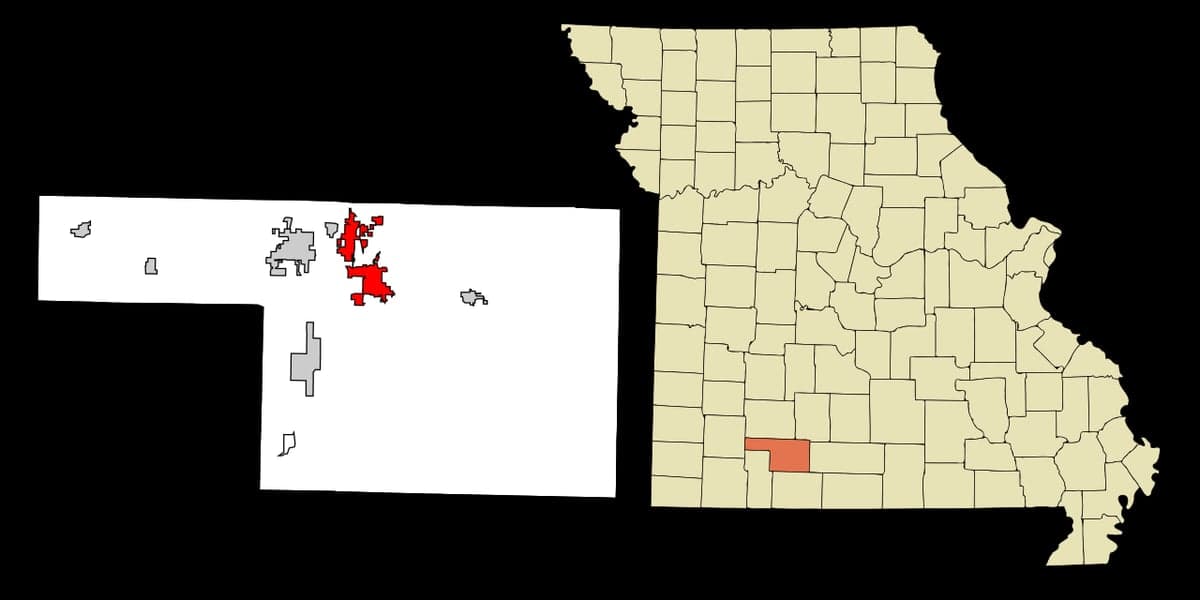
Photo: Wikipedia
Demographics of Ozark, MO
Affluence Level in Ozark, MO
A middle-class area roughly in line with national averages across income, home values, education, and employment.
People of Ozark, MO
The people of Ozark, Missouri, today number 21,953 and form a predominantly white, family-oriented community with a notably low foreign-born population of just 1.3%. The city is characterized by a strong sense of local identity, a 33.0% college-educated rate, and a demographic profile that is 87.5% white, 5.7% Hispanic, 1.2% Black, 0.5% Indian (subcontinent), and 0.3% East/Southeast Asian. This is a community shaped by steady domestic in-migration from the Midwest and South, not by international immigration, giving it a culturally homogeneous and conservative character that appeals to families seeking a slower pace near Springfield.
How the city was settled and grew
Ozark was founded in the 1830s as a trading post along the Finley River, drawing its earliest settlers from Kentucky, Tennessee, and the Upper South. These were yeoman farmers and millers who established the Historic Downtown Ozark district along the river, building the first gristmills and churches. The arrival of the St. Louis–San Francisco Railway in the 1880s triggered a second wave of settlement, bringing merchants and craftsmen who built the North 3rd Street corridor and the surrounding residential blocks. The population remained small and overwhelmingly Anglo-American through the early 1900s, with the city serving as the county seat for Christian County. By 1950, Ozark had fewer than 2,000 residents, almost entirely native-born whites, with a tiny Black population concentrated near the railroad tracks in what is now the Southwest Industrial Park area.
Modern era (post-1965)
The post-1965 era brought no significant international immigration to Ozark. Instead, the city experienced rapid domestic in-migration beginning in the 1990s, driven by the expansion of Springfield's economy and the construction of U.S. Highway 65. Families from rural Missouri and the Ozarks moved into new subdivisions like Rivercut and Finley Farms, which today house the bulk of the city's population. The Hispanic population grew from negligible to 5.7% during this period, largely through domestic migration from Texas and the Southwest, settling in the East Jackson Street corridor and the Ozark South area near the high school. The Indian-subcontinent population (0.5%) arrived primarily in the 2010s, drawn by professional jobs at CoxHealth and Mercy Hospital in Springfield, and tends to live in newer subdivisions like Wildwood Estates. The East/Southeast Asian population (0.3%) is small and scattered, with no distinct ethnic enclave. The Black population (1.2%) has remained stable and is concentrated in the Old Towne area near the historic railroad depot.
The future
Ozark's population is projected to continue growing at a moderate pace, driven by domestic in-migration from the Midwest and South rather than international immigration. The city is homogenizing in terms of racial composition, with the white share remaining above 85% and the foreign-born share staying below 2%. The Hispanic population is likely to grow slowly, reaching perhaps 8-10% by 2040, but will assimilate into existing neighborhoods rather than forming a distinct enclave. The Indian-subcontinent and East/Southeast Asian communities are expected to remain small and professional, concentrated in newer subdivisions. The city is not tribalizing into distinct ethnic enclaves; instead, it is becoming a more uniformly middle-class, family-oriented suburb of Springfield, with new development pushing south toward the Finley River and east toward Highway 65.
For someone moving in now, Ozark is becoming a stable, culturally homogeneous bedroom community where the population is overwhelmingly native-born, conservative, and family-focused. The low foreign-born rate and high white share mean that newcomers will find a community with little ethnic diversity but strong schools, low crime, and a clear sense of local identity. The next decade will likely see continued growth in the Rivercut and Finley Farms subdivisions, with the city's character remaining largely unchanged from its current profile.

* Values derived from national, state, county, city and local statistics and may differ in a specific area. Last updated: 2026-04-24T20:38:07.000Z
Narrative content on this page is AI-generated and may contain mistakes. Verify any details that matter before acting on them.
ReloMaps may earn a commission from affiliate links at no extra cost to you.

