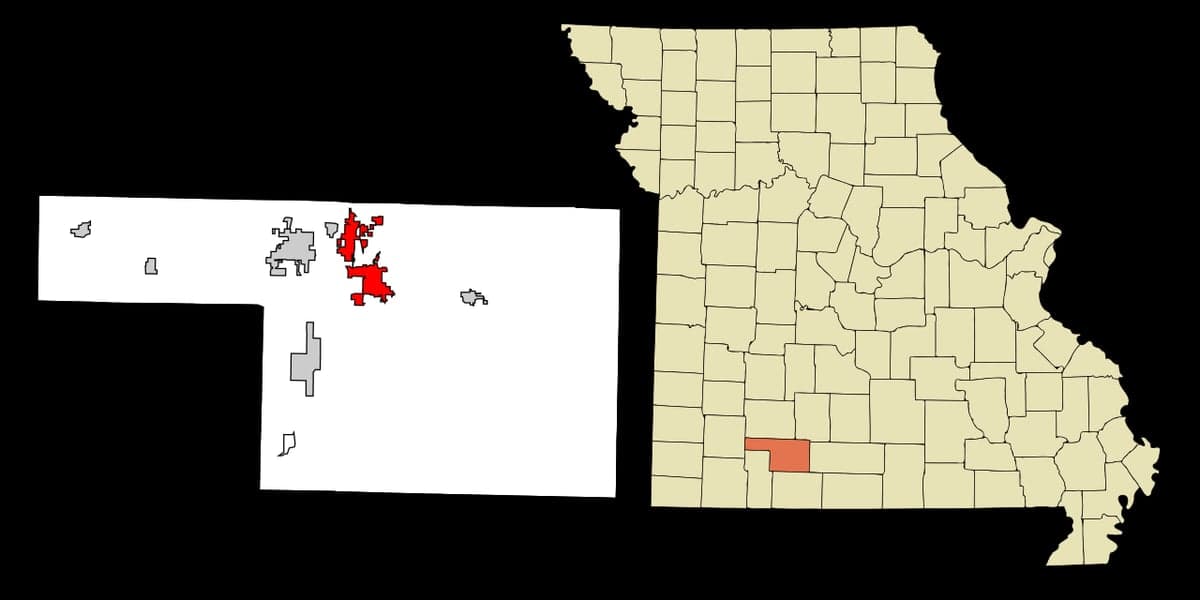
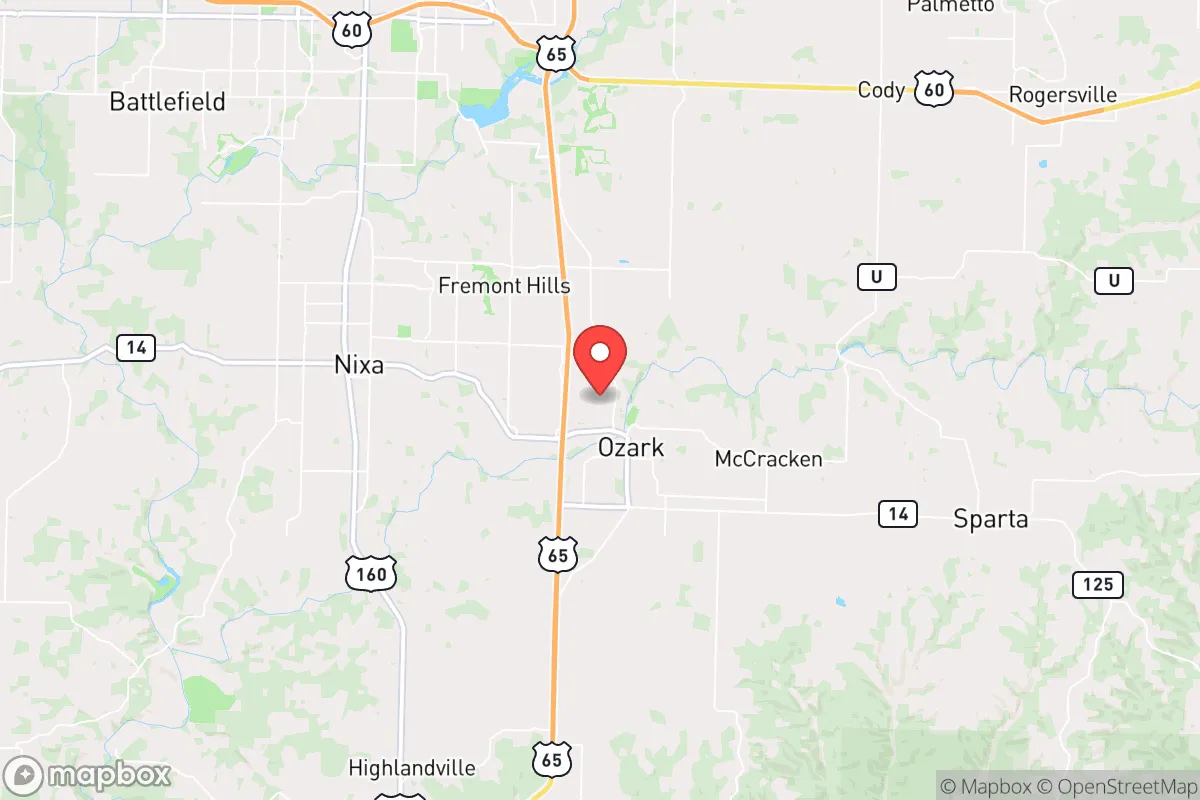
Photo: Wikipedia
Political ClimatePolitical Climate in Ozark, MO
District shown is the primary district for this city’s centroid. Cities may span multiple districts.
Local Political AnalysisPolitical Analysis of Ozark, MO
Ozark, Missouri, is about as solidly conservative as they come, with a Cook PVI of R+21 that puts it deep in the red column. That number isn't just a statistic; it reflects a community where the default assumption is that government should stay out of your business, your family life, and your paycheck. The political trajectory here has been remarkably stable—unlike some of the boomtowns closer to Springfield, Ozark hasn't seen a meaningful shift toward progressive ideology. If anything, the growth has reinforced the local culture, with new residents often moving here specifically to escape the policies and politics of places like St. Louis or Kansas City.
How it compares
Drive ten minutes north into Springfield, and you'll feel the difference. While Springfield still leans conservative overall, it has pockets of progressive activism and a city council that occasionally flirts with left-leaning policy experiments. Ozark, by contrast, is a different animal. The surrounding Christian County is one of the most reliably Republican counties in the state, and the city government reflects that. Compare it to a place like Columbia or even Branson—Branson is conservative but tourism-driven, so it tolerates a bit more regulation. Ozark doesn't have that pressure. The local leadership here is more focused on keeping taxes low and zoning light, which means fewer headaches for homeowners and small business owners. If you're coming from a place where the county board is constantly dreaming up new fees or land-use restrictions, Ozark feels like a breath of fresh air.
What this means for residents
For the average person living here, the political climate translates into a pretty hands-off experience. You won't see the city council trying to mandate what kind of lightbulbs you use or how many chickens you can keep in your backyard. The school board tends to focus on academics and local control rather than national culture-war distractions. Property taxes are reasonable, and there's no city income tax. The downside? If you're hoping for robust public transit or a lot of government-funded programs, you'll be disappointed. But for folks who see government overreach as a bigger threat than a pothole or two, that trade-off is welcome. The general attitude is: we pay our taxes, we follow the law, and we expect the government to do the same without getting creative.
One cultural distinction worth noting: Ozark has a strong sense of local identity that resists outside pressure. When statewide or national debates about gun rights, vaccine mandates, or school curriculum flare up, Ozark tends to side with individual liberty and local decision-making. There's a wariness of federal or even state-level overreach that runs deep. That said, the area is growing, and with growth comes change. The long-term concern for conservative residents is whether the newcomers—many from more liberal states—will eventually shift the political balance. So far, the data and the voting patterns suggest the opposite: people are moving here because of the political climate, not in spite of it. As long as that holds, Ozark will likely stay a place where the government's main job is to stay out of the way.

State Political ClimatePolitical Climate in Missouri
State Political AnalysisPolitical Environment in the State
Missouri has long been a bellwether state, but over the past 20 years it has shifted from a classic purple battleground to a solidly red, conservative stronghold. The state hasn’t voted for a Democratic presidential candidate since Bill Clinton in 1996, and by 2024, Donald Trump carried it by over 18 points. The dominant coalition is a mix of rural and exurban conservatives, with a growing libertarian streak, though the urban cores of St. Louis and Kansas City remain deeply blue. The trajectory is clear: Missouri is getting redder, faster than most people realize, driven by out-migration from liberal cities and an influx of conservatives from Illinois and California.
Urban vs. rural divide
The political map of Missouri is a study in stark contrasts. The two major metros—St. Louis and Kansas City—are deep blue islands, with St. Louis County and Jackson County delivering massive Democratic margins. In 2024, St. Louis City voted 85% for Kamala Harris, while Kansas City’s core was around 75% Democratic. But step outside the 270 loop or I-435, and the landscape flips hard. The rural Ozarks, including Springfield and Branson, are among the most Republican regions in the country, with Christian County and Stone County routinely voting 80%+ Republican. The real story is in the exurbs and smaller cities. St. Charles County, just west of St. Louis, has flipped from a swing county to a GOP stronghold, voting 62% for Trump in 2024. Jefferson City, the state capital, is reliably red, while Columbia (home to the University of Missouri) is a blue outlier in the middle of the state, driven by the academic population. The divide isn’t just geographic—it’s cultural. Rural Missourians feel increasingly alienated from the coastal values of St. Louis and Kansas City, and that resentment fuels the state’s conservative momentum.
Policy environment
Missouri’s policy environment is aggressively pro-freedom, at least by traditional conservative standards. The state has a flat income tax of 4.8% (down from 5.4% in 2023), with a path to eliminate it entirely by 2027 if revenue triggers are met. There is no state property tax on vehicles, and property taxes on real estate are among the lowest in the nation, averaging 0.85% of home value. The regulatory posture is light-touch: Missouri is a right-to-work state (though the law was repealed by ballot initiative in 2018, the legislature has since passed a new version), and it has no state-level minimum wage above the federal $7.25. On education, Missouri has a robust school choice ecosystem, including charter schools in St. Louis and Kansas City, and a growing voucher program (the Missouri Empowerment Scholarship Accounts) that allows parents to use state funds for private or homeschool expenses. Healthcare policy is mixed: the state expanded Medicaid under the 2020 ballot initiative, but the legislature has resisted further expansion and has passed laws restricting abortion to the first eight weeks (the Missouri Stands with the Unborn Act). Election laws are strict: voter ID is required, and the state purges inactive voters regularly. Overall, the policy environment leans heavily toward individual liberty and limited government, though the Medicaid expansion is a notable exception that rankles many conservatives.
Trajectory & freedom
Missouri is becoming more free in several key areas, but the trend is not uniform. On gun rights, the state is a national leader: in 2021, it passed the Second Amendment Preservation Act (SAPA), which nullifies federal gun laws and prohibits state and local law enforcement from enforcing them. This law has been challenged in court but remains in effect, and it has made Missouri a haven for gun owners. On parental rights, the state passed the Parental Bill of Rights in 2022, which gives parents explicit authority over their children’s education and medical decisions. On medical autonomy, Missouri banned nearly all abortions in 2019 (trigger law), and in 2023, it passed a law banning gender-affirming care for minors, with a sunset clause that makes it permanent unless renewed. On taxation, the trend is toward elimination: the flat tax is being phased down, and there is serious talk of repealing the corporate income tax entirely. However, there are concerning signs. The state’s marijuana legalization (Amendment 3, 2022) was a libertarian win, but the regulatory framework is heavy-handed, with high licensing fees and limited home grow. And the state’s handling of COVID—with extended emergency powers by Governor Mike Parson—left a bad taste for many freedom-minded residents. Overall, the trajectory is positive for conservatives, but vigilance is needed to prevent backsliding.
Civil unrest & political movements
Missouri has seen its share of civil unrest, most notably in Ferguson (a suburb of St. Louis) in 2014, which sparked the Black Lives Matter movement and left deep scars. Protests and occasional property damage continue in St. Louis and Kansas City over police reform and racial justice issues, though they have diminished in intensity since 2020. On the right, the most visible movement is the Second Amendment sanctuary movement, which has spread to over half of Missouri’s counties, with local sheriffs refusing to enforce federal gun laws. Immigration politics are relatively quiet, but there is a growing tension in rural areas over meatpacking plants (like in Sedalia and Marshall) that have brought in immigrant labor, leading to local debates over housing and schools. Election integrity is a hot-button issue: after the 2020 election, Missouri passed strict voter ID laws and banned ballot drop boxes, and there is ongoing litigation over the state’s purging of voter rolls. There is no serious secessionist movement, but there is a strong strain of nullification rhetoric, particularly around gun laws and federal mandates. A new resident would notice the prevalence of “Don’t Tread on Me” flags and pro-gun signage, especially outside the urban cores. The political climate is polarized but not violent—most Missourians are civil, even when they disagree.
Projection
Over the next 5-10 years, Missouri will likely become even more conservative. The demographic trends are clear: the urban cores of St. Louis and Kansas City are losing population (St. Louis City has lost 7% of its population since 2010), while the exurbs and rural areas are growing. In-migration from blue states like Illinois and California is accelerating, but these newcomers tend to be conservatives fleeing high taxes and crime, not progressives. The state’s Hispanic population is growing (now 5% of the total), but this group leans conservative on social issues and is not likely to shift the state left. The biggest wildcard is the potential for a Democratic governor in 2028 if the party can nominate a moderate, but the legislature will remain supermajority Republican for the foreseeable future. Expect further tax cuts, expanded school choice, and continued resistance to federal overreach. The biggest risk is that the state’s rural-urban divide could lead to a push for city-county consolidation or even a breakaway movement from St. Louis and Kansas City, but that remains unlikely. For someone moving in now, expect to find a state that is increasingly aligned with traditional conservative values, with a government that is more responsive to rural and exurban voters than to the coastal elites.
Bottom line for a new resident: If you’re a conservative looking for a state that respects your gun rights, keeps taxes low, and lets you raise your kids without government interference, Missouri is a strong bet. The urban areas are blue, but they’re shrinking, and the state’s political trajectory is firmly red. Just be prepared for the culture war to be a constant background noise—Missourians take their freedoms seriously, and they’re not shy about defending them. If you’re moving from a blue state, you’ll find the transition refreshing, but don’t expect a libertarian utopia—the state still has its share of bureaucracy and local quirks. Overall, it’s a solid choice for anyone who values personal liberty and community values.
* Values derived from national, state, county, city and local statistics and may differ in a specific area. Last updated: 2026-04-24T20:38:07.000Z
Narrative content on this page is AI-generated and may contain mistakes. Verify any details that matter before acting on them.
ReloMaps may earn a commission from affiliate links at no extra cost to you.

