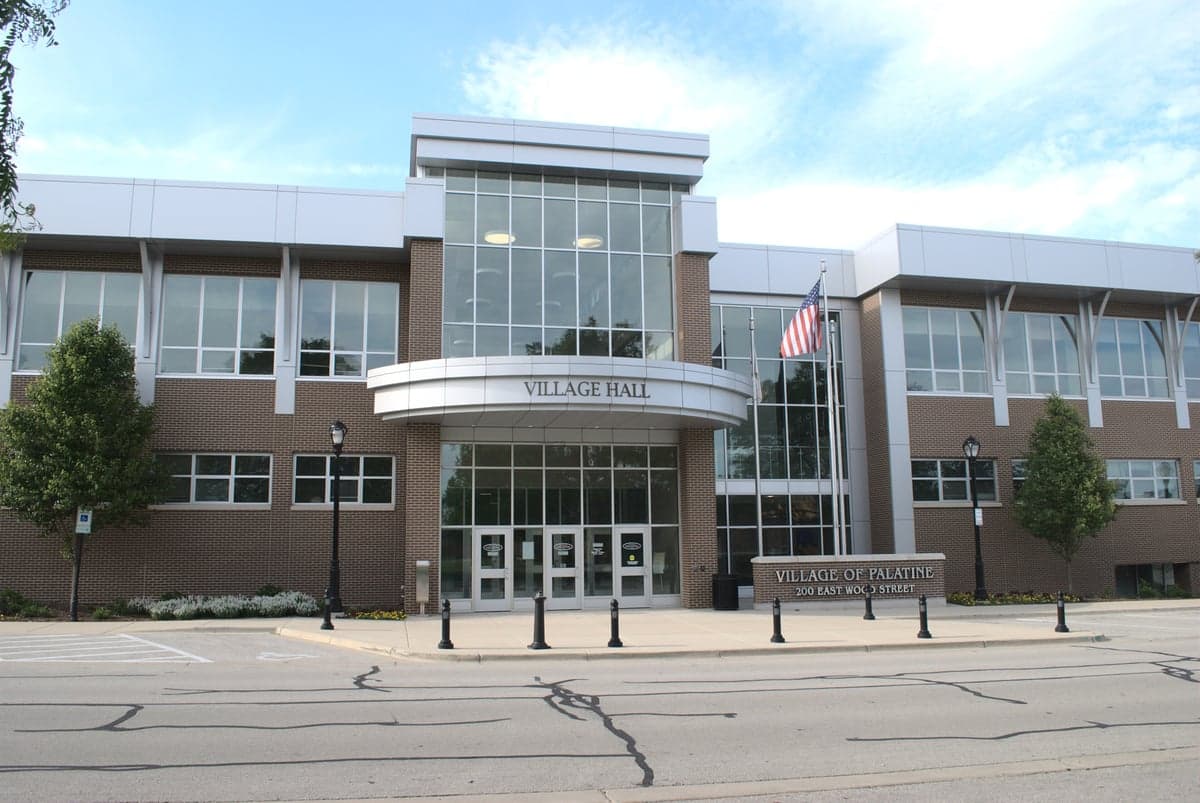
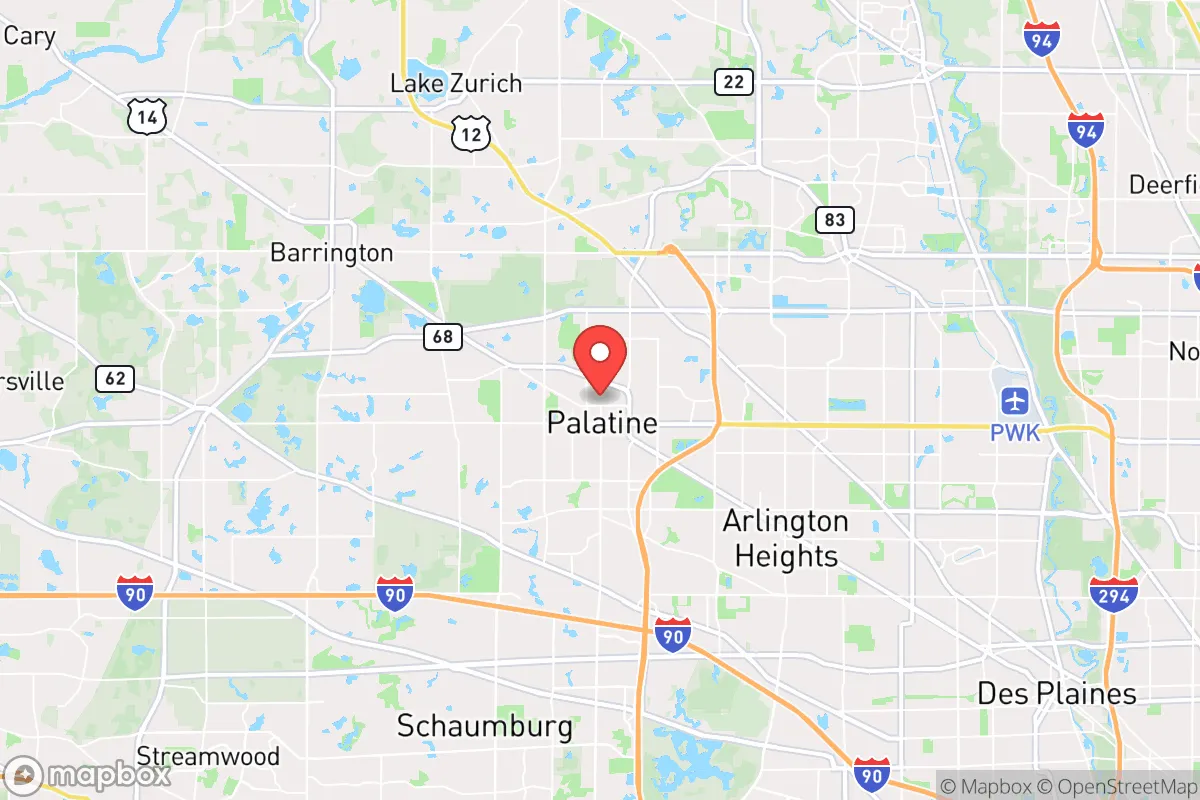
Photo: Wikipedia
Demographics of Palatine, IL
Affluence Level in Palatine, IL
A middle-class area roughly in line with national averages across income, home values, education, and employment.
People of Palatine, IL
Palatine, Illinois, is a densely settled northwest suburb of Chicago with 66,548 residents, characterized by a middle-to-upper-middle-class, family-oriented population that is notably diverse for the region. The city’s identity is shaped by a strong European ethnic foundation, a large and growing Hispanic community, and significant East/Southeast Asian and Indian-subcontinent populations, creating a multi-ethnic, largely stable suburban environment. Palatine balances its historic village feel with the practical demands of a commuter-heavy, highly educated workforce, where nearly half of adults hold a college degree.
How the city was settled and grew
Palatine’s original population was almost entirely German and Luxembourgish immigrants who arrived in the 1830s and 1840s, drawn by fertile prairie land and the promise of independent farming. These early settlers established the core of what is now the Old Town Palatine neighborhood, centered around the intersection of Northwest Highway and Slade Avenue, building simple frame homes and a Lutheran church that anchored the community. A second wave of German and Irish laborers arrived in the 1850s and 1860s to work on the Chicago and North Western Railway, settling in the Deer Grove area near the tracks, which became a working-class enclave of railroad employees and tradesmen. By 1900, Palatine remained a small, overwhelmingly German-American farming village of fewer than 1,000 people, with a distinct cultural identity rooted in its Lutheran and Catholic congregations.
Modern era (post-1965)
The post-1965 era transformed Palatine from a sleepy farm town into a booming commuter suburb. The 1970s and 1980s saw massive domestic in-migration of white-collar families from Chicago and other Midwest cities, drawn by the newly completed Route 53 expressway and the expansion of Motorola’s corporate campus in neighboring Schaumburg. These new residents filled large subdivisions like Willow Bend and Brentwood, built on former farmland in the city’s north and west sides, creating a landscape of single-family homes with two-car garages. The 1990s and 2000s brought the most significant demographic shift: a surge of Hispanic immigrants, primarily of Mexican origin, who settled in the Palatine Station area near the Metra train line and the older housing stock south of Dundee Road. This community grew steadily, now comprising 19.3% of the population, and has established a visible commercial corridor along Rand Road with taquerias, bakeries, and bodegas. Simultaneously, East/Southeast Asian families (6.2% of the population) and Indian-subcontinent families (6.6%) began moving into newer subdivisions in the Deer Grove West and Deer Park fringe areas, attracted by top-rated schools like Palatine High School and William Fremd High School. The white population, still a majority at 59.7%, has become more concentrated in the older, established neighborhoods of Old Town and Willow Bend, while the city’s overall racial and ethnic landscape has become a patchwork of distinct, stable enclaves rather than a fully integrated melting pot.
The future
Palatine’s population is trending toward greater ethnic diversity, but along lines of increasing spatial separation rather than wholesale assimilation. The Hispanic population is projected to continue growing slowly, likely reaching 22-25% by 2035, driven by family reunification and the availability of affordable rental housing in the Palatine Station corridor. The East/Southeast Asian and Indian-subcontinent communities are expected to plateau or grow modestly, as these groups tend to be highly educated and financially mobile, often moving to newer exurban developments in Barrington or Kildeer as their incomes rise. The white population, while still the largest group, is aging in place in the established subdivisions, with younger white families increasingly priced out of the market. The city is not homogenizing; rather, it is tribalizing into distinct ethnic neighborhoods: Old Town remains the historic white stronghold, Palatine Station is the Hispanic hub, and Deer Grove West is the primary Asian and Indian enclave. The next decade will likely see continued infill development of townhomes and luxury apartments near the train station, attracting a younger, more transient professional class that may blur these boundaries slightly.
For someone moving in now, Palatine offers a stable, safe, and well-run suburb with strong schools and a genuine multi-ethnic character, but it is not a place of rapid demographic change or social friction. The city’s future is one of managed diversity, where distinct communities coexist with minimal tension, each maintaining its own institutions and commercial strips. New residents should expect a quiet, family-focused environment where neighborhood identity matters more than a unified citywide culture.

* Values derived from national, state, county, city and local statistics and may differ in a specific area. Last updated: 2026-04-29T21:08:19.000Z
Narrative content on this page is AI-generated and may contain mistakes. Verify any details that matter before acting on them.
ReloMaps may earn a commission from affiliate links at no extra cost to you.

