
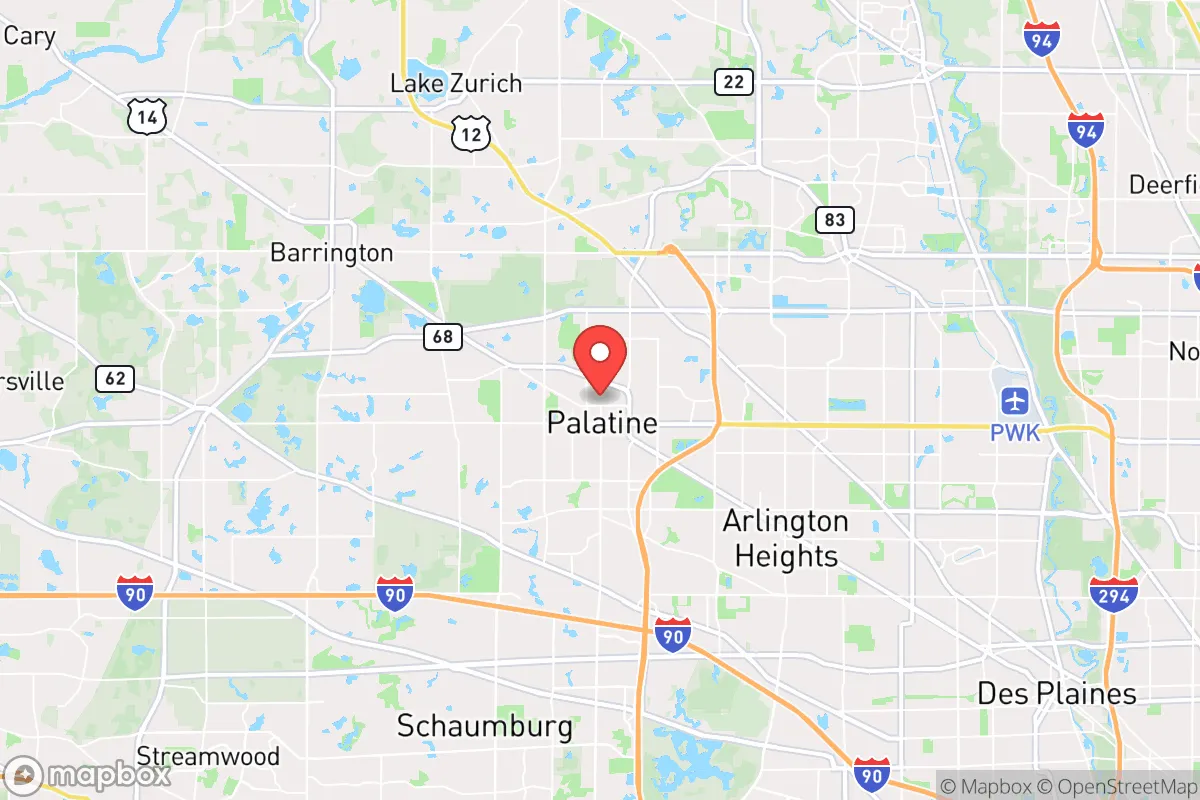
Photo: Wikipedia
Personal Sovereignty in Palatine, IL
Viable for self-reliance. Generally workable, though some barriers may limit total independence.
What does Personal Sovereignty tell us?
Personal Sovereignty measures your capacity for self-reliance and independence with minimal government friction. Higher scores mean fewer barriers between you and the way you want to live... but it assumes you have the space you need and good neighbors.
What does this tell us?
Personal Sovereignty measures your capacity for self-reliance and independence with minimal government friction. Higher scores mean fewer barriers between you and the way you want to live... but it assumes you have the space you need and good neighbors.
State Policy
Energy independence: Importer (45% of energy produced in-state)
Personal Liberty
Homesteading

Personal Liberty Analysis
For the individual who values personal sovereignty above all else, Palatine, Illinois presents a complex and often frustrating environment. While the village itself maintains a relatively quiet, suburban character, it operates entirely under the thumb of Cook County and the State of Illinois, two jurisdictions that have aggressively expanded government control over personal decisions, property rights, and self-defense in recent years. The net effect is that a resident of Palatine enjoys far less autonomy than someone in a free state like Texas or New Hampshire, and the legal and financial architecture here is designed to make self-reliance more difficult, not easier. If your relocation calculus prioritizes maximum personal freedom and minimal government overreach, Palatine is a location you approach with eyes wide open, understanding the specific constraints you will face.
Tax burden and regulatory posture: the cost of living under a heavy hand
The most immediate assault on personal sovereignty in Palatine is the tax burden. Illinois has the second-highest property tax rate in the nation, and Palatine, being in Cook County, sits at the epicenter of that burden. Expect to pay 2.5% to 3.0% of your home's assessed value annually in property taxes, a figure that can easily exceed $10,000 per year on a modest single-family home. This is not a fee for services you can opt out of; it is a forced wealth transfer to a school district and county government that have shown little restraint. Beyond property taxes, the state income tax is a flat 4.95%, and sales taxes in Cook County push the combined rate to over 10% in many areas. The regulatory posture is equally stifling. Illinois is a state where the government presumes to regulate everything from the type of lightbulbs you can buy to the fuel efficiency of your vehicle. For the prepper or survivalist, this means that building a detached garage, installing a rainwater catchment system, or even keeping a few chickens in your backyard will require permits, inspections, and approvals that can be denied or delayed at the whim of a bureaucrat. The message is clear: your property is not truly yours; you are merely a tenant of the state, paying rent through taxes and compliance.
Self-defense and gun law specifics: navigating a hostile legal landscape
For anyone serious about the right to keep and bear arms, Palatine is a legal minefield. Illinois is a "may-issue" state for concealed carry, meaning the state police have discretion to deny your permit, and the process is expensive, time-consuming, and requires a 16-hour training course. In 2023, the state passed the Protect Illinois Communities Act, which bans the sale and possession of many common semi-automatic rifles and standard-capacity magazines. If you own an AR-15 or a Glock with a 15-round magazine, you are now a felon in Illinois unless you registered it with the state police before the deadline—a registration that many gun owners rightly view as a precursor to confiscation. The law is currently being challenged in court, but as of 2026, it remains in effect. Furthermore, Cook County has its own additional restrictions, including a county-wide ban on certain firearms and a requirement that all gun owners obtain a Firearm Owner's Identification (FOID) card, which the state police can revoke without due process. Self-defense in the home is legally recognized, but the "duty to retreat" standard applies outside the home, meaning you cannot use deadly force unless you have exhausted every possible avenue of escape. For the survivalist, this legal environment is a direct threat to the ability to defend oneself, one's family, and one's property.
Self-reliance and homesteading viability: lot sizes, zoning, and off-grid feasibility
Palatine is a dense, suburban village with an average lot size of around a quarter-acre. This is not homesteading country. Zoning codes are strict and heavily enforced, with no allowances for keeping livestock, building a root cellar, or installing a wind turbine. The village's municipal code explicitly prohibits "the keeping of any farm animals" including chickens, goats, and bees, and any outbuilding larger than a small shed requires a building permit and adherence to setback requirements that make self-sufficient food production nearly impossible. Off-grid living is effectively illegal: you are required to connect to the municipal water and sewer systems, and any attempt to install solar panels with battery storage is subject to approval by the homeowners' association (if applicable) and the village's building department. The climate is also a limiting factor, with harsh winters and a short growing season. For the serious prepper, Palatine offers no viable path to self-reliance. You will be entirely dependent on the grid, the grocery store, and the municipal water supply. The best you can do is maintain a small vegetable garden and a pantry, but you will never achieve meaningful independence from the system.
Personal liberties: parental rights, medical autonomy, speech, and property
On paper, the First Amendment protects your speech in Palatine, but in practice, local government has shown a willingness to use zoning and permitting laws to silence dissent. Public protests require permits, and the village has used "time, place, and manner" restrictions to limit demonstrations near schools and government buildings. Parental rights are under direct assault in Illinois. The state has passed laws that allow minors to consent to certain medical procedures, including gender transition care, without parental knowledge or consent, and schools are prohibited from notifying parents if a child changes their name or pronouns. For a parent who believes they have the fundamental right to raise their children according to their values, this is a dealbreaker. Medical autonomy is similarly constrained: Illinois has some of the most permissive vaccine mandates in the country, and during the pandemic, the state imposed lockdowns and mask mandates that were among the longest-lasting in the nation. Your property rights are also severely limited. The village has a strict rental registration program, and the county has used eminent domain aggressively for transit-oriented development. You do not have the freedom to use your land as you see fit; every decision is subject to government approval.
In the final analysis, Palatine, Illinois is a location where personal sovereignty is heavily circumscribed by a powerful, interventionist state government and a county that views itself as a nanny. The tax burden is crushing, the gun laws are among the most restrictive in the nation, homesteading is a legal impossibility, and your rights as a parent and property owner are constantly under threat. Compared to a state like Texas, Florida, or Tennessee, where property taxes are lower, gun rights are protected by state preemption, and parental rights are enshrined in law, Palatine represents a significant downgrade in personal freedom. For the strategic relocator who values autonomy and self-reliance above all else, this area is best viewed as a cautionary tale of what happens when government overreach goes unchecked. If you must live here for work or family, your best strategy is to keep your head down, minimize your tax exposure, and maintain a low profile. But if you have the ability to choose, look elsewhere for a place that respects your sovereignty.

* Values derived from national, state, county, city and local statistics and may differ in a specific area. Last updated: 2026-04-29T21:08:19.000Z
Narrative content on this page is AI-generated and may contain mistakes. Verify any details that matter before acting on them.
ReloMaps may earn a commission from affiliate links at no extra cost to you.

