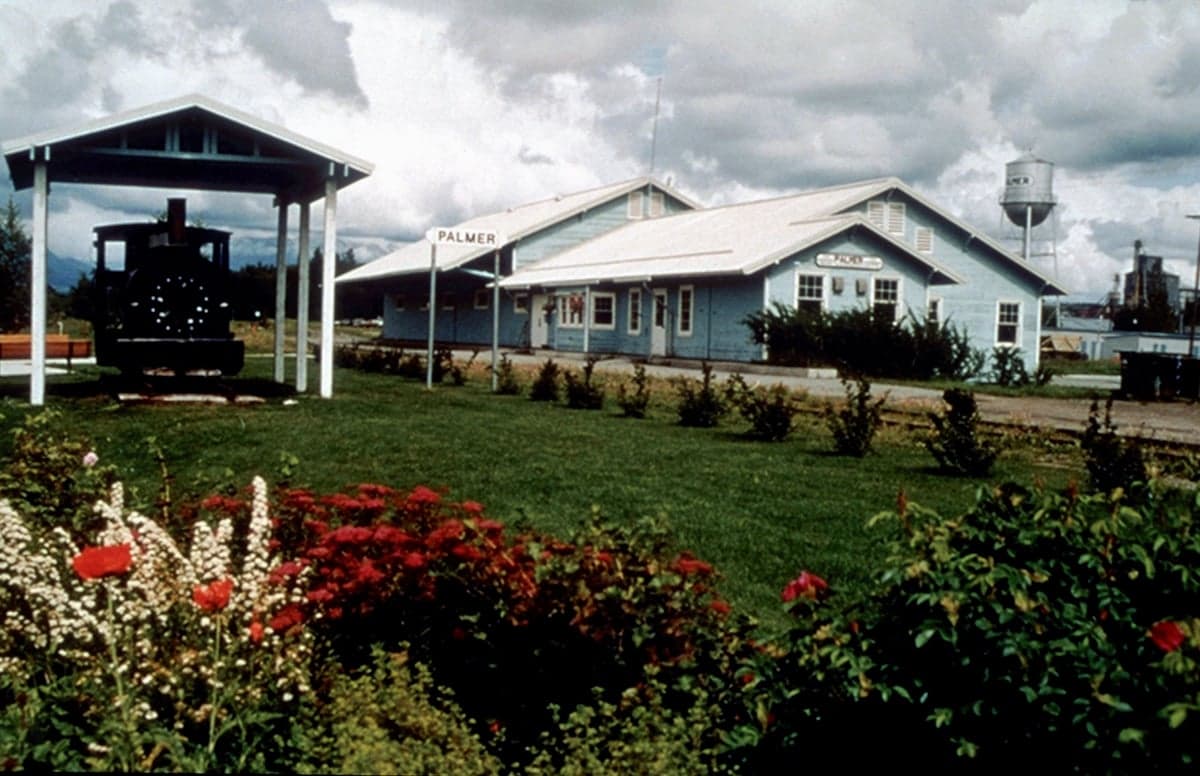
Photo: Wikipedia
Demographics of Palmer, AK
Affluence Level in Palmer, AK
A below-average socioeconomic profile. Incomes, home values, and educational attainment trail the U.S., with higher poverty and unemployment.
People of Palmer, AK
The people of Palmer, Alaska today number 6,141, forming a predominantly white (71.1%) community with a distinctly small-town, self-reliant character rooted in its agricultural and pioneer past. The city’s identity is shaped by a very low foreign-born population (1.0%) and a modest Hispanic presence (5.2%), with Black (2.7%) and East/Southeast Asian (1.4%) residents making up smaller shares. Palmer is notably less diverse than the Anchorage metro area, and its residents tend to value local governance, outdoor recreation, and a slower pace of life. The population is older and less college-educated (23.8%) than the national average, reflecting a community built on practical trades, farming, and state government employment.
How the city was settled and grew
Palmer was not a Gold Rush town. It was deliberately created in 1935 as a New Deal agricultural colony under the Matanuska Valley Colonization Project, which relocated 202 families—mostly from the drought-stricken Upper Midwest (Minnesota, Wisconsin, Michigan)—to farm the fertile Matanuska Valley. These original colonists, overwhelmingly white and Protestant, were given 40-acre plots and built the town’s early infrastructure. The Colony Village neighborhood, centered around the original colony houses on Arctic Avenue and Colony Way, still retains the historic homes and barns of those founding families. A second wave came during and after World War II, when the Alaska Railroad and nearby Fort Richardson (now Joint Base Elmendorf-Richardson) brought military personnel and civilian support workers. Many settled in the Downtown Palmer core and along the Glenn Highway corridor, establishing small businesses and service trades. The 1964 Good Friday earthquake, which devastated parts of Southcentral Alaska, prompted a modest relocation of families from harder-hit areas like Valdez and Anchorage into Palmer’s more stable ground.
Modern era (post-1965)
After the 1965 Immigration Act, Palmer saw little direct international immigration—its foreign-born share remains just 1.0%—but experienced steady domestic in-migration from other parts of Alaska and the Lower 48. The 1970s oil boom drew workers to the state, and many chose Palmer for its lower cost of living and land availability compared to Anchorage. These newcomers, largely white and from the Pacific Northwest and Midwest, filled new subdivisions like Pioneer Ridge and Knik-Goose Bay Road areas, which remain predominantly white and middle-class. The Hispanic population, now 5.2%, began growing in the 1990s and 2000s, primarily through agricultural labor and construction work, with families settling in the Matanuska River Valley and the Fishhook-Wasilla Highway fringe. The Black population (2.7%) is largely tied to military and state government employment, with many living in the Trunk Road area near the Palmer-Wasilla border. East/Southeast Asian residents (1.4%) are a small but stable presence, often connected to the healthcare and university sectors, and are scattered rather than concentrated in a single neighborhood. The Indian subcontinent population is effectively zero, and there is no identifiable Arab community.
The future
Palmer’s population is projected to grow slowly, driven by continued domestic migration from Anchorage and the Lower 48, rather than international immigration. The city is likely to remain overwhelmingly white, with the Hispanic share rising modestly to perhaps 7-8% by 2035 as agricultural and service-sector jobs attract more families. The Black and East/Southeast Asian populations are expected to plateau or grow only slightly, as Palmer lacks the economic diversity and urban amenities that draw larger minority communities to Anchorage. The city is not tribalizing into distinct ethnic enclaves; instead, it is slowly homogenizing into a broader white-majority, English-dominant culture, with Hispanic families gradually assimilating into existing neighborhoods like Colony Village and Pioneer Ridge. The college-educated share may inch upward as remote work attracts some professionals, but Palmer will likely remain a blue-collar and agricultural hub.
For someone moving in now, Palmer offers a stable, low-diversity community where the population is rooted in a shared pioneer and agricultural history. The city is not becoming more cosmopolitan or fragmented; it is quietly aging and slowly diversifying at the margins, while retaining its core character as a white, conservative, family-oriented town. New residents should expect a place where neighborly ties are strong, local politics lean right, and the population’s future looks much like its present—just a little larger and a little older.

* Values derived from national, state, county, city and local statistics and may differ in a specific area. Last updated: 2026-04-19T19:34:10.000Z
Narrative content on this page is AI-generated and may contain mistakes. Verify any details that matter before acting on them.
ReloMaps may earn a commission from affiliate links at no extra cost to you.

