
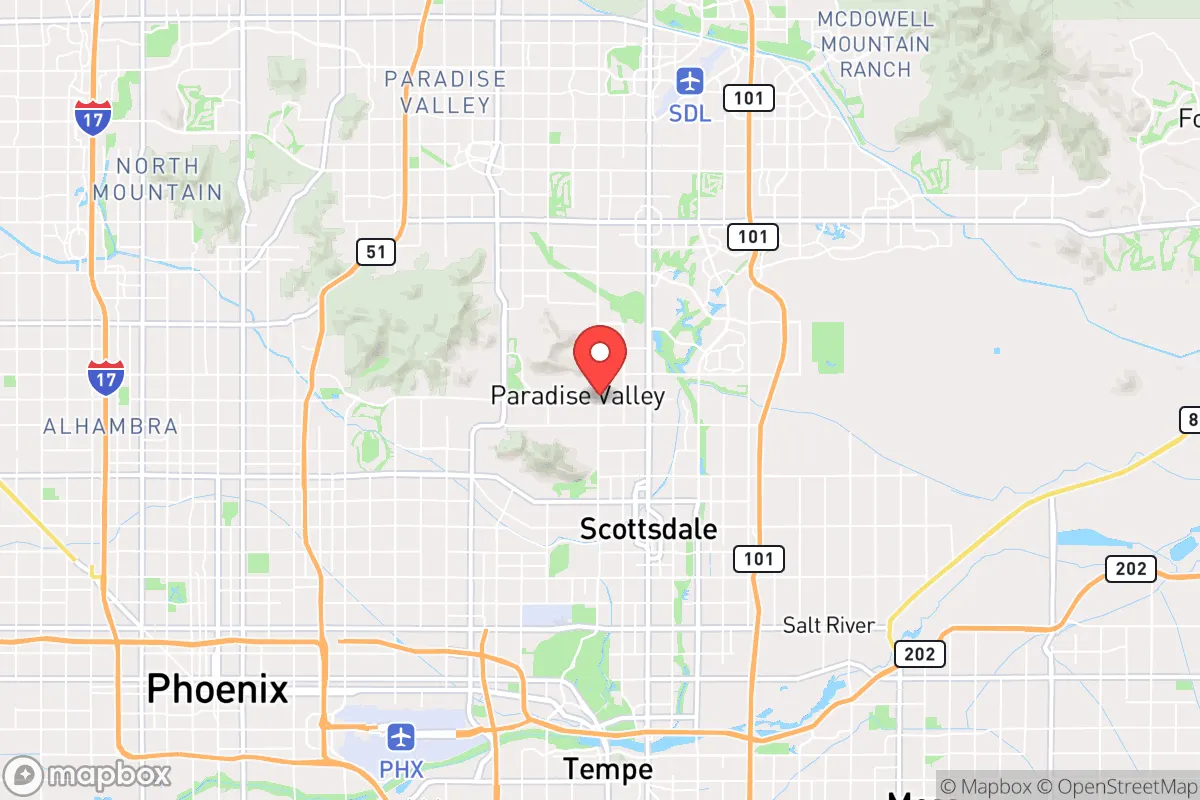
Photo by Tyrel Johnson on Unsplash
Demographics of Paradise Valley, AZ
Affluence Level in Paradise Valley, AZ
An elite concentration of wealth — high incomes, strong home values, advanced degrees, and minimal poverty signal a top-tier socioeconomic profile.
People of Paradise Valley, AZ
Today, Paradise Valley, Arizona is home to roughly 12,621 residents, making it one of the state's most exclusive and low-density enclaves. The population is overwhelmingly white (78.8%) and highly educated, with 72.9% holding a college degree, while the foreign-born share sits at just 3.8% — well below the national average. The town's identity is defined by its large-lot estates, strict zoning, and a reputation as a haven for affluent families, business leaders, and retirees seeking privacy and proximity to Phoenix. Unlike the sprawling suburbs around it, Paradise Valley has deliberately resisted densification, preserving its character as a deliberately curated community of single-family homes on acre-sized lots.
How the city was settled and grew
Paradise Valley was not settled in the traditional pioneer sense — it was never a farming or mining town. The area was originally part of the Salt River Valley's open desert, used sporadically for cattle grazing by Anglo ranchers in the late 19th century. The modern story begins in the 1920s and 1930s, when wealthy Phoenicians began buying large parcels for winter retreats. The first wave of permanent residents were upper-income families from the Midwest and Northeast, drawn by the dry climate and the promise of a rural escape just minutes from downtown Phoenix. The Mummy Mountain area, with its elevated views and natural rock outcroppings, became the first concentrated neighborhood, attracting doctors, lawyers, and early real estate developers. By the 1940s, a handful of citrus groves and horse properties dotted the landscape, but the population remained under 500. The town was officially incorporated in 1961 specifically to prevent annexation by Phoenix and to maintain its low-density, high-value character. The Lincoln Drive corridor and the area around Paradise Valley Country Club became the nucleus for the second wave — corporate executives and snowbirds building custom homes on one- to five-acre lots.
Modern era (post-1965)
The post-1965 period transformed Paradise Valley from a seasonal retreat into a year-round primary residence for the Phoenix metro's elite. The 1970s and 1980s saw the construction of the town's most iconic estates, particularly along Quail Run Road and in the Village of Paradise Valley neighborhood, where lot sizes often exceed two acres. Domestic in-migration from California, Illinois, and New York accelerated as corporate relocations and second-home buyers discovered the area. The Hispanic population, now 10.2%, grew modestly during this period, primarily through service-sector workers employed by the wealthy households — landscapers, domestic staff, and construction trades — who settled in adjacent areas of Phoenix rather than within Paradise Valley itself. The East/Southeast Asian community (1.7%) and Indian subcontinent community (3.4%) arrived later, largely from the 1990s onward, drawn by the town's proximity to Scottsdale's technology and healthcare sectors and the top-ranked Scottsdale Unified School District that serves most of Paradise Valley. The Black population remains negligible at 0.1%, reflecting the town's extreme housing costs — the median home price consistently exceeds $3 million — which effectively limit demographic diversity to income rather than ethnicity. The Doubletree Ranch area and the gated sections near Paradise Valley Drive have become the primary landing points for Indian and East Asian families, who tend to be physicians, engineers, and tech executives.
The future
Paradise Valley's population is projected to remain stable or decline slightly over the next decade, as buildable lots are exhausted and zoning laws prevent subdivision. The town is not homogenizing into a single bloc but rather tribalizing by wealth tier: the older, long-established Anglo families on Mummy Mountain versus newer money from tech and finance concentrated in the eastern sections near Scottsdale. The Indian subcontinent community (3.4%) is the fastest-growing demographic segment, driven by high-income professionals in healthcare and semiconductor industries, but growth is constrained by the limited housing supply. The Hispanic share (10.2%) is likely to plateau, as most new Hispanic residents cannot afford entry-level home prices above $2 million. The East/Southeast Asian population (1.7%) is growing slowly, primarily through second-generation families moving from Scottsdale. The town's extreme wealth filtering means that the next 20 years will see a gradual aging of the white population and a slow, income-restricted diversification among the highest-earning immigrant groups. For a newcomer, Paradise Valley is becoming a place where demographic change happens at the very top of the income ladder — and only there.
For a conservative-leaning individual or family moving in now, Paradise Valley offers a stable, low-crime, highly educated environment where property values are insulated from broader market swings by scarcity. The population is not diversifying rapidly in the way Phoenix or Scottsdale are; instead, it is becoming more stratified by income, with the Indian and East Asian communities integrating into the existing elite structure rather than forming separate enclaves. The town's future is one of managed continuity — a deliberately small, wealthy, and politically conservative bastion that will change slowly and only at the margins.

* Values derived from national, state, county, city and local statistics and may differ in a specific area. Last updated: 2026-04-16T00:42:05.000Z
Narrative content on this page is AI-generated and may contain mistakes. Verify any details that matter before acting on them.
ReloMaps may earn a commission from affiliate links at no extra cost to you.

