
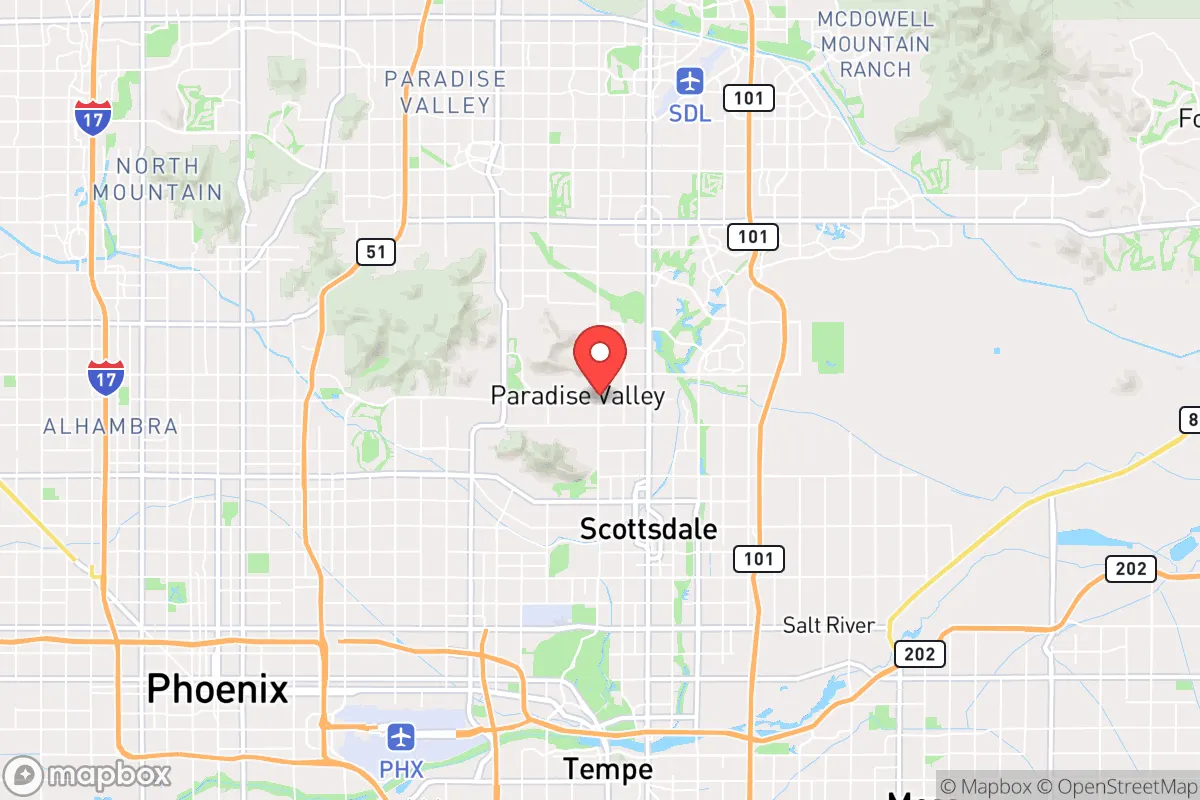
Photo by Tyrel Johnson on Unsplash
Quality of Life in Paradise Valley, AZ
Above-average quality of iife. The area offers a reasonable cost of living, decent mobility, and a mix of neighborhood amenities.
What does Quality of Life tell us?
Quality of Life blends cost of living, nearby amenities, socioeconomic signals, and neighborhood character. City-level scores represent the whole municipality; individual neighborhoods can differ.
What does this tell us?
Quality of Life blends cost of living, nearby amenities, socioeconomic signals, and neighborhood character. City-level scores represent the whole municipality; individual neighborhoods can differ.
Cost of Living
364% above national average
The Real Cost of Living in Paradise Valley, AZ for 2026
| Tier | Individual | Family (4) |
|---|---|---|
| Survival | $56k | $105k |
| Comfortable | $389k | $571k |
| Luxury | $427k+ | $662k+ |
| Elite (Top 5%) | $689k+ | $1.1M+ |
41%
The Area Signal
A metric tracking the socioeconomic signals of the area.


Hobbies
Explore the areaGroceries
4 within 10 miles
Gas
0 within 10 miles
Hospital
3 within 20 miles
Airport
PHX — Phoenix Sky Harbor International
Post Office
USPS — Scottsdale, AZ
Critical Amenities
Quality-of-Life Analysis
Paradise Valley, Arizona, is one of the wealthiest municipalities in the United States, defined by its sprawling estates, strict low-density zoning, and a population that skews toward high-net-worth individuals, corporate executives, and retirees seeking extreme privacy and exclusivity. With a cost of living index of 464 (more than four times the national average), the town is not merely expensive—it is a deliberate enclave where the median home value sits at $2,000,001 and median rent reaches $3,501. This is not a place for budget-conscious families or young professionals; it is a lifestyle choice for those who prioritize space, security, and prestige over urban convenience or affordability.
Cost of living, housing prices, and how Paradise Valley compares to Scottsdale and Phoenix
Paradise Valley’s housing market operates on a different plane than its neighbors. The median home value of over $2 million is roughly five times higher than Scottsdale’s median and nearly ten times that of Phoenix. Rents, while high, are less extreme relative to the local luxury market, but still far exceed metro averages. The cost of living index of 464 is driven almost entirely by housing; groceries, healthcare, and transportation are only modestly above national norms. The town’s zoning code mandates minimum lot sizes of one acre in most areas, effectively preventing any multifamily or affordable housing development. For context, a typical 3,500-square-foot home on a half-acre lot in Scottsdale might sell for $1.2 million; the same square footage in Paradise Valley, on a full acre, often exceeds $3 million. Property taxes are relatively low for Arizona (around 0.6% of assessed value), but the absolute dollar amount on a $2 million home still runs $12,000+ annually. The average commute of 22 minutes is shorter than the Phoenix metro average of 26 minutes, reflecting the town’s proximity to high-end employment centers in north Scottsdale and the Camelback Corridor.
What daily life is like for families: schools, amenities, and the local rhythm
Daily life in Paradise Valley is quiet, car-dependent, and oriented around private amenities. The town has no downtown, no sidewalks in most areas, and no commercial zoning—residents drive to adjacent Scottsdale or Phoenix for groceries, dining, and shopping. The Paradise Valley Unified School District serves the area, with Cherokee Elementary School and Paradise Valley High School both rated above average by GreatSchools, though many families opt for private institutions like Phoenix Country Day School or Brophy College Preparatory. Recreation centers on the Paradise Valley Municipal Pool, the town’s 11 parks (including the 40-acre Mountain Shadows Park), and the adjacent Camelback Mountain hiking trails. The town’s strict noise and light ordinances, combined with a low crime rate (violent crime is 80% below the national average), create an atmosphere of near-total tranquility. There are no nightclubs, no major retail, and no events that draw crowds—the rhythm is deliberately slow, with most social life occurring in private homes, country clubs, or the nearby Scottsdale Fashion Square mall.
Paradise Valley is best suited for affluent retirees, corporate executives, and families who value extreme privacy, large lots, and low density above all else. It is not a fit for anyone seeking walkability, nightlife, or a sense of urban community. Those who thrive here are willing to trade convenience for seclusion and pay a premium for the assurance that their neighbors are equally invested in maintaining the town’s exclusive character. For the right buyer—one with a net worth comfortably in the eight figures—Paradise Valley offers a level of residential privacy and prestige unmatched in the Phoenix metro area.

Crime in Paradise Valley, AZ
Lower crime rates than 94% of comparable U.S. locations.
Violent CrimeViolent Crime Analysis
Property CrimeProperty Crime Analysis
Crime Analysis
Paradise Valley, Arizona, consistently ranks as one of the safest municipalities in the Phoenix metropolitan area, with crime rates far below both state and national averages. The town's violent crime rate of 72.1 incidents per 100,000 residents and property crime rate of 560.8 per 100,000 reflect a community where serious offenses are rare. This safety profile is a primary reason affluent families and retirees choose Paradise Valley over neighboring Scottsdale or Phoenix.
Crime in context
Paradise Valley's violent crime rate is roughly 80% lower than the national average and approximately 75% lower than the Arizona state average. Property crime, while higher than violent crime, still sits well below the U.S. median. For comparison, nearby Phoenix reports violent crime rates exceeding 700 per 100,000—nearly ten times higher. The town's low density, extensive private security presence, and proactive police department contribute to these figures. However, residents should note that property crimes like vehicle break-ins and package thefts do occur, particularly in areas near resort properties or main thoroughfares like Lincoln Drive.
What residents experience
Most residents describe feeling safe walking their neighborhoods at night and leaving homes unlocked during the day—a rarity in a major metro area. The Paradise Valley Police Department maintains a visible patrol presence and responds quickly to calls. A key concern for many homeowners is the influence of Maricopa County's justice system, which has seen progressive district attorneys and judges implement policies that critics argue prioritize offender rehabilitation over public safety. These policies, including reduced bail requirements and diversion programs for repeat property offenders, have led to frustration among victims who feel the system is too lenient. Residents report that while major violent crime is virtually nonexistent, the revolving door for property criminals creates a persistent nuisance, especially for those living near the town's borders with Phoenix and Scottsdale.
Neighborhood-level variation
Safety is not uniform across Paradise Valley. The gated estates along Camelback Mountain and Mummy Mountain enjoy the highest security, with private patrols and limited access points. In contrast, neighborhoods along the southern edge, closer to the 101 freeway and Phoenix city limits, see slightly higher rates of property crime. The area around the Paradise Valley Country Club and the commercial corridor on Tatum Boulevard also reports more incidents, primarily vehicle break-ins. For the most secure experience, buyers should prioritize properties within the town's interior, away from major roads and municipal borders. Overall, Paradise Valley remains an exceptionally safe community, but the broader county's progressive criminal justice policies are a legitimate concern for those seeking maximum security and accountability for offenders.
* Values derived from national, state, county, city and local statistics and may differ in a specific area. Last updated: 2026-04-16T00:42:05.000Z
Narrative content on this page is AI-generated and may contain mistakes. Verify any details that matter before acting on them.
ReloMaps may earn a commission from affiliate links at no extra cost to you.

