
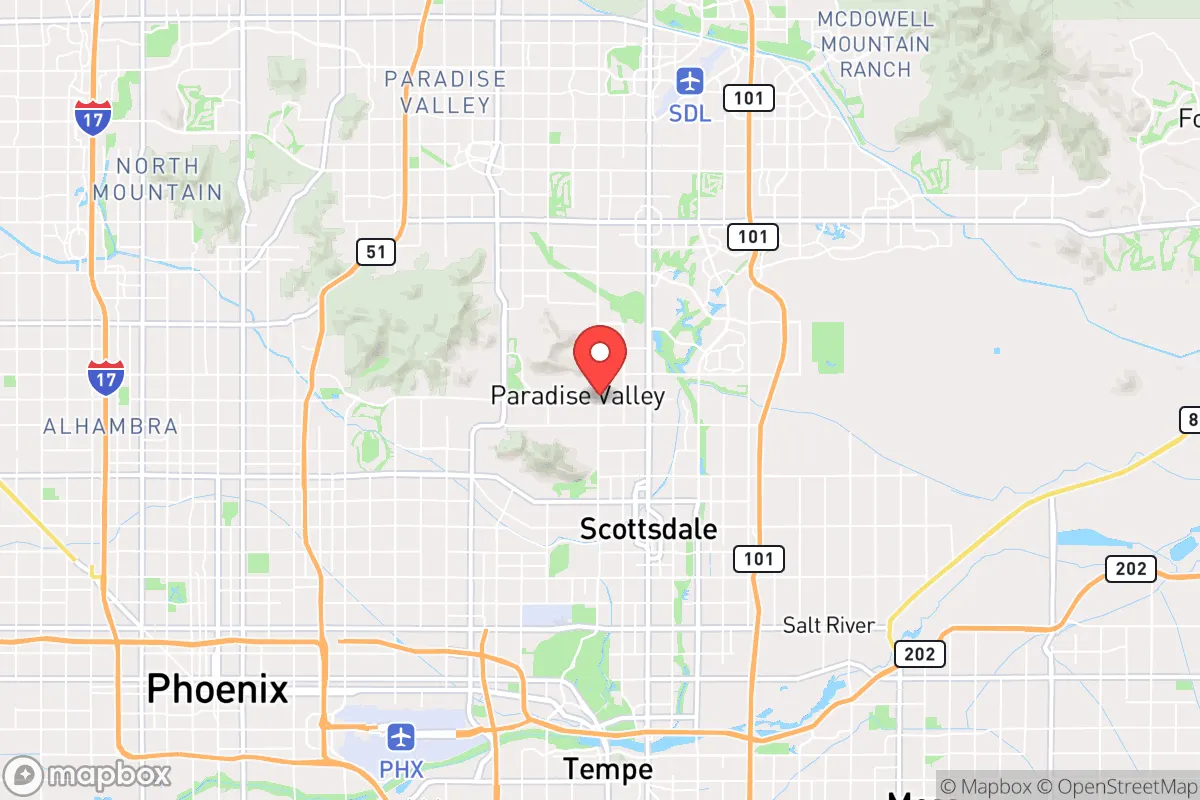
Photo by Tyrel Johnson on Unsplash
Personal Sovereignty in Paradise Valley, AZ
Viable for self-reliance. Generally workable, though some barriers may limit total independence.
What does Personal Sovereignty tell us?
Personal Sovereignty measures your capacity for self-reliance and independence with minimal government friction. Higher scores mean fewer barriers between you and the way you want to live... but it assumes you have the space you need and good neighbors.
What does this tell us?
Personal Sovereignty measures your capacity for self-reliance and independence with minimal government friction. Higher scores mean fewer barriers between you and the way you want to live... but it assumes you have the space you need and good neighbors.
State Policy
Energy independence: Importer (20% of energy produced in-state)
Personal Liberty
Homesteading

Personal Liberty Analysis
Paradise Valley, Arizona, offers one of the strongest personal sovereignty environments in the United States, particularly for those who prioritize minimal government interference, self-reliance, and the preservation of individual rights. Nestled between Phoenix and Scottsdale, this affluent enclave benefits from Arizona’s robust state-level protections while adding a layer of local governance that largely leaves residents alone. For a conservative-leaning individual or family concerned with federal overreach and the erosion of personal freedoms, Paradise Valley represents a strategic stronghold where autonomy is not just tolerated but structurally supported by law and local culture.
Tax burden and regulatory posture: How Arizona’s low-tax framework protects your wallet and choices
Arizona’s tax environment is a cornerstone of personal sovereignty here. The state imposes a flat income tax rate of 2.5% as of 2025, one of the lowest in the nation, and Paradise Valley itself has no city income tax. Property taxes are capped under Arizona’s constitutional limits, with effective rates in Paradise Valley hovering around 0.6% of assessed value—well below the national average. This means less of your earnings are funneled to government programs you may not support. The regulatory posture is equally favorable: Arizona is a right-to-work state, meaning you cannot be forced to join a union as a condition of employment. Business licensing is streamlined, and there are no onerous local ordinances that restrict home-based enterprises or firearm-related businesses. For the prepper or survivalist, this low-tax, low-regulation environment means more capital retained for personal preparedness, land improvements, and self-sufficiency investments.
Self-defense and gun law specifics: Constitutional carry, stand your ground, and castle doctrine protections
Paradise Valley sits in Maricopa County, which is part of a state that enforces some of the strongest self-defense laws in the country. Arizona is a constitutional carry state—no permit is required to carry a concealed firearm for anyone legally able to possess one. The state’s “stand your ground” statute (A.R.S. § 13-405) removes any duty to retreat before using deadly force if you are lawfully present and reasonably believe force is necessary to prevent death or great bodily harm. The castle doctrine extends this protection to your home, vehicle, and workplace. Local law enforcement in Paradise Valley is generally supportive of Second Amendment rights; the Paradise Valley Police Department does not maintain a registry of firearms and does not enforce magazine capacity bans or “assault weapon” restrictions, as none exist at the state level. For the survivalist, this means you can legally stockpile ammunition, build a defensive arsenal, and train without fear of local ordinances changing overnight. The only notable restriction is that carrying firearms on K-12 school grounds is prohibited without a valid permit, but this is a standard limitation nationwide.
Self-reliance and homesteading viability: Lot sizes, zoning, and off-grid feasibility in an affluent desert enclave
Paradise Valley is unique among Phoenix-area suburbs for its large residential lots—minimum lot sizes are typically one acre, with many properties exceeding two or three acres. This is a deliberate zoning choice that preserves space for private gardens, rainwater catchment systems, and even small livestock like chickens (allowed with a permit). The town’s zoning code explicitly permits “accessory dwelling units” (ADUs) and “guest houses,” which can serve as secure storage for supplies or as a separate living quarters for extended family. Off-grid feasibility is moderate: while the town requires connection to municipal water and sewer, solar panel installation is permitted by right, and battery storage systems are common. The desert climate means water is the primary constraint—rainwater harvesting is legal and encouraged, but you’ll need significant cistern capacity to be truly independent. For the prepper, the one-acre minimum provides a buffer from neighbors, reducing the risk of disputes over noise, livestock, or defensive shooting practice. However, note that Paradise Valley’s HOA-style covenants (the town acts as its own architectural review board) require approval for major structures like fences over six feet or large outbuildings, so full “homesteading” is possible but must be done within a polished, upscale aesthetic.
Personal liberties: Parental rights, medical autonomy, speech, and property protections
Arizona has become a national leader in protecting parental rights. The state’s “Parental Rights” law (A.R.S. § 1-601) affirms that parents have the fundamental right to direct their children’s upbringing, education, and healthcare. This means no mandatory vaccine mandates for school attendance (though some private schools may require them), and parents can opt their children out of any curriculum they find objectionable. Medical autonomy is similarly strong: Arizona does not have a state-level vaccine passport system, and the 2022 law (HB 2498) prohibits discrimination based on vaccination status. During the COVID-19 pandemic, Paradise Valley’s local government did not impose mask mandates or business closures, reflecting a community that values individual choice over collective compliance. Free speech is protected under the Arizona Constitution, which explicitly states that “no law shall be enacted restraining or abridging the liberty of speech.” Property rights are reinforced by the state’s “private property rights” act, which limits eminent domain and requires just compensation for any regulatory taking. For the survivalist, this means you can speak freely about preparedness, stockpile supplies without government interference, and resist federal overreach with state-level legal backing.
In the broader context of American personal sovereignty, Paradise Valley ranks among the top-tier locations for those seeking to minimize government intrusion while maintaining access to urban infrastructure. Compared to states like California, Oregon, or New York, where local ordinances can restrict everything from firearm ownership to homeschooling to rainwater collection, Arizona’s legal framework provides a durable shield. The town’s high property values and low crime rate (violent crime is roughly 80% below the national average) mean that the primary threat to your sovereignty is not local government but potential federal overreach—and Arizona’s state preemption laws and strong county sheriffs (Maricopa County Sheriff’s Office) provide a bulwark against that. For the conservative individual or family prioritizing autonomy, self-defense, and the ability to live as they see fit, Paradise Valley offers a rare combination of legal protections, physical space, and cultural alignment that is difficult to replicate elsewhere in the United States.

* Values derived from national, state, county, city and local statistics and may differ in a specific area. Last updated: 2026-04-16T00:42:05.000Z
Narrative content on this page is AI-generated and may contain mistakes. Verify any details that matter before acting on them.
ReloMaps may earn a commission from affiliate links at no extra cost to you.

