
Photo by Tyrel Johnson on Unsplash
Political ClimatePolitical Climate in Paradise Valley, AZ
District shown is the primary district for this city’s centroid. Cities may span multiple districts.
Local Political AnalysisPolitical Analysis of Paradise Valley, AZ
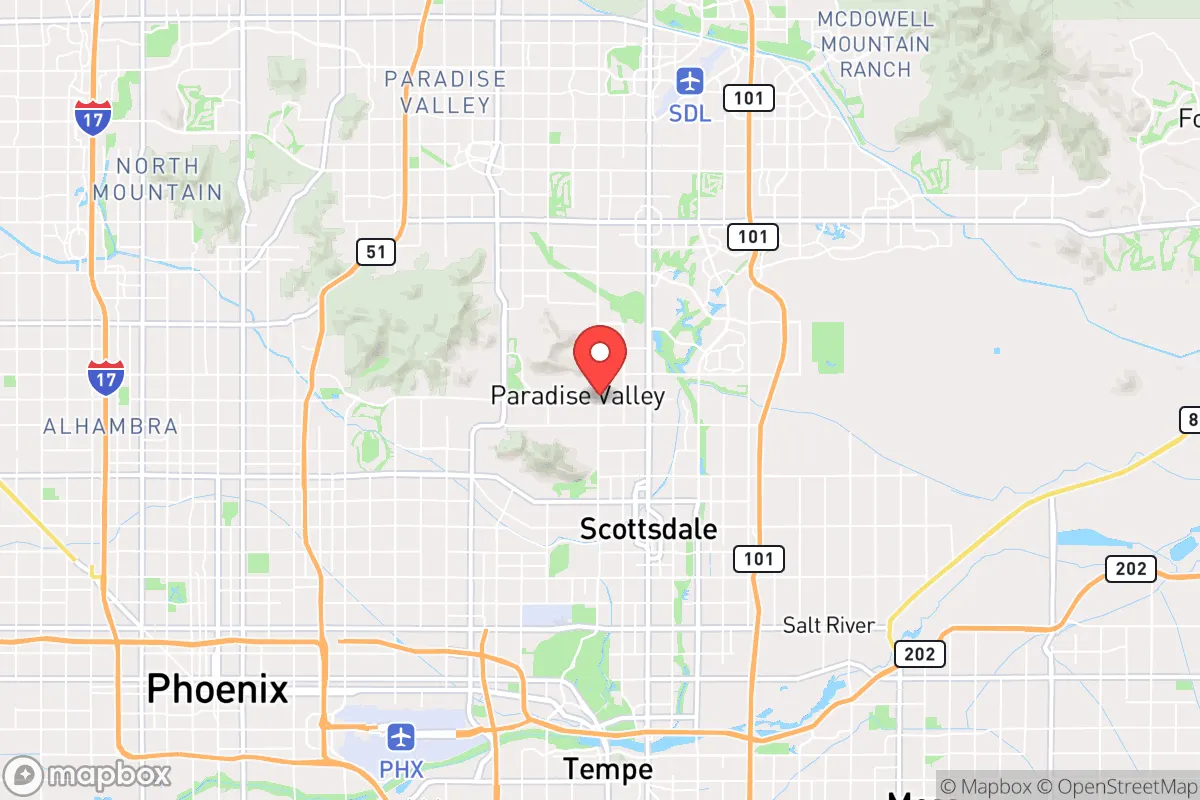
Paradise Valley has long been one of the most reliably conservative enclaves in Maricopa County, and while the town’s voter registration still leans Republican, the political climate here has gotten a bit more complicated over the last decade. The Cook PVI sits at R+1, which tells you this isn’t a deep-red stronghold like Fountain Hills or Cave Creek—it’s a place where the old guard of fiscal conservatives and libertarian-leaning homeowners is increasingly bumping up against a wave of new money and out-of-state transplants who bring more progressive social views with them. The town council and local zoning board remain firmly in the hands of property-rights advocates, but the broader county and state trends are something to keep an eye on if you value limited government and local control.
How it compares
Drive ten minutes south to Scottsdale’s Old Town or Tempe, and you’ll feel the political temperature shift noticeably—those areas have swung left in recent cycles, with Tempe’s city council now dominated by progressive Democrats who’ve pushed higher density zoning and expanded public transit. Head north to Carefree or Cave Creek, and you’re back in solidly Republican territory where the biggest political fights are about keeping development low and taxes lower. Paradise Valley sits right in the middle of that spectrum: the town’s homeowners association and planning commission still fight tooth and nail against any hint of government overreach into property rights, but the county board of supervisors and state legislature have both seen creeping influences from Phoenix’s urban agenda. The R+1 rating reflects that tension—it’s a bellwether for whether the Valley’s traditional conservative culture can hold the line against the metro area’s broader drift toward progressive policies on land use, water rights, and school curriculum.
What this means for residents
For someone who moved here to escape the regulatory headaches of California or the East Coast, the day-to-day reality is still pretty good—Paradise Valley’s town government is lean, responsive, and generally stays out of your business. Property taxes remain among the lowest in the Phoenix metro for homes of this value, and there’s no city income tax to worry about. But the long-term trend is what gives longtime residents pause. The influx of younger families and remote workers from blue states has started to shift the conversation at town hall meetings, with more calls for “equity” in zoning and “sustainability” mandates that sound an awful lot like the kind of regulatory creep that drove people out of California in the first place. The school board elections have become a battleground, with parental rights groups fighting to keep curriculum decisions local and transparent. If you value personal freedom and minimal government interference, Paradise Valley still delivers, but you’ll want to stay engaged locally—the quiet erosion of those protections happens one zoning variance and one school board vote at a time.
Culturally, Paradise Valley remains a place where neighbors still wave from their golf carts and the biggest local controversy is usually about a new mansion blocking someone’s mountain view. There’s no downtown, no public transit to speak of, and the town has no plans to add either—that’s by design. The policy distinction that matters most here is the fierce defense of single-family zoning and large lot sizes, which keeps density low and property values high. If the county ever pushes for more affordable housing mandates or transit-oriented development, you can expect the town council to fight it tooth and nail. For now, Paradise Valley is still a refuge for those who believe the best government is the one that governs least, but the political winds are shifting, and staying informed is the only way to keep it that way.

State Political ClimatePolitical Climate in Arizona
State Political AnalysisPolitical Environment in the State
Arizona has shifted from a reliably Republican stronghold to a true battleground state over the past two decades, with its current political climate defined by a razor-thin partisan split. The state’s overall lean is now a toss-up, with Democrats winning the presidential vote in 2020 by just over 10,000 votes out of 3.4 million cast, while Republicans still hold a narrow registration edge and control the governorship and legislature as of 2026. The trajectory is concerning for conservatives: the once-solid red state has moved leftward by roughly 10 points since 2000, driven by explosive growth in Maricopa County and an influx of voters from blue states, though rural and exurban areas remain deeply conservative.
Urban vs. rural divide
The political map of Arizona is a tale of two landscapes. The Phoenix metro area, anchored by Maricopa County, is the decisive battleground—home to 60% of the state’s population, it flipped from +3 Republican in 2016 to +2 Democratic in 2020, powered by suburban voters in Scottsdale, Tempe, and Chandler who have trended left on social issues. Meanwhile, Tucson (Pima County) is a reliably blue stronghold, delivering 60%+ Democratic margins, driven by the university and government sectors. The real conservative firepower comes from the rural and exurban counties: Yavapai County (Prescott) votes +30 Republican, Mohave County (Kingman/Lake Havasu) hits +40, and Pinal County (Casa Grande) has shifted from +20 to +15 as Phoenix sprawl pushes in. Flagstaff (Coconino County) is an outlier—a liberal mountain town surrounded by red rural territory, voting +25 Democratic. The divide is stark: drive 30 minutes outside any metro and you’re in Trump country, but the population weight of the urban core keeps the state competitive.
Policy environment
Arizona’s policy landscape is a mixed bag for conservatives. The state has a flat income tax rate of 2.5% (down from 4.5% in 2021 thanks to 2022’s Proposition 132 and legislative action), and no estate or inheritance tax—a strong selling point for freedom-minded movers. Property taxes are low, averaging 0.62% of home value, and the state has right-to-work laws. However, education policy is a flashpoint: the 2023 expansion of universal school vouchers (Empowerment Scholarship Accounts) was a major win for parental rights, but the state also mandates social-emotional learning standards that raise eyebrows. Healthcare is relatively free-market, with no state-level price controls, but Medicaid expansion under the 2013 AHCCCS program (Arizona’s version of Obamacare) remains in place. Election laws have been a rollercoaster: the 2021 audit of Maricopa County ballots (the “Cyber Ninjas” audit) exposed deep distrust, but subsequent laws like SB 1260 (requiring proof of citizenship for federal voter registration) and the 2022 ban on ballot drop boxes in certain counties have tightened security. Still, the state’s permanent early voting list (over 80% of voters use mail ballots) remains a point of contention for those skeptical of mail-in integrity.
Trajectory & freedom
On the freedom front, Arizona is a tale of two trends. The good news: the state has expanded gun rights significantly. In 2021, Governor Doug Ducey signed a permitless carry law (SB 1382), allowing any law-abiding adult to carry a concealed firearm without a permit—a major win for Second Amendment advocates. Property rights are strong, with no statewide rent control and a 2023 law (HB 2570) limiting local governments’ ability to impose zoning restrictions that reduce housing supply. Parental rights got a boost with the 2022 “Don’t Say Gay” style law (HB 2495) restricting classroom instruction on sexual orientation in grades K-3. However, concerning trends are emerging: the 2024 passage of a ballot measure (Proposition 139) enshrined a “fundamental right to abortion” in the state constitution, overriding the 1864 near-total ban that had been reinstated by the state supreme court. This was a major blow to pro-life advocates. Medical autonomy also took a hit with the 2023 law (SB 1001) requiring pharmacists to dispense abortion pills even if they object—a clear government overreach into conscience rights. The trajectory is mixed: the state is becoming freer on guns and taxes, but less free on life and medical conscience.
Civil unrest & political movements
Arizona has been a hotspot for political activism and flashpoints. The 2020 election aftermath saw massive protests in Phoenix, with both “Stop the Steal” rallies and Black Lives Matter demonstrations drawing thousands. The 2021 Maricopa County ballot audit became a national spectacle, with partisan observers clashing and the final report confirming no widespread fraud but fueling ongoing distrust. Immigration politics are a constant pressure point: Yuma and Nogales see regular border crossings, and the state’s 2010 SB 1070 (the “show me your papers” law) remains a touchstone, though much of it was struck down by courts. In 2024, the legislature passed a new border security bill (HB 2828) allowing local police to enforce federal immigration law, which is being challenged in court. Organized movements include the Arizona Freedom Caucus (a hardline conservative group in the legislature) and the progressive “Arizona for All” coalition. Election integrity remains a live issue: the 2022 midterms saw armed poll watchers in Maricopa County, and the 2024 cycle brought lawsuits over ballot drop box surveillance. A new resident would notice the constant political tension in local news and yard signs—it’s a state where politics is personal.
Projection
Looking ahead 5-10 years, the trend lines are worrying for conservatives. In-migration from California, Illinois, and New York—which has added 500,000+ new residents since 2020—is disproportionately blue-leaning, especially in Maricopa County’s suburbs. The 2024 election saw Trump lose the state by 2 points, and the 2026 governor’s race is expected to be a toss-up. Demographic shifts are key: the growing Latino population (now 32% of the state) is not monolithic—many are conservative on social issues—but younger Latinos trend Democratic. The rural counties are losing population share, meaning the urban vote will only grow. If the trend holds, Arizona could become a lean-Democratic state by 2032, similar to Colorado’s trajectory. However, there are wildcards: if the border crisis worsens, it could drive moderate voters back to the GOP. The 2025 legislative session saw a push for a state constitutional amendment to require a supermajority for tax increases, which could lock in fiscal conservatism. For now, the state is a battleground, but the demographic winds are blowing left.
Bottom line for a new resident: If you’re moving to Arizona for lower taxes and gun rights, you’ll find them—but you’ll also find a state that’s politically volatile and trending left. The rural areas (Prescott, Kingman, Yuma) offer a more stable conservative environment, while Phoenix suburbs like Gilbert and Mesa are still red-leaning but shifting. Expect to live in a perpetual campaign season, with ballot measures on abortion, taxes, and immigration every election cycle. The freedom you gain in your wallet may come with a cost in cultural and political battles. Choose your county carefully—it matters more than the state as a whole.
* Values derived from national, state, county, city and local statistics and may differ in a specific area. Last updated: 2026-04-16T00:42:05.000Z
Narrative content on this page is AI-generated and may contain mistakes. Verify any details that matter before acting on them.
ReloMaps may earn a commission from affiliate links at no extra cost to you.

