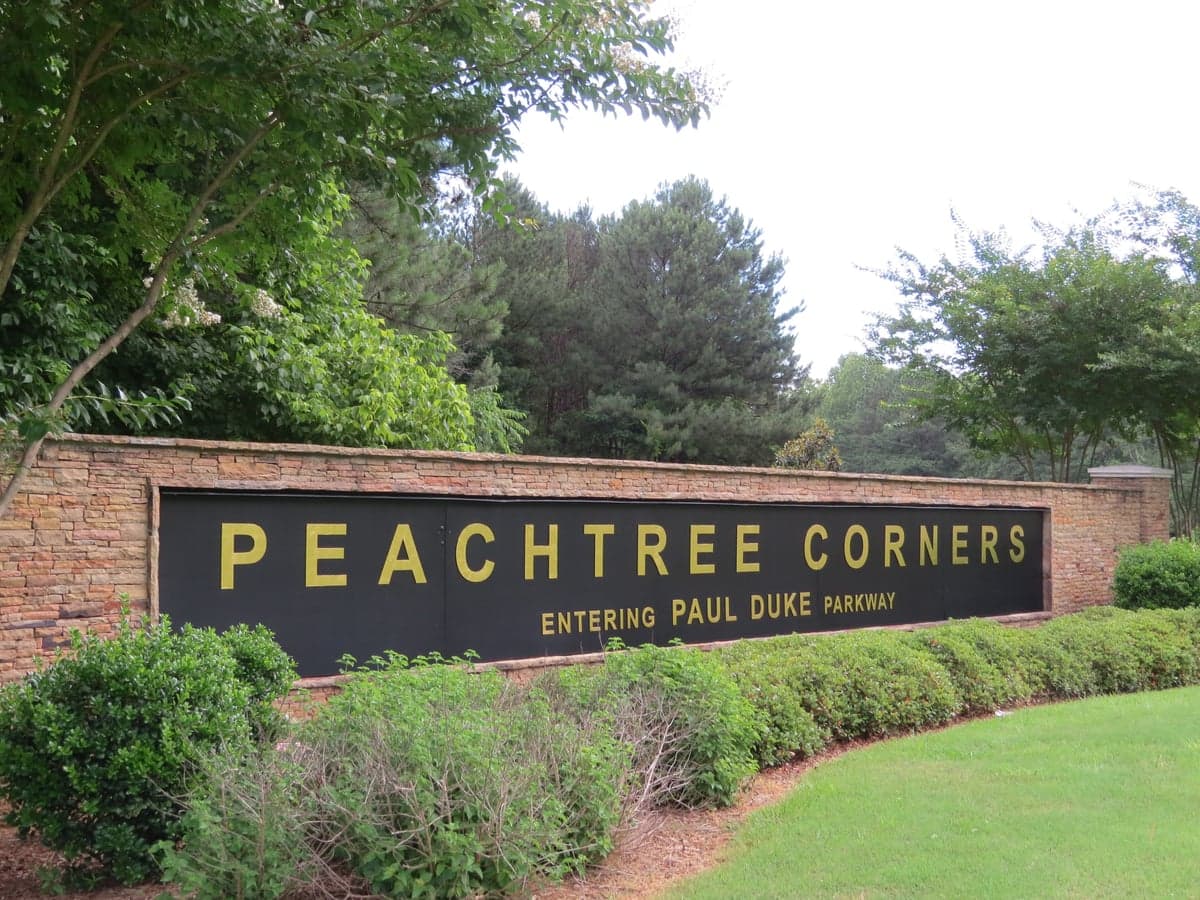
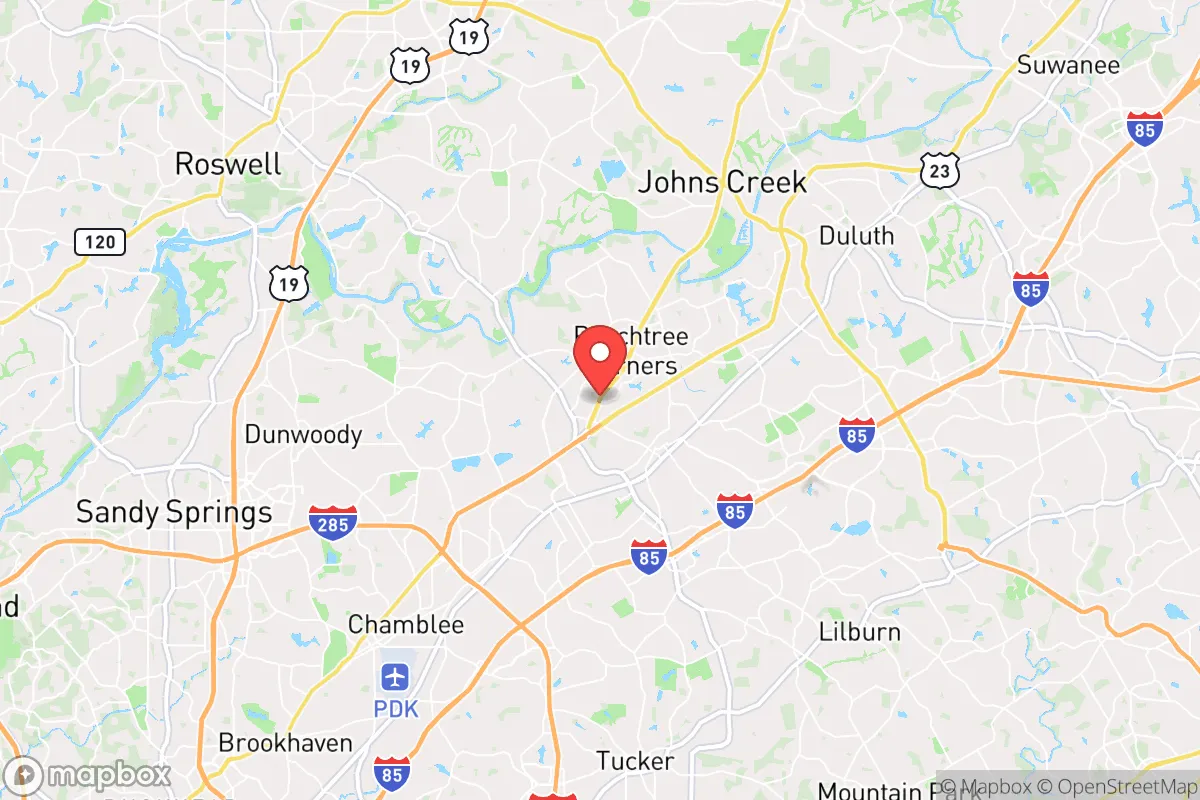
Photo: Wikipedia
Strategic Assessment of Peachtree Corners, GA
Meaningful friction. Expect exposure to either population pressure, blast zones, or natural disaster risk. Consider buying a retreat property.
What does the Strategic Assessment tell us?
Our Strategic Assessment grades tactical survivability of an area. Major population centers, military targets, fallout zones, natural disasters, and border exposure all drive risk — lower exposure means a more defensible position in a crisis.
This is heavily inspired by Joel Skousen's Strategic Relocation book. Highly recommended you checkout the book ($)What does this tell us?
Our Strategic Assessment grades tactical survivability of an area. Major population centers, military targets, fallout zones, natural disasters, and border exposure all drive risk — lower exposure means a more defensible position in a crisis.
This is heavily inspired by Joel Skousen's Strategic Relocation book. Highly recommended you checkout the book ($)Strategic Pillars

Key Distances
Regional Safe Places
Below is our recommended "safe zones" in Georgia and the surrounding area based on our strategic heuristics. For most people, it's unrealistic to live in a “safe zone” full-time due to work, family or other personal reasons. They tend to be more rural. However, many of these areas are perfect for second homes and retreat properties that double as a vacation home or even a short-term rental.
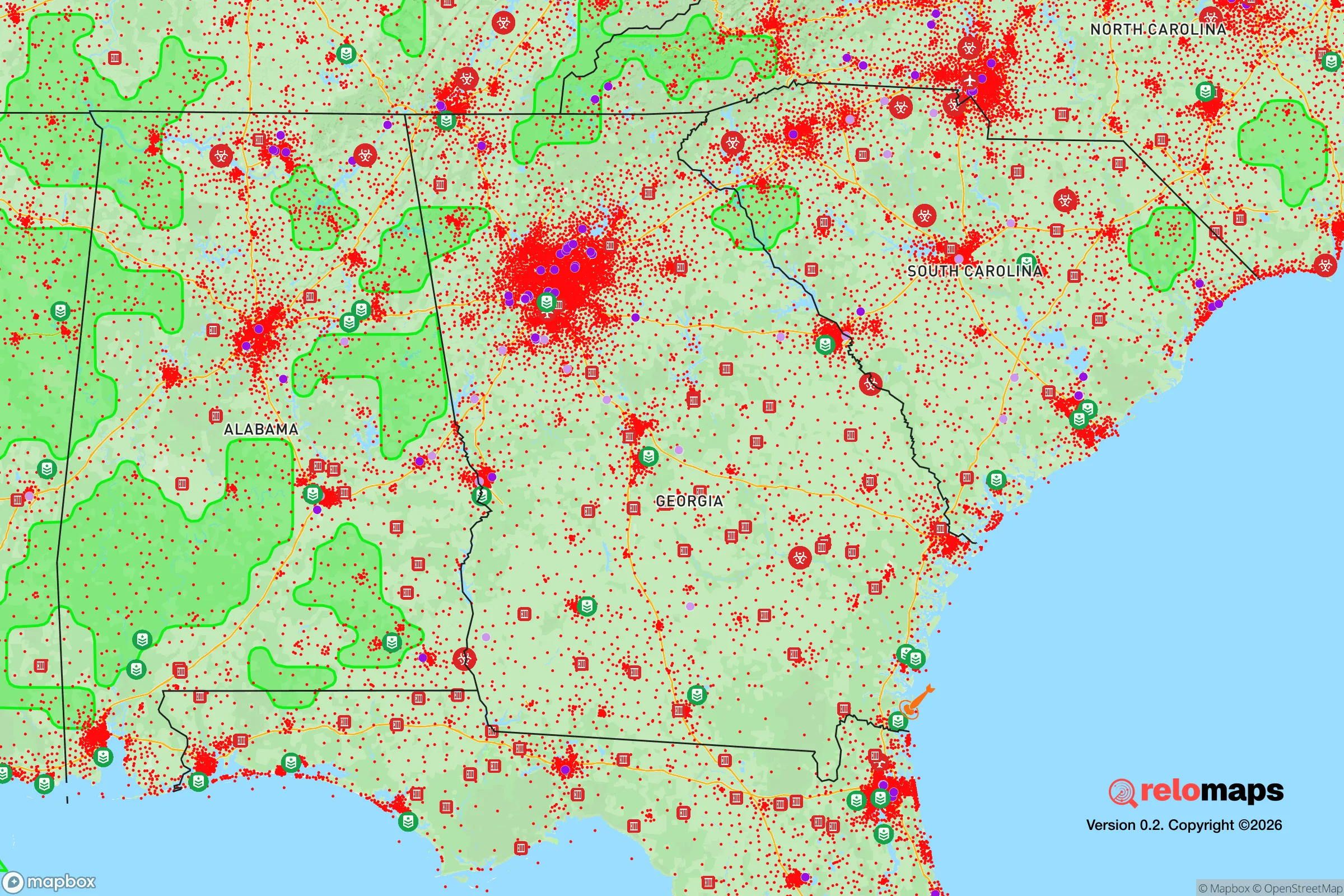
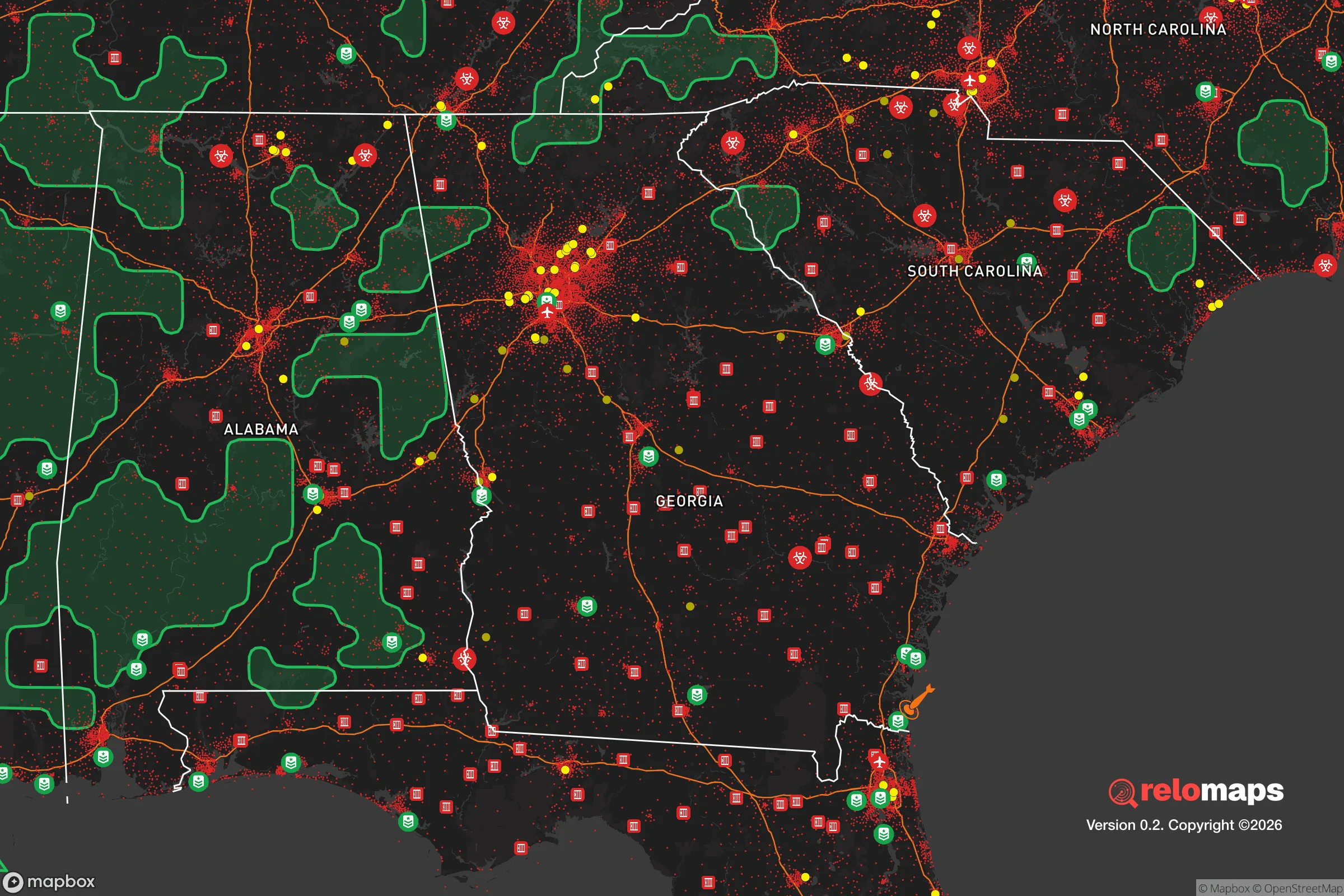


Important Note: For informational purposes only. This does not mean nothing bad ever happens in the green zones. Please use common sense. This is based on public data and modeled with AI. We tried to take a conservative approach but mistakes happen. We update this regularly as new information becomes available.
Solar Generator Recommendations
Backup power matters more here than in safer locations. We've picked three solar generators across budgets and capacity tiers — start with the budget unit if you only need a few essentials, or step up if you want to run a fridge and HVAC for days at a time.

Jackery Portable Power Station Explorer 300
Budget OptionPower on the Go: Weighing only 11 lbs, it's convenient to set up and store with book-sized foldable solar panels

BLUETTI Portable Power Station AC180
Designed for both indoor and outdoor scenarios, AC180 is highly capable as it has a robost capacity and continuous output power.

EF ECOFLOW DELTA Pro Ultra Power Station
Upgraded PickEcoFlow DELTA Pro Ultra is a whole-home energy system designed to grow with your family. Integrated with the Smart Home Panel 2, it scales to meet your evolving energy needs — keeping your home powered, intelligent, and secure through every stage of life.
We earn a commission, at no additional cost to you.
Strategic Assessment Analysis
Peachtree Corners, Georgia, sits in a position that demands a hard look from anyone serious about strategic relocation in an unstable era. Located roughly 25 miles northeast of downtown Atlanta, this planned city of about 45,000 residents offers a mix of suburban infrastructure and proximity to critical resources, but its advantages come with real, calculable risks. For a conservative-minded prepper or survivalist, the core question isn't whether the area is pleasant—it's whether it can sustain you and your family when the systems that underpin modern life begin to fray. The answer is nuanced: Peachtree Corners has genuine resilience in its water access and local governance, but its location near a major metropolitan target zone and its dependence on fragile supply chains demand a clear-eyed, sober assessment.
Geographic position and natural advantages for long-term sustainability
Peachtree Corners benefits from a geography that offers more than just a pleasant commute. The city sits along the Chattahoochee River, a major water source that flows through the region and provides a reliable, if not pristine, supply of surface water. The area's underlying geology includes the Piedmont region's granite and clay soils, which support decent well water potential in outlying parcels, though most suburban lots are on municipal systems. The local topography is gently rolling, with forested patches that offer some natural cover and a moderate climate that allows for year-round gardening—a critical factor for any long-term food strategy. The city's location at the intersection of Peachtree Parkway (GA-141) and Holcomb Bridge Road gives it road access to both the northern suburbs and the rural corridors leading toward the Appalachian foothills, which could serve as a fallback zone if Atlanta becomes untenable. However, the area's natural advantages are tempered by its position within a sprawling metro region: the same river that provides water also draws development, and the forests are fragmented by subdivisions and commercial strips. For a relocator, the key takeaway is that Peachtree Corners offers a decent base for short-to-medium-term sustainability, but it is not a remote retreat—it's a suburban node that could become a pressure point during a crisis.
Risks, exposures, and proximity to fallout-relevant landmarks
The most significant risk for Peachtree Corners is its proximity to Atlanta, a city that ranks high on any list of potential targets for civil unrest, infrastructure collapse, or even a mass casualty event. Atlanta is a major transportation hub (Hartsfield-Jackson airport, I-85/I-75 corridors), a center for federal agencies (CDC, FBI field office), and a concentration of corporate headquarters (Coca-Cola, Delta, Home Depot). In a scenario involving a coordinated attack or a cascading grid failure, Peachtree Corners sits within the likely fallout zone—not from a nuclear blast, but from the secondary effects: refugees fleeing the city, supply chain disruptions, and the breakdown of law and order. The city is also within 30 miles of the Vogtle nuclear power plant (Waynesboro, GA), a potential target for sabotage or accident, though prevailing winds typically carry fallout eastward. More immediate risks include the area's reliance on the Georgia Power grid, which has shown vulnerability during winter storms (e.g., the 2014 ice storm left thousands without power for days). The city's location near the Chattahoochee River also puts it in a floodplain zone for certain neighborhoods, though most of Peachtree Corners sits on higher ground. For the prepper, the calculus is clear: Peachtree Corners is not a safe distance from Atlanta's dangers. It is close enough to feel the shockwaves of any major event, but far enough that you might have a few hours' warning to execute a bug-out plan. The city's planned layout—with its town center, office parks, and residential clusters—means that during a crisis, choke points like Peachtree Parkway and Holcomb Bridge Road could become impassable, trapping residents in their neighborhoods.
Practical resilience for a relocator: food, water, energy, and defensibility
For a single individual or family looking to establish a resilient household in Peachtree Corners, the practical considerations break down into four categories. Water: The city's municipal water comes from the Chattahoochee River, treated at the Hemphill Water Treatment Plant. In a grid-down scenario, this system would fail within hours. A well is not feasible for most suburban lots due to zoning and depth requirements, so a prepper must invest in rainwater catchment (the area averages 50 inches of rain per year) and storage—at least 55 gallons per person for a two-week buffer. Food: Local grocery stores (Publix, Kroger, Walmart) are abundant but would empty within 48 hours of a panic event. The city has a farmers market (Peachtree Corners Farmers Market) that operates seasonally, but year-round food security requires a home garden. The climate supports three-season growing, but soil quality varies; raised beds with imported topsoil are recommended. Energy: The grid is the weak link. Solar panels with battery storage (e.g., Tesla Powerwall or DIY lithium setups) are a wise investment, as the area gets ample sun. Natural gas is available in most neighborhoods, which can power a generator for critical loads, but gas lines are vulnerable to earthquakes (rare but possible) and sabotage. Defensibility: Peachtree Corners is a low-crime area by national standards, but its suburban layout—with cul-de-sacs, open yards, and multiple access points—makes it difficult to secure. A home on a corner lot or near a greenway is a liability. The best defensive posture is a home with a fenced backyard, a reinforced door, and a neighborhood watch that is actually active. The city's police department is well-funded and responsive, but in a widespread crisis, they would be overwhelmed. For a relocator, the practical takeaway is that Peachtree Corners requires significant upfront investment in self-sufficiency to be viable as a long-term base. It is not a "bug-in" location by default; it is a location that can be made resilient with deliberate effort and capital.
The overall strategic picture for Peachtree Corners is one of calculated trade-offs. It offers a stable, low-crime environment with decent access to water and a moderate climate, but its proximity to Atlanta and its suburban infrastructure create vulnerabilities that cannot be ignored. For a conservative-minded relocator who values community and local governance but is willing to invest in hardening a home and building a network of like-minded neighbors, Peachtree Corners can work as a base of operations—provided you have a clear bug-out route to the north (toward the Blue Ridge Mountains) and a plan for the first 72 hours of any crisis. The city's planned nature means it has good roads, reliable utilities, and a functioning local government, but those same features make it a target for population displacement and resource competition. If you are looking for a remote, off-grid retreat, look elsewhere. If you need a suburban foothold with strategic options, Peachtree Corners deserves a place on your short list—but only if you go in with eyes wide open and a fully stocked pantry.

* Values derived from national, state, county, city and local statistics and may differ in a specific area. Last updated: 2026-05-04T02:49:12.000Z
Narrative content on this page is AI-generated and may contain mistakes. Verify any details that matter before acting on them.
ReloMaps may earn a commission from affiliate links at no extra cost to you.

