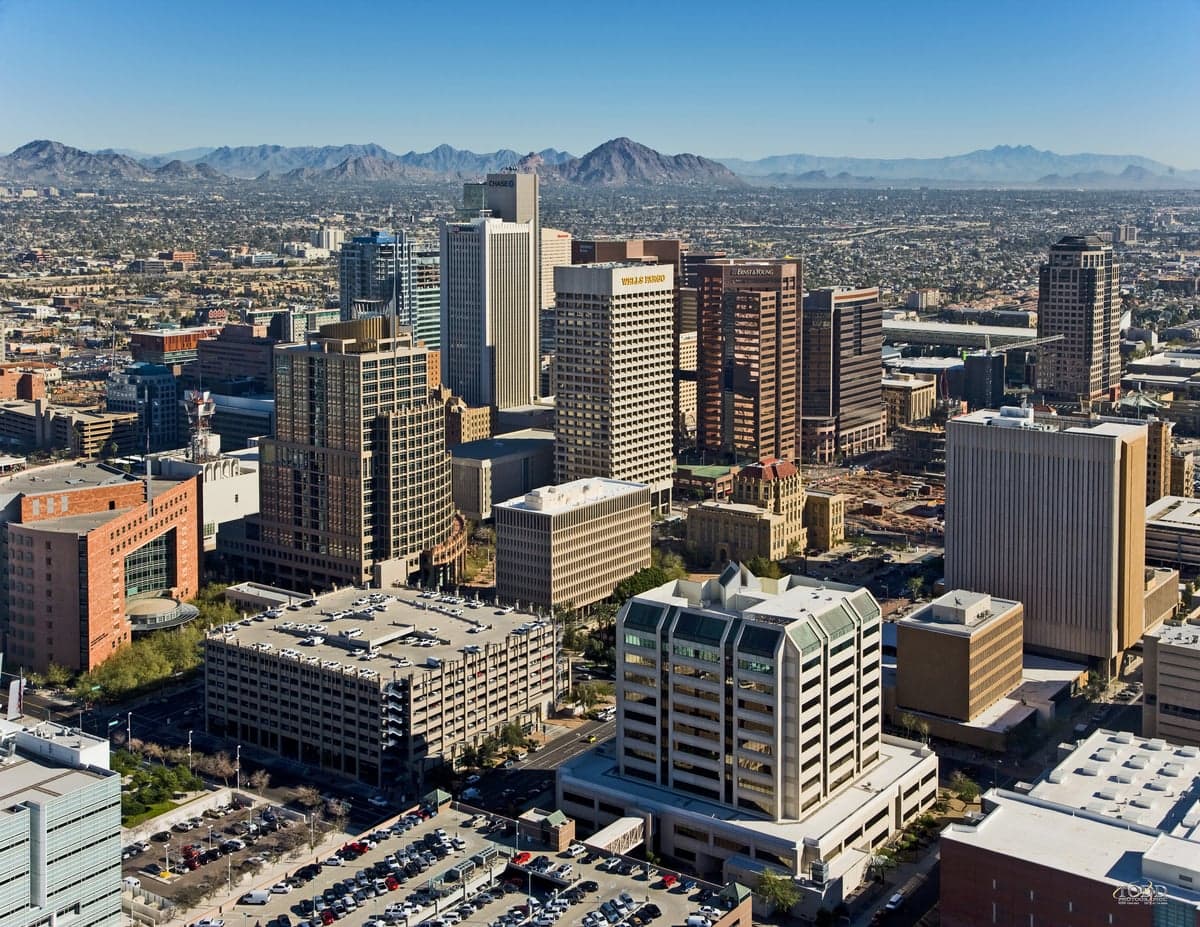
Photo: Wikipedia
Demographics of Phoenix, AZ
Affluence Level in Phoenix, AZ
A middle-class area roughly in line with national averages across income, home values, education, and employment.
People of Phoenix, AZ
Phoenix is a sprawling, majority-minority city where no single ethnic group holds a numerical majority, with Hispanics (41.8%) slightly outnumbering non-Hispanic Whites (41.3%). Its population of 1.6 million is relatively young, moderately educated (32.3% hold a bachelor's degree), and shaped by decades of domestic migration from the Midwest and West Coast alongside sustained immigration from Latin America and Asia. The city's identity is defined less by a single founding culture and more by a patchwork of distinct neighborhoods that reflect successive waves of settlement, from early Anglo homesteaders to post-1965 immigrant communities.
How the city was settled and grew
Phoenix was founded in 1867 on the site of the ancient Hohokam canal system, but its modern population history begins with the 1880s railroad arrival. The original Anglo settlers were predominantly farmers, merchants, and speculators from the Midwest and South, drawn by irrigated agriculture and the promise of dry-heat health benefits for tuberculosis patients. By 1900, the population was roughly 5,500 and overwhelmingly white, with a small Mexican-origin labor force living in what is now Grant Park and the Central City South corridor. The 1910s and 1920s brought a second wave: Midwestern retirees and winter visitors ("snowbirds") who established neighborhoods like Encanto and Willo with their bungalow-style homes. The post-World War II boom transformed Phoenix from a farm town into a Sun Belt magnet. Air conditioning, defense industry jobs (Luke Air Force Base, Motorola), and cheap land drew hundreds of thousands of white families from the Rust Belt and California. Subdivisions like Maryvale (built 1950s) and Ahwatukee (1970s) filled with these newcomers, while restrictive covenants kept most Black and Hispanic families confined to the South Phoenix area south of the Salt River. By 1960, Phoenix had grown to 439,000 residents, 90% of whom were non-Hispanic white.
Modern era (post-1965)
The 1965 Immigration and Nationality Act, combined with the 1980s Central American crises and ongoing Mexican migration, fundamentally reshaped Phoenix's population. The Hispanic share rose from roughly 15% in 1970 to 41.8% today, driven by both immigration and higher birth rates. This wave settled heavily in South Phoenix, Maryvale, and Alhambra, transforming those areas from predominantly Anglo to predominantly Hispanic neighborhoods. Meanwhile, the 1990s and 2000s saw a surge of East/Southeast Asian immigrants (now 2.3% of the city) and Indian-subcontinent immigrants (1.5%), who clustered in Ahwatukee and the Deer Valley area near high-tech employers like Intel and Honeywell. The Black population (7.4%) grew more slowly, with many families moving from South Phoenix to newer subdivisions in Laveen and the far West Valley. The white population peaked numerically around 1990 and has since declined in share, though white residents remain concentrated in Arcadia, Biltmore, and North Central Phoenix. The foreign-born share (11.5%) is lower than in coastal gateway cities, reflecting Phoenix's character as a domestic-migration magnet first and an immigrant destination second.
The future
Phoenix's population is trending toward a Hispanic-plurality future, with non-Hispanic Whites projected to fall below 35% by 2040. The city is not homogenizing; instead, it is tribalizing into distinct ethnic enclaves. Maryvale and South Phoenix are becoming overwhelmingly Hispanic, while Ahwatukee and Deer Valley are diversifying with Asian and Indian families. The white population is aging and slowly shrinking, but younger white transplants from California and Colorado are gentrifying Roosevelt Row and Midtown. Immigrant communities from Latin America are plateauing in growth rate but remain the primary source of population increase, while East/Southeast Asian and Indian communities are growing from a small base. The city's future is a patchwork of ethnically distinct neighborhoods rather than a melting pot, with political and cultural divisions likely to persist along geographic lines.
For a conservative-leaning individual or family moving to Phoenix today, the city offers a choice of distinct communities: heavily Hispanic working-class areas in the south and west, older Anglo enclaves in the north and east, and rapidly diversifying suburbs in the southeast. The population is growing, but it is also sorting itself by ethnicity and income, meaning newcomers should research specific neighborhoods carefully to find the cultural and political environment that matches their priorities.

* Values derived from national, state, county, city and local statistics and may differ in a specific area. Last updated: 2026-04-29T02:20:33.000Z
Narrative content on this page is AI-generated and may contain mistakes. Verify any details that matter before acting on them.
ReloMaps may earn a commission from affiliate links at no extra cost to you.

