
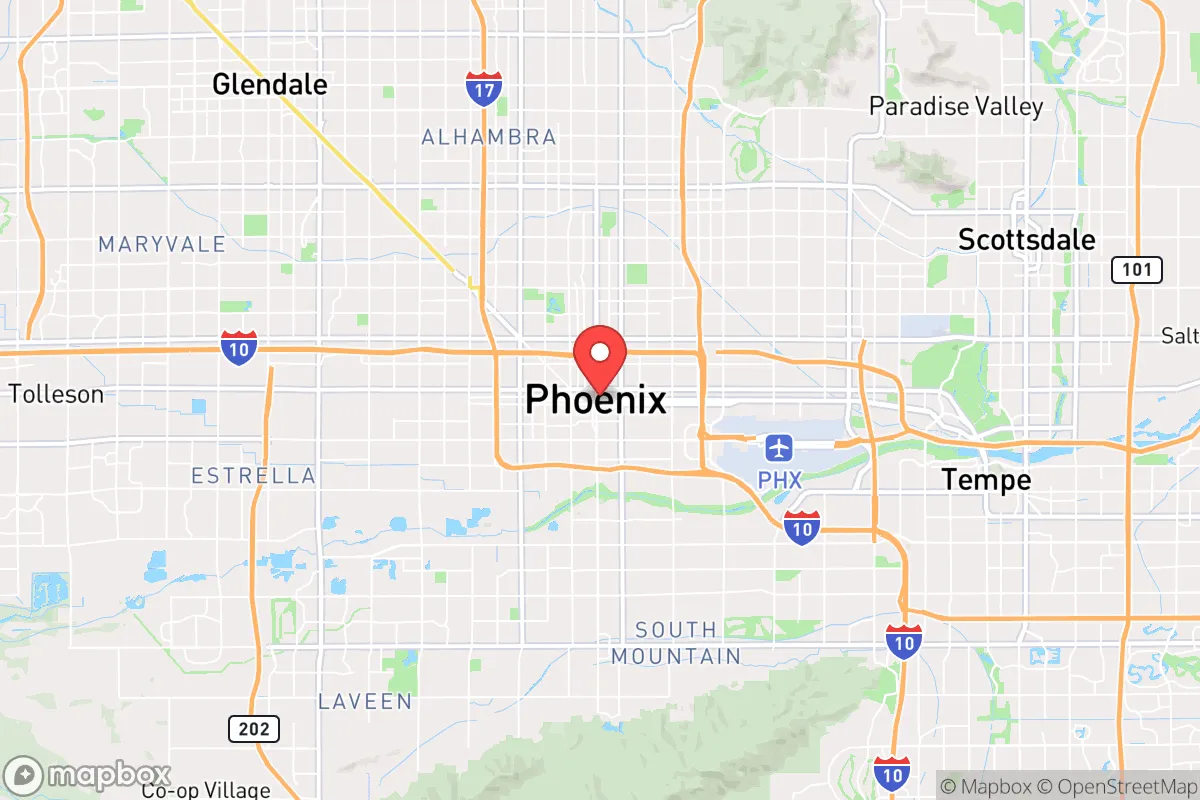
Photo: Wikipedia
Personal Sovereignty in Phoenix, AZ
Viable for self-reliance. Generally workable, though some barriers may limit total independence.
What does Personal Sovereignty tell us?
Personal Sovereignty measures your capacity for self-reliance and independence with minimal government friction. Higher scores mean fewer barriers between you and the way you want to live... but it assumes you have the space you need and good neighbors.
What does this tell us?
Personal Sovereignty measures your capacity for self-reliance and independence with minimal government friction. Higher scores mean fewer barriers between you and the way you want to live... but it assumes you have the space you need and good neighbors.
State Policy
Energy independence: Importer (20% of energy produced in-state)
Personal Liberty
Homesteading

Personal Liberty Analysis
Phoenix, Arizona, offers one of the strongest personal sovereignty environments in the Sun Belt, particularly for those who prioritize minimal government interference in daily life, self-defense, and economic independence. The state’s constitutional framework and legislative track record create a legal atmosphere where individual autonomy is the default, not the exception. For a conservative-leaning individual or family evaluating relocation from a high-regulation state, Phoenix represents a strategic pivot toward a jurisdiction that respects the right to keep and bear arms, limits tax burdens, and largely leaves parents and property owners to manage their own affairs. The key question is whether the urban scale of Maricopa County dilutes these advantages or if the city’s political culture still supports a prepper-friendly, self-reliant lifestyle.
Tax burden and regulatory posture: how Arizona’s fiscal climate supports personal autonomy
Arizona’s tax structure is deliberately designed to minimize the state’s claim on your income and property, which directly translates into more resources retained for personal preparedness and investment. The state levies a flat income tax rate of 2.5% as of 2023, down from a progressive rate that once topped 4.5%, and there is no state-level estate or inheritance tax. Property taxes in Maricopa County average around 0.62% of assessed value, roughly half the national average, meaning a $400,000 home carries an annual tax bill near $2,500. This low burden allows homeowners to allocate more capital toward land improvements, solar arrays, water storage, and other self-sufficiency infrastructure. On the regulatory side, Arizona operates under a right-to-work framework and has preempted most local ordinances that would exceed state standards on land use, firearms, and occupational licensing. Phoenix itself has a reputation for business-friendly permitting, though the city’s zoning code can be more restrictive than outlying counties. Still, the overall regulatory posture is one of restraint: there are no state-level rent control laws, no mandatory paid family leave mandates, and no aggressive environmental regulations that would prevent a homeowner from installing a rainwater catchment system or keeping livestock on appropriately zoned property. For the survivalist-minded, this means fewer bureaucratic hurdles when building a resilient homestead within city limits.
Self-defense and gun law specifics: what Phoenix offers for the armed citizen
Arizona is a constitutional carry state, meaning no permit is required to carry a concealed firearm for any law-abiding adult 21 or older. This is not a recent concession but a long-standing statutory right, codified in 2010, and Phoenix police generally respect the presumption of lawful carry. There is no state-level requirement to register firearms, no waiting periods for purchases, and no magazine capacity restrictions. The state also maintains strong Stand Your Ground and Castle Doctrine laws, eliminating any duty to retreat before using deadly force in self-defense, whether in your home, vehicle, or any place you have a legal right to be. For parents, this legal environment extends to school zones: while federal law prohibits firearms within 1,000 feet of K-12 schools, Arizona law allows concealed carry with a permit on school grounds, and the state has preempted local school districts from enacting stricter bans. Practical considerations for the prepper include the ease of purchasing body armor (no state restrictions), the legality of suppressors (allowed with federal tax stamp), and the absence of a state red-flag law as of 2026. However, Phoenix is a large city, and some municipal police departments have shown varying degrees of enthusiasm for enforcing state preemption on local gun ordinances. Overall, the legal framework strongly favors the individual’s right to self-defense, making Phoenix a solid base for those who view personal armament as a non-negotiable component of sovereignty.
Self-reliance and homesteading viability: lot sizes, zoning, and off-grid feasibility in Phoenix
Phoenix’s arid climate and urban density present both challenges and opportunities for the self-reliant lifestyle. The city’s zoning code allows for single-family residential lots as small as 5,000 square feet in many neighborhoods, but larger parcels—up to one acre or more—exist in areas like North Phoenix, Ahwatukee, and the rural fringe near the Tonto National Forest. For those serious about homesteading, the key is to target unincorporated Maricopa County or cities like Cave Creek and Fountain Hills, where lot sizes of one to five acres are common and zoning permits chickens, goats, and even small-scale agriculture. Phoenix itself allows up to 25 chickens on a standard residential lot with a permit, but prohibits roosters and limits beekeeping to registered apiaries. Off-grid feasibility is limited within city limits due to building code requirements for grid-tied electrical connections and water access, but solar panel installation is widely permitted and net metering is available through APS and SRP. Rainwater harvesting is legal and even encouraged—Arizona law actually grants a property right to captured rainwater—and many homeowners install 1,000-gallon tanks for landscape irrigation. For the prepper focused on long-term resilience, the biggest constraint is water: Phoenix relies on the Colorado River and Salt River Project allocations, which face ongoing drought pressures. A well on a large lot is the gold standard for water independence, but drilling depths of 500 to 1,000 feet are common, with costs ranging from $15,000 to $30,000. Overall, true off-grid living is difficult inside Phoenix proper, but the surrounding county offers viable options for those willing to invest in land and infrastructure.
Personal liberties: parental rights, medical autonomy, speech, and property protections
Arizona has been a battleground for parental rights, and the current legal landscape strongly favors family autonomy. The state passed a Parents’ Bill of Rights in 2022, codifying that parents have the fundamental right to direct their children’s education, healthcare, and religious upbringing. This law has been used to challenge school mask mandates, curriculum transparency issues, and medical consent procedures. On medical autonomy, Arizona does not have a state-level vaccine mandate for adults, and while some employers and schools require certain immunizations, the legislature has repeatedly blocked universal mandates. The state also protects the right to refuse medical treatment and has a robust health freedom statute that allows individuals to purchase dietary supplements and alternative treatments without excessive state interference. Free speech protections are strong, with no state-level hate speech laws that would criminalize political or religious expression, and Phoenix has not enacted the kind of social media content moderation mandates seen in some blue states. Property rights are reinforced by Arizona’s strong eminent domain protections—the state constitution requires “just compensation” and limits takings for private economic development. For the survivalist, this means fewer worries about the government seizing land for a bike path or a transit corridor. The overall legal environment treats the individual as sovereign in most personal and family decisions, with the state’s role limited to public safety and contract enforcement.
In the broader landscape of American personal sovereignty, Phoenix ranks among the top tier for conservative-leaning individuals seeking a balance of urban opportunity and legal freedom. It lacks the extreme libertarian ethos of rural Idaho or New Hampshire, but it compensates with a warmer climate, a growing economy, and a political culture that has consistently resisted federal overreach on guns, taxes, and parental rights. The primary trade-offs are water scarcity and urban density, both of which require strategic planning for the serious prepper. For a single person or family willing to invest in a larger lot, solar power, and water storage, Phoenix offers a legal and fiscal environment that maximizes personal control over life, liberty, and property—exactly the foundation a sovereign individual needs in uncertain times.

* Values derived from national, state, county, city and local statistics and may differ in a specific area. Last updated: 2026-04-29T02:20:33.000Z
Narrative content on this page is AI-generated and may contain mistakes. Verify any details that matter before acting on them.
ReloMaps may earn a commission from affiliate links at no extra cost to you.

