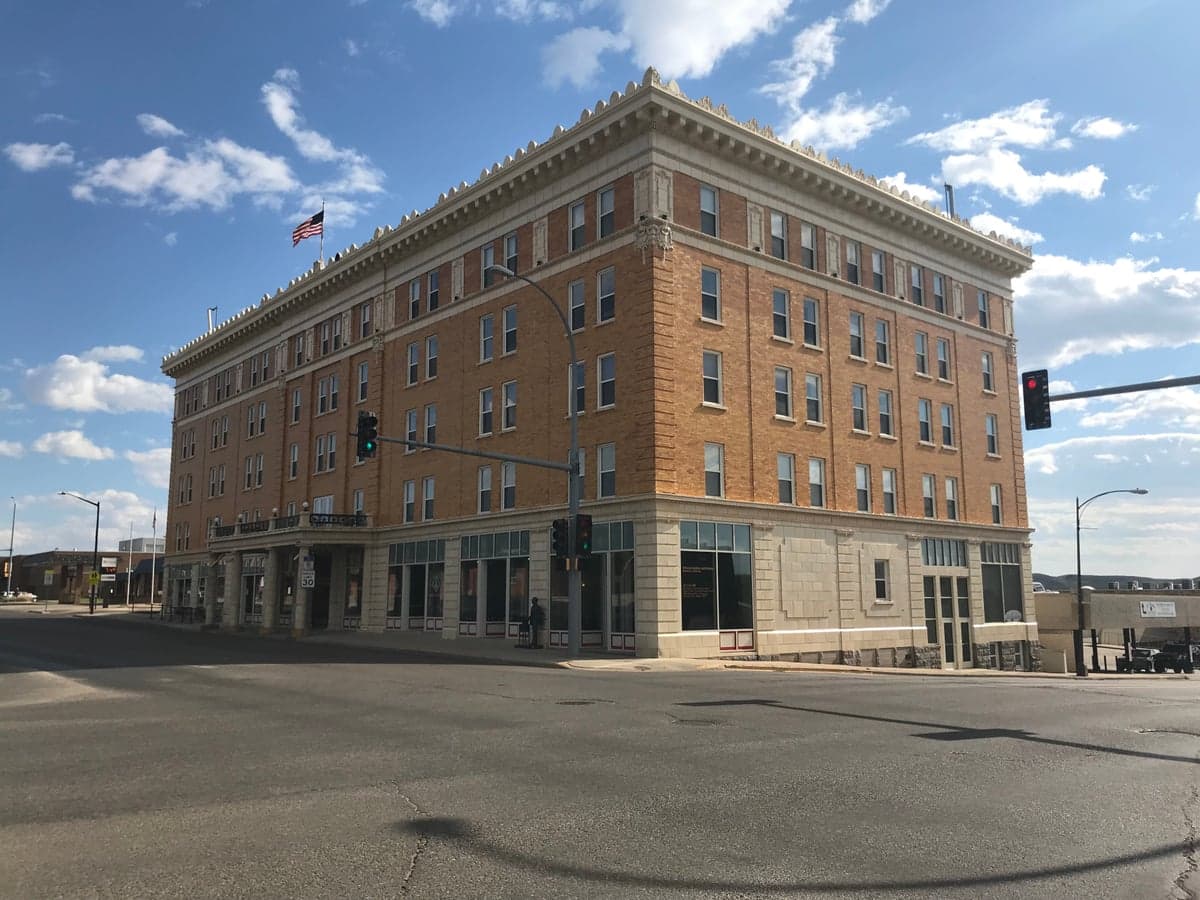
Photo: Wikipedia
Political ClimatePolitical Climate in Pierre, SD
District shown is the primary district for this city’s centroid. Cities may span multiple districts.
Inherited from parent state — no local data available.
Local Political AnalysisPolitical Analysis of Pierre, SD
Pierre leans heavily Republican, with a Cook PVI of R+15 that puts it among the most conservative state capitals in the country. That number isn't just a statistic—it reflects a deep-rooted, live-and-let-live culture where folks have long expected the government to stay out of their business. Over the last decade, the city has held steady, but you can feel the pressure building as outside influences and federal overreach start to creep into local conversations.
How it compares
Drive an hour east to Huron, and you'll find a similar conservative bent, though it's a bit more blue-collar and less tied to state government. Head west to Rapid City, and the politics get a little more mixed—still solidly red, but with a libertarian streak that sometimes clashes with Pierre's more establishment Republicanism. The real contrast is with Sioux Falls, two hours southeast, which has grown more moderate and even leans slightly left on social issues as its population booms with out-of-state transplants. Pierre, by comparison, feels like a time capsule of traditional values—where the Second Amendment is a given, property rights are sacred, and the idea of a carbon tax or a mask mandate would get laughed out of a coffee shop.
What this means for residents
For the people who live here, the political climate means a lot of freedom in day-to-day life. You won't see the kind of zoning overreach or business restrictions that choke smaller towns in blue states. The local government tends to keep its hands off, which is a big reason why property taxes stay reasonable and why you can still build a shop in your backyard without a dozen permits. That said, there's a growing unease about state-level mandates—especially around education and health—that feel like they're testing the limits of local control. The push for more state oversight on curriculum and vaccine requirements has some folks worried that the same government they trust to stay out of their lives might start meddling in the name of "safety" or "progress."
Looking ahead, the trajectory is cautiously optimistic but not without warning signs. Pierre's population is aging, and younger families moving in often bring different expectations—some good, like a renewed focus on small business, but some concerning, like a willingness to accept more government programs. The real test will be whether the city can hold the line against the kind of progressive policies that have reshaped places like Brookings or Vermillion. If the state legislature keeps pushing for more centralized control over local decisions, you might see a quiet rebellion from folks who just want to be left alone. For now, Pierre remains a place where a handshake still means something and where the biggest political fight is usually about how to keep the deer herd healthy—not about which bathroom to use.

State Political ClimatePolitical Climate in South Dakota
State Political AnalysisPolitical Environment in the State
South Dakota is as reliably red as any state in the Union, with a Republican trifecta that has held uninterrupted for decades and a statewide partisan lean of roughly +30 points in presidential elections. The dominant coalition is a blend of rural ranchers, small-town Main Street conservatives, and a growing wave of freedom-minded transplants fleeing blue states. Over the past 10-20 years, the state has shifted even further right, driven by an influx of new residents to places like Rapid City and Sioux Falls who are explicitly seeking lower taxes, less regulation, and a culture that respects individual liberty. The old moderate Republicanism of the 1990s has been replaced by a more assertive, liberty-oriented conservatism that dominates both chambers of the legislature and the governor's mansion.
Urban vs. rural divide
The political map is straightforward: the state's two population centers, Sioux Falls (Minnehaha County) and Rapid City (Pennington County), lean Republican but are not monolithic. Sioux Falls, home to about a quarter of the state's population, votes roughly 55-60% Republican in most races, with a noticeable libertarian streak among its tech and finance workers. Rapid City is more reliably red, often hitting 65% Republican. The real firepower comes from the vast rural expanse: counties like Harding, Perkins, and Jones routinely deliver 85-90% Republican margins. The only reliably blue spots are the tribal lands of Pine Ridge (Shannon County) and Rosebud (Todd County), which vote 70-80% Democratic, but their populations are small and turnout is low. The Black Hills region around Spearfish and Sturgis is a conservative stronghold, while the Missouri River towns like Pierre and Chamberlain are deeply red. There is no suburban swing district; the state's political geography is a sea of red with a few isolated blue islands.
Policy environment
South Dakota's policy environment is a conservative's dream. There is no state income tax, no personal or corporate income tax, and the sales tax is a modest 4.5% (with local add-ons). Property taxes are low by national standards, and the state has a constitutional spending limit that keeps government growth in check. The regulatory posture is aggressively pro-business: no occupational licensing for dozens of professions, no state-level minimum wage above the federal floor, and a right-to-work law that keeps unions weak. Education policy is dominated by school choice: the state has a robust voucher-like program for special needs students and a growing charter school sector, though most kids still attend traditional public schools. Healthcare is a mixed bag: the state did expand Medicaid under Trump-era waivers, but the legislature has resisted Obamacare-style mandates and protects direct primary care agreements. Election laws are among the most secure in the nation: voter ID is required, same-day registration is not allowed, and the state uses paper ballots. There is no mail-in voting unless you have a valid excuse. The legislature has also passed laws to ban ranked-choice voting and restrict ballot initiatives from out-of-state funding.
Trajectory & freedom
South Dakota is becoming more free, not less, and the trajectory is accelerating. In 2023, Governor Kristi Noem signed a package of bills that expanded gun rights: permitless carry (constitutional carry) became law, and the state preempted local gun ordinances, meaning a city like Sioux Falls cannot impose its own restrictions. Parental rights were strengthened with the "Parents' Bill of Rights," which requires schools to notify parents of any curriculum involving sexuality or gender identity and prohibits schools from hiding a child's gender transition from parents. Medical autonomy was bolstered by a law banning vaccine mandates by private employers and a ban on mRNA vaccine mandates for state employees. Property rights were expanded with a law limiting eminent domain for carbon pipelines, a direct response to the Summit Carbon Solutions project that had landowners up in arms. Taxation freedom improved with a gradual reduction of the state sales tax on groceries, from 4.5% to 3.5% by 2027. The only area where freedom has contracted is in the realm of ballot initiatives: the legislature made it harder to get constitutional amendments on the ballot, requiring a 60% supermajority for passage, which was a direct response to the 2020 marijuana legalization vote that passed but was later overturned by the courts. This is a mixed bag—it protects against progressive overreach but also limits direct democracy.
Civil unrest & political movements
South Dakota is remarkably stable compared to the coasts. There have been no major riots or sustained protest movements in recent years. The most visible flashpoint was the 2020-2021 dispute over the Mount Rushmore fireworks display, which Governor Noem pushed through despite federal objections, drawing both supporters and a small group of Native American protesters. The Dakota Access Pipeline protests in 2016-2017 were centered in North Dakota, but spillover activism occurred in Sioux Falls and Rapid City, with small solidarity rallies. The state has a growing "constitutional sheriff" movement, with several county sheriffs publicly refusing to enforce federal gun laws they deem unconstitutional. Immigration politics are muted: South Dakota has a very small foreign-born population (about 4%), and there are no sanctuary cities. The state passed a law requiring local law enforcement to cooperate with ICE. Election integrity controversies are minimal; the state's paper ballot system and voter ID laws are widely trusted. The most organized political movement on the right is the "grassroots liberty" faction within the state GOP, which has successfully primaried moderate Republicans in places like Brookings and Vermillion. On the left, the most active group is the South Dakota Democratic Party, which is essentially a non-factor in statewide races but maintains a presence in tribal areas and a few college towns.
Projection
Over the next 5-10 years, South Dakota will likely become even more conservative. The in-migration pattern is overwhelmingly from blue states like California, Illinois, and Minnesota, and these newcomers are not bringing progressive politics—they are fleeing them. The state's population is growing fastest in the Sioux Falls metro and the Black Hills, both of which are attracting remote workers and small business owners who value low taxes and personal freedom. The only demographic counterweight is the growing Hispanic population in Sioux Falls, which is still small (about 6%) and tends to vote more conservatively than Hispanic populations in other states. The tribal population is declining in relative terms, reducing the Democratic base. The legislature will likely continue to push the envelope on school choice, gun rights, and tax cuts. The biggest wildcard is the carbon pipeline issue: if the state's landowners lose their property rights battle against Summit Carbon Solutions, it could spark a populist backlash that reshapes the GOP primary landscape. But overall, the trend is clear: South Dakota is solidifying as a redoubt of conservative governance, and a new resident moving in today should expect to find a state that is more, not less, aligned with their values in a decade.
Bottom line for a new resident: If you are moving to South Dakota, you are coming to a place where the government largely stays out of your life, your taxes are low, your gun rights are protected, and your children's education is under your control. The political climate is stable, the culture is welcoming to conservatives, and the trajectory is toward even greater personal freedom. The only thing you need to watch is the occasional ballot initiative fight and the pipeline drama—but those are minor compared to the chaos in most other states. You will find like-minded neighbors in Rapid City, Sioux Falls, or any small town along the Missouri River. This is a state that rewards self-reliance and punishes government overreach. Come prepared to work hard, keep what you earn, and enjoy the wide-open spaces without a bureaucrat looking over your shoulder.
* Values derived from national, state, county, city and local statistics and may differ in a specific area. Last updated: 2026-04-21T10:56:14.000Z
Narrative content on this page is AI-generated and may contain mistakes. Verify any details that matter before acting on them.
ReloMaps may earn a commission from affiliate links at no extra cost to you.

