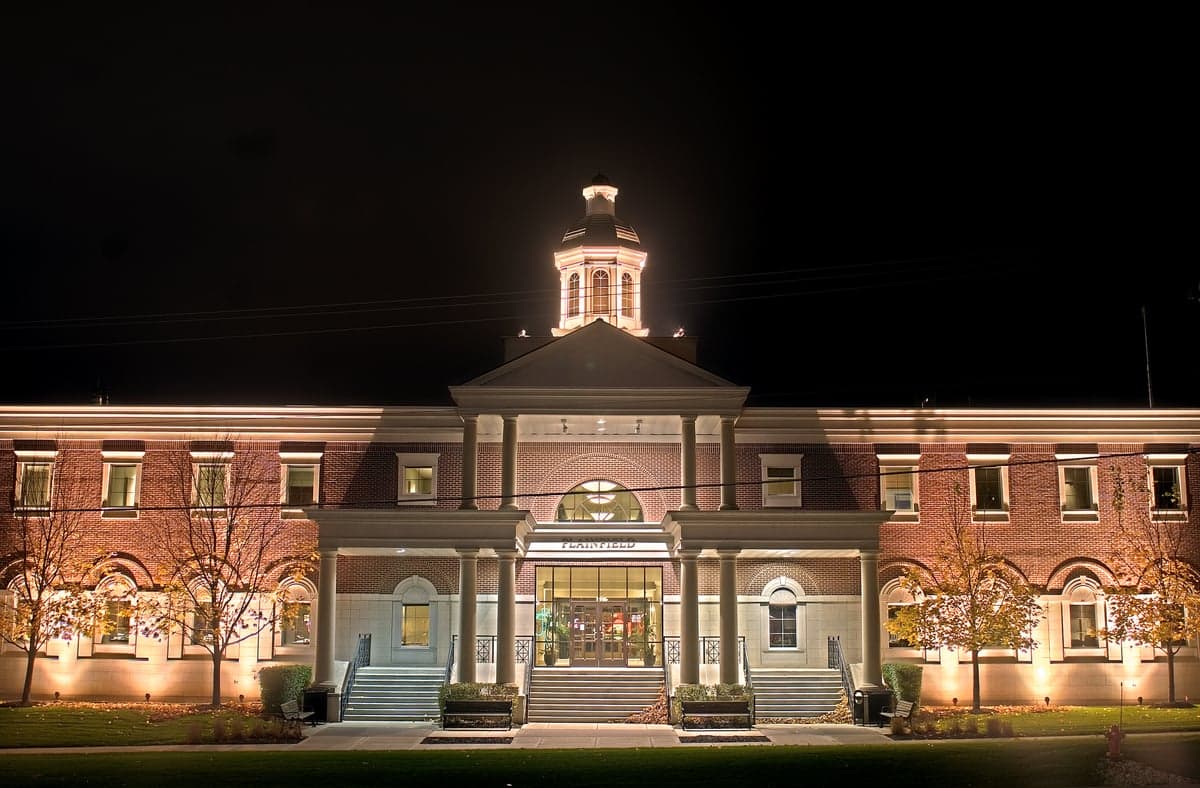
Photo: Wikipedia
Demographics of Plainfield, IL
Affluence Level in Plainfield, IL
An upper-middle-class area. Household wealth, education levels, and homeownership run ahead of national benchmarks.
People of Plainfield, IL
The people of Plainfield, Illinois today number 45,705, forming a predominantly white (68.8%) but increasingly diverse suburban community with a strong family-oriented character. The city is marked by a high college attainment rate (54.9%) and a growing professional class, while its foreign-born population sits at a modest 5.5%. Distinctive identity markers include a deep-rooted sense of local history, a visible Indian-subcontinent community (5.7%) that has grown rapidly since 2010, and a pattern of newer subdivisions absorbing waves of in-migration from both Chicago and other states.
How the city was settled and grew
Plainfield’s original population was drawn by the fertile DuPage River valley and the promise of the Illinois & Michigan Canal in the 1830s and 1840s. Yankee settlers from New England and upstate New York were the first to arrive, establishing farms and a small village core around what is now the Downtown Plainfield Historic District. German and Irish immigrants followed in the 1850s and 1860s, many working on canal construction or as farm laborers; their descendants settled in the West Side neighborhood near the river and in the Lily Cache area to the south. The village remained a quiet agricultural hub through the early 20th century, with a population that barely topped 1,500 by 1950. No major industrial or railroad boom occurred, so Plainfield’s growth was slow and ethnically homogeneous—overwhelmingly white, Protestant, and native-born—until the post-war suburban explosion.
Modern era (post-1965)
The 1965 Hart-Cellar Act had little immediate effect on Plainfield, as the village remained a small, rural outpost through the 1970s. The real demographic shift began with the 1990s suburban boom, when Chicago-area families—mostly white, middle-class, and seeking larger homes and better schools—poured into new subdivisions like Winding Creek and Grand Prairie in the northern and eastern parts of town. This wave doubled Plainfield’s population from roughly 13,000 in 1990 to over 39,000 by 2010. During this period, the Indian-subcontinent community began to establish a foothold, drawn by the strong school system (Plainfield Community Consolidated School District 202) and proximity to tech and engineering jobs in Naperville and the I-88 corridor. Today, Indian families are concentrated in the Eagle Ridge and Wesmere subdivisions, where newer, larger homes (built 2000–2015) attracted professional households. The East/Southeast Asian community (3.6%) is smaller but visible in the same areas, particularly in Caton Farm and Ridgefield, where a mix of Chinese, Korean, and Filipino families have settled. The Black population (8.4%) and Hispanic population (10.0%) are more dispersed, with Hispanic families concentrated in older, more affordable housing near the Downtown and Lily Cache areas, while Black residents are spread across newer subdivisions in the east and south. The white share has declined from roughly 85% in 2000 to 68.8% today, but Plainfield remains less diverse than nearby Joliet or Aurora, with racial and ethnic groups largely living in distinct enclaves rather than fully integrated neighborhoods.
The future
Plainfield’s population is likely to continue diversifying, but at a slower pace than the 1990–2010 boom. The city is approaching build-out, with limited undeveloped land, so future growth will come from infill and redevelopment rather than massive new subdivisions. The Indian-subcontinent community is the fastest-growing ethnic group and shows no signs of plateauing; it is expected to reach 8–10% of the population by 2035, driven by chain migration and the reputation of District 202 schools. The East/Southeast Asian share is likely to grow modestly, while the Hispanic and Black populations may stabilize or increase slightly as younger families move in from more expensive suburbs. The white population will continue its gradual decline in share but remain the majority. Plainfield is not tribalizing into hostile enclaves, but distinct residential patterns—Indian families in newer subdivisions, Hispanic families in older housing, white families across the board—are likely to persist. The city is becoming a more layered, multi-ethnic suburb, but one where assimilation into a common suburban lifestyle (high homeownership, strong schools, low crime) is the norm.
For someone moving in now, Plainfield is a stable, family-oriented suburb that is quietly diversifying without losing its core character. The city offers a high-quality school system, a low crime rate, and a growing professional job base, but newcomers should expect to find a community where ethnic groups live in distinct neighborhoods rather than fully integrated blocks. The next decade will likely see continued Indian-subcontinent growth, a stable white majority, and a slow increase in overall diversity—making Plainfield a solid choice for families who value predictability and good schools over urban energy or radical demographic change.

* Values derived from national, state, county, city and local statistics and may differ in a specific area. Last updated: 2026-04-24T13:02:10.000Z
Narrative content on this page is AI-generated and may contain mistakes. Verify any details that matter before acting on them.
ReloMaps may earn a commission from affiliate links at no extra cost to you.

