Photo: Wikipedia
Demographics of Portsmouth, VA
Affluence Level in Portsmouth, VA
A below-average socioeconomic profile. Incomes, home values, and educational attainment trail the U.S., with higher poverty and unemployment.
People of Portsmouth, VA
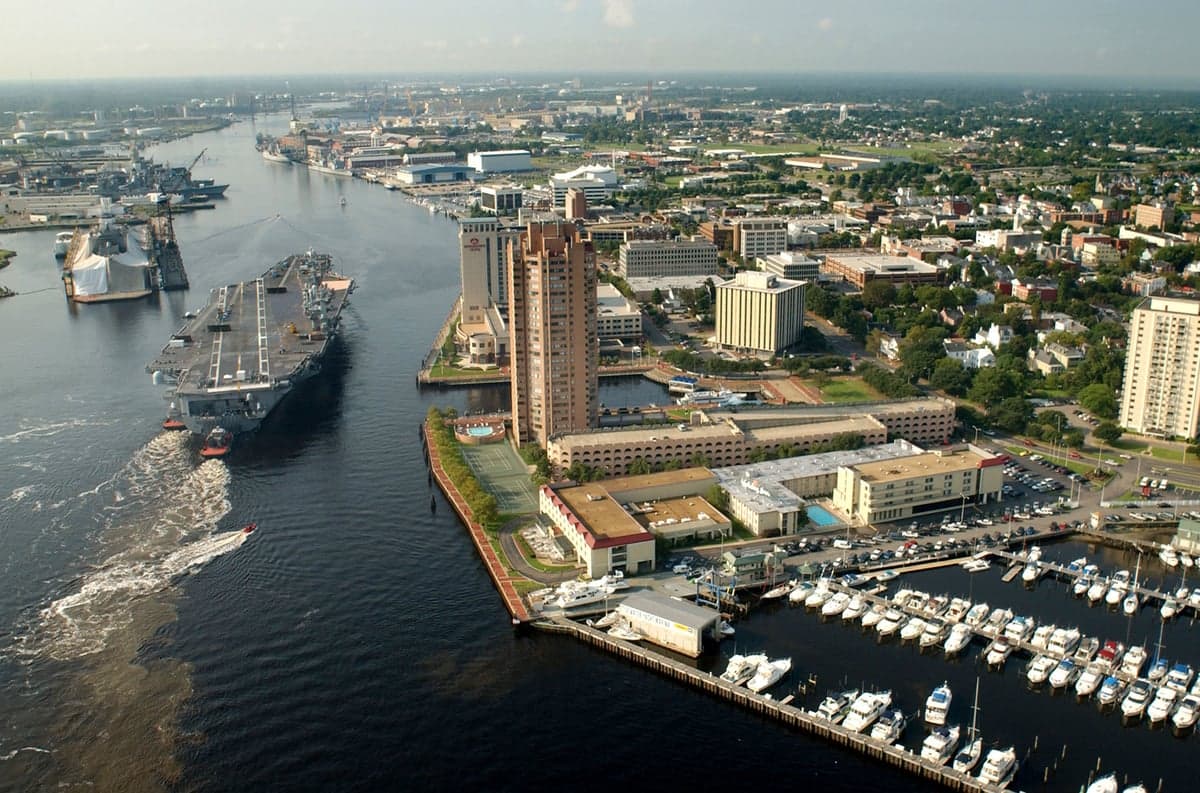
The people of Portsmouth, Virginia today form a predominantly Black (51.2%) and working-to-middle-class city of 97,299, marked by a strong military and shipyard heritage and a notably low foreign-born share of just 1.4%. With only 23.2% of adults holding a bachelor’s degree or higher, the population skews practical and blue-collar, anchored by the Norfolk Naval Shipyard and nearby military bases. The city’s identity is rooted in deep generational ties to the Tidewater region, producing a stable but slowly shrinking population that has seen modest Hispanic growth (5.1%) and a small but visible East/Southeast Asian community (1.3%). For a conservative-leaning newcomer, Portsmouth offers a dense, historically grounded Southern city where neighborhood character varies sharply by district.
How the city was settled and grew
Founded in 1752 as a port and shipbuilding center on the Elizabeth River, Portsmouth’s early population was a mix of English merchants, Scottish shipwrights, and enslaved Africans who built the city’s maritime economy. The Norfolk Naval Shipyard, established in 1767, became the dominant employer and drew successive waves of workers: first free White laborers from the surrounding Virginia countryside, then freedmen after the Civil War who settled in neighborhoods like Prentis Park and Brighton. By the early 20th century, the shipyard’s expansion during World War I and World War II attracted a large influx of Black migrants from the rural South, who formed tight-knit communities in Port Norfolk and West Norfolk. These neighborhoods remain predominantly Black today, with many families tracing their roots to the Great Migration. The city’s White population, historically concentrated in Churchland and Olde Towne, was largely composed of shipyard managers, naval officers, and small-business owners.
Modern era (post-1965)
The post-1965 period brought significant demographic change. The Immigration and Nationality Act of 1965 had a muted effect on Portsmouth due to its low foreign-born share (1.4%), but domestic migration reshaped the city. White flight accelerated after school desegregation in the 1970s, with many White families moving to neighboring Chesapeake and Suffolk, leaving Portsmouth’s White share at 35.9% today. Black in-migration from other parts of Hampton Roads continued, reinforcing the city’s majority-Black character. The small East/Southeast Asian community (1.3%) is largely tied to military and shipyard employment, with families concentrated near the naval base in Cradock, a historic planned community built for shipyard workers. The Indian-subcontinent population (0.2%) is negligible and scattered. Hispanic growth (5.1%) is a recent phenomenon, driven by Puerto Rican and Central American families moving into more affordable housing in West Norfolk and Port Norfolk, though the share remains well below regional averages. The city’s overall population has declined from a peak of about 114,000 in 1960 to 97,299 in 2024, reflecting suburban outmigration and a shrinking tax base.
The future
Portsmouth’s population trajectory points toward continued slow decline, with modest diversification driven by Hispanic in-migration and a small but stable East/Southeast Asian presence. The Black majority is likely to persist, but the White share may continue to edge downward as older White residents age out and younger families choose suburban jurisdictions. The city is not homogenizing; instead, it is tribalizing into distinct enclaves: Olde Towne is gentrifying with a mix of White professionals and empty-nesters, Churchland remains a middle-class White and Black buffer zone, and Prentis Park and Brighton stay predominantly Black and lower-income. The foreign-born population is unlikely to grow significantly given the city’s weak job market outside the shipyard and military. The next 10-20 years will likely see Portsmouth remain a majority-Black, working-class city with a small but growing Hispanic minority, while the East/Southeast Asian and Indian communities remain marginal.
For a conservative-leaning mover, Portsmouth is a city of deep roots and clear boundaries—neighborhoods matter more than the citywide average. It offers affordable housing and proximity to military employment, but the declining population and limited college-educated workforce signal a place that is stable rather than growing. Newcomers should expect a community where local identity is strong, change is slow, and the best opportunities lie in established enclaves like Olde Towne or Churchland.

* Values derived from national, state, county, city and local statistics and may differ in a specific area. Last updated: 2026-05-02T04:06:43.000Z
Narrative content on this page is AI-generated and may contain mistakes. Verify any details that matter before acting on them.
ReloMaps may earn a commission from affiliate links at no extra cost to you.

