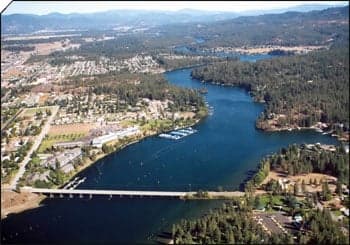
Photo: Wikipedia
Demographics of Post Falls, ID
Affluence Level in Post Falls, ID
A middle-class area roughly in line with national averages across income, home values, education, and employment.
People of Post Falls, ID
The people of Post Falls, Idaho, today number 41,716 and form a predominantly white, family-oriented community with a distinctly conservative character. The city’s population is 84.4% white, with a Hispanic share of 6.6% and negligible foreign-born presence at just 0.5%, reflecting a population shaped overwhelmingly by domestic in-migration rather than international immigration. Post Falls carries the identity of a working-to-middle-class bedroom community, where 23.4% of adults hold a college degree and the daily rhythm is tied to nearby Coeur d’Alene and Spokane employment centers.
How the city was settled and grew
Post Falls was founded in 1871 when Frederick Post, a German immigrant, built a sawmill on the Spokane River, drawing the first wave of settlers—largely Northern European loggers, millworkers, and farmers. The city’s early population was almost entirely white, with families clustering in what is now Historic Downtown Post Falls, where the original mill and worker cottages stood. By the early 1900s, the railroad arrived, and a second wave of Scandinavian and German homesteaders filled the Pleasant View and Huetter areas, farming the river valley and working in timber. The city remained a small, homogeneous mill town through the mid-20th century, with population hovering around 1,500 as late as 1950. No significant non-white population existed during this era; the area’s isolation and resource-based economy attracted only those tied to the timber and railroad industries.
Modern era (post-1965)
Post Falls’ modern growth began in earnest after the 1970s, driven not by immigration reform but by domestic migration from California, Washington, and other Western states seeking lower taxes, cheaper housing, and a conservative lifestyle. The city’s population exploded from roughly 3,000 in 1970 to over 41,000 today, with the vast majority of newcomers being white families. The Greensferry and Ponderosa neighborhoods, developed in the 1980s and 1990s, absorbed most of these arrivals—typical subdivisions of single-family homes on quarter-acre lots. Hispanic presence grew modestly during this period, rising to 6.6% by 2025, concentrated in the West Post Falls area near the river, where some agricultural and construction workers settled. East and Southeast Asian communities remain tiny at 0.6%, with no visible enclave; Indian-subcontinent residents register at 0.0%. The Black population, at 0.3%, is scattered and statistically negligible. Post Falls did not experience the post-1965 ethnic diversification seen in larger cities; its growth has been overwhelmingly white domestic in-migration.
The future
The population trajectory of Post Falls points toward continued homogenization rather than tribalization into distinct ethnic enclaves. The city is projected to grow to roughly 55,000–60,000 by 2040, driven by ongoing spillover from Spokane and Coeur d’Alene. New master-planned communities like Riverbend and Chase are attracting younger white families and some retirees, reinforcing the existing demographic profile. The Hispanic share may rise slowly to 8–10% as second-generation families remain, but the foreign-born rate is unlikely to climb above 1–2% given the lack of entry-level jobs or refugee resettlement programs. East/Southeast Asian and Indian communities are expected to remain below 1% each, as the local economy—dominated by construction, healthcare, and retail—does not draw the tech or academic professionals that diversify other Idaho cities like Boise. Post Falls is not becoming a patchwork of ethnic neighborhoods; it is becoming a larger, whiter, more suburban version of itself.
For a conservative-leaning mover today, Post Falls represents a place where the population is stable, culturally cohesive, and growing in a predictable, family-oriented direction. The city offers a low-crime, low-tax environment with minimal ethnic or political friction, but also limited diversity and a workforce that skews toward trades and service roles rather than professional or tech sectors. The people of Post Falls are overwhelmingly native-born, white, and politically conservative—and that character is likely to deepen, not dilute, in the decade ahead.

* Values derived from national, state, county, city and local statistics and may differ in a specific area. Last updated: 2026-04-19T05:23:42.000Z
Narrative content on this page is AI-generated and may contain mistakes. Verify any details that matter before acting on them.
ReloMaps may earn a commission from affiliate links at no extra cost to you.

